Last Updated: 9 March 2026
Direct Answer: The Vajjahthu Dua is an opening supplication recited at the start of Salah in which a Muslim turns their face and heart entirely toward Allah, declaring complete submission before the prayer begins.
Quick Reference: Vajjahthu Dua at a Glance
| Detail | Info |
|---|---|
| Full Name | Inni Vajjahthu / Wajjahtu Wajhiya |
| Also Known As | Du’a al-Istiftah (Opening Supplication) |
| When Recited | After Takbiratul Ihram (first Allahu Akbar) |
| Found In | Sahih Muslim, Abu Dawud |
| Language | Arabic |
| Recitation Type | Silent (in most schools of thought) |
| Who Should Recite | Every adult Muslim performing Salah |
| Obligation Level | Sunnah (recommended, not obligatory) |
Disclaimer: This article is for general Islamic educational purposes. Rulings on Salah may vary by school of thought. Consult a qualified Islamic scholar for guidance specific to your practice.
Let’s Talk About this dua — What Is It Really?
Okay, so you’ve heard someone whisper something right after saying Allahu Akbar at the start of prayer. That quiet moment — that’s where this dua lives.
Think of it this way: before you start any important meeting, you mentally gather yourself and set your intention, right? That’s exactly what this dua does for your Salah. It’s your soul saying, “I am here. I am fully present. I am turning toward You, O Allah.”
This beautiful supplication is known in Arabic as Inni vajjahthu wajhiya — and it is one of the most profound moments in a Muslim’s prayer, even though it lasts only a few seconds.
Vajjahthu Dua in Arabic — The Full Text
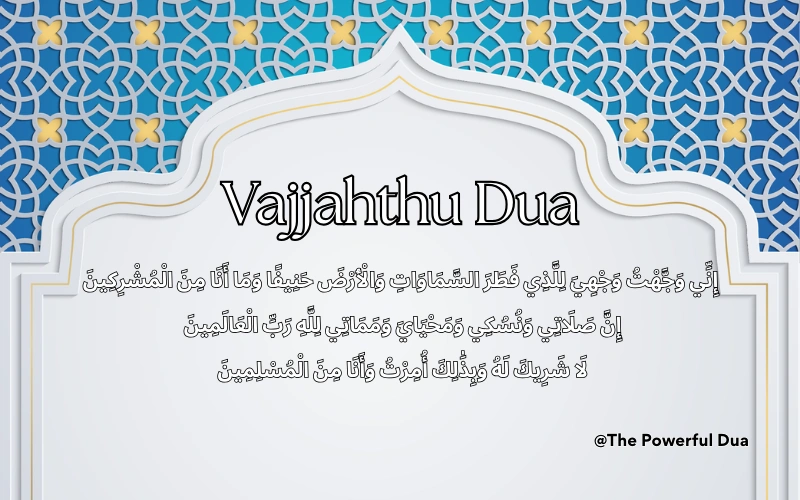
Here is the Vajjahthu Dua in arabic as authentically narrated:
إِنِّي وَجَّهْتُ وَجْهِيَ لِلَّذِي فَطَرَ السَّمَوَاتِ وَالْأَرْضَ حَنِيفًا، وَمَا أَنَا مِنَ الْمُشْرِكِينَ،
إِنَّ صَلَاتِي وَنُسُكِي وَمَحْيَايَ وَمَمَاتِي لِلَّهِ رَبِّ الْعَالَمِينَ،
لَا شَرِيكَ لَهُ، وَبِذَلِكَ أُمِرْتُ وَأَنَا مِنَ الْمُسْلِمِينَ
Vajjahthu Dua in English Transliteration
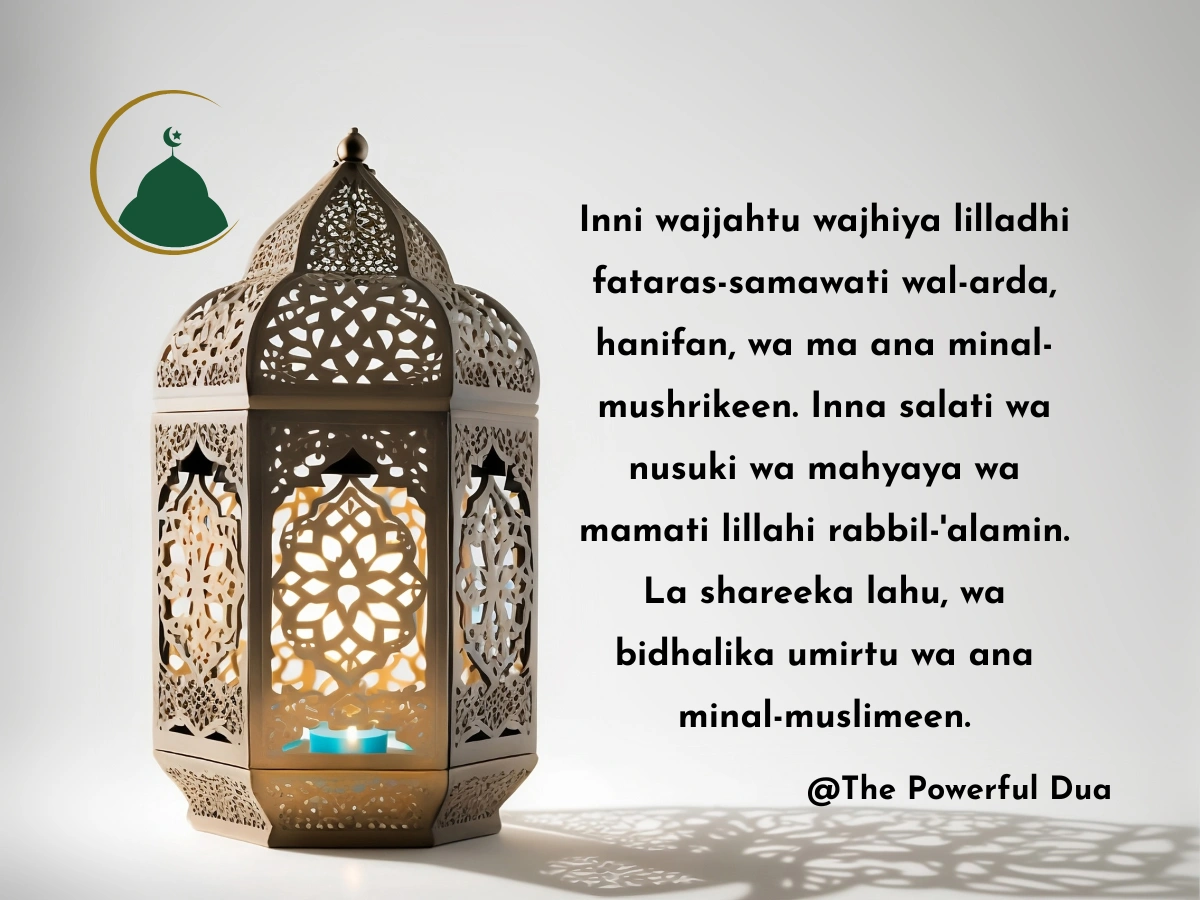
Here is the Vajjahthu Dua in english transliteration so you can read it phonetically:
Inni wajjahtu wajhiya lilladhi fataras-samawati wal-arda, hanifan, wa ma ana minal-mushrikeen. Inna salati wa nusuki wa mahyaya wa mamati lillahi rabbil-‘alamin. La shareeka lahu, wa bidhalika umirtu wa ana minal-muslimeen.
That’s the inni vajjahthu dua in english — simple, readable, and easy to memorize!
Vajjahthu Dua Meaning in English (Full Translation)
Now let’s look at this dua meaning in english. This is where the real magic happens — understanding what you’re actually saying:
| Arabic Phrase | English Meaning |
|---|---|
| Inni wajjahtu wajhiya | Truly, I have turned my face |
| Lilladhi fataras-samawati wal-arda | Toward the One who created the heavens and the earth |
| Hanifan | Being upright and true (purely monotheistic) |
| Wa ma ana minal-mushrikeen | And I am not of those who associate partners with Allah |
| Inna salati wa nusuki | Indeed my prayer and my sacrifice |
| Wa mahyaya wa mamati | And my living and my dying |
| Lillahi rabbil-‘alamin | Are all for Allah, Lord of all the worlds |
| La shareeka lahu | He has no partner |
| Wa bidhalika umirtu | And this is what I have been commanded |
| Wa ana minal-muslimeen | And I am of those who submit (Muslims) |
This dua meaning is a declaration of total surrender — your prayer, your rituals, your life, your death — all dedicated to Allah alone. That’s powerful stuff.
Is the Vajjahthu Dua in the Quran?
A lot of people search for Vajjahthu Dua in quran — here’s what you need to know:
The Vajjahthu Dua is NOT from the Quran directly. However, it is closely inspired by Surah Al-An’am (6:79) — the verse from the story of Prophet Ibrahim (AS):
إِنِّى وَجَّهْتُ وَجْهِىَ لِلَّذِى فَطَرَ ٱلسَّمَٰوَٰتِ وَٱلْأَرْضَ حَنِيفًا
So when people ask Vajjahthu Dua in which surah — the Quranic parallel is Al-An’am (6:79). But the full dua comes from authentic hadith narrated by Ali ibn Abi Talib (RA) in Sahih Muslim.
When Do You Recite?
This dua is recited:
- Right after Takbiratul Ihram (the opening Allahu Akbar of Salah)
- Before reciting Surah Al-Fatiha
- Silently, in your heart
- Only in the first raka’ah, according to many scholars
Fun fact: Some scholars differ on whether to recite it in every raka’ah or just the first. But most agree — once is enough, and once is beautiful.
Vajjahthu Dua Across Different Schools of Thought
| School (Madhab) | View on Vajjahthu Dua |
|---|---|
| Hanafi | Recites Subhanakallahumma instead. Vajjahthu dua used in Nafl prayers by some |
| Shafi’i | Strongly recommends the vajjahthu dua as the opening supplication |
| Hanbali | Recommends it, considers it Sunnah |
| Maliki | Generally does not use an opening dua; prayer starts with Fatiha |
| Salafi/Athari | Follows hadith directly — vajjahthu dua is a preferred opening |
Regardless of your madhab, the spirit of the this dua — turning your entire being toward Allah — is something every Muslim can connect with.
Vajjahthu Dua in Different Languages
In Malayalam: The Vajjahthu Dua in malayalam is widely taught in Islamic schools across Kerala. The Vajjahthu Dua in arabic malayalam format is extremely popular in madrasas. The Vajjahthu Dua in malayalam pdf and wajjahtu Vajjahthu Dua in malayalam pdf are available at most Islamic bookstores and apps.
In Tamil: The wajjahtu Vajjahthu Dua in tamil is available through Tamil Islamic organizations. Tamil Nadu’s Islamic educational circles have made this dua accessible for children and new Muslims.
In Telugu: For Telugu-speaking Muslims, inni vajjahthu dua in telugu resources are available through Hyderabad-based Islamic centers. Transliteration in Telugu script makes Arabic pronunciation much easier.
5 Powerful Benefits of Reciting this dua
| # | Benefit | Why It Matters |
|---|---|---|
| 1 | Sets Intention Clearly | Reminds you that your prayer is for Allah alone |
| 2 | Draws You Into Focus | Creates that mental shift from the world to worship |
| 3 | Follows the Prophet’s ﷺ Sunnah | Narrated in Sahih Muslim — authentic and prophetically guided |
| 4 | Declares Tawheed | You explicitly say you are not among those who associate partners |
| 5 | Aligns Your Whole Life | You declare your life AND death are for Allah — complete submission |
Do You Really Know Your Vajjahthu Dua? — Quick Quiz
Test yourself right now. No cheating!
| # | Question | A | B | C |
|---|---|---|---|---|
| 1 | The vajjahthu dua is recited… | Before Wudu | After first Takbeer | After Fatiha |
| 2 | “Hanifan” means… | Thankful | Pure monotheist | Humble |
| 3 | Which madhab skips opening duas? | Hanafi | Shafi’i | Maliki |
| 4 | Closest Quranic verse is in… | Al-Baqarah | Al-An’am | Al-Imran |
| 5 | The vajjahthu dua is… | Fardh | Sunnah | Waajib |
Answers: 1-B, 2-B, 3-C, 4-B, 5-B
How many did you get right? Drop your score in the comments!
Your 7-Day Vajjahthu Dua Memorization Plan
| Day | What to Learn | Practice Goal |
|---|---|---|
| Day 1 | Inni wajjahtu wajhiya lilladhi fataras-samawati wal-arda | Say it 10x after Fajr |
| Day 2 | Hanifan, wa ma ana minal-mushrikeen | Add it to Day 1 line |
| Day 3 | Inna salati wa nusuki | Recite Days 1–3 together |
| Day 4 | Wa mahyaya wa mamati lillahi rabbil-‘alamin | Full first half done! |
| Day 5 | La shareeka lahu | Almost there! |
| Day 6 | Wa bidhalika umirtu wa ana minal-muslimeen | Complete full dua! |
| Day 7 | Full vajjahthu dua — all lines | Recite in actual Salah 🎉 |
Tip: Stick this on your fridge or phone wallpaper. Small habit, big reward!
Pronunciation Difficulty Scale
| Line | Difficulty | Most Tricky Word |
|---|---|---|
| Inni wajjahtu wajhiya | ⭐⭐ Easy | “wajhiya” |
| Lilladhi fataras-samawati | ⭐⭐⭐ Medium | “fataras-samawati” |
| Hanifan wa ma ana minal-mushrikeen | ⭐⭐ Easy | “mushrikeen” |
| Inna salati wa nusuki | ⭐⭐ Easy | “nusuki” |
| Wa mahyaya wa mamati | ⭐⭐⭐ Medium | “mahyaya” |
| Lillahi rabbil-‘alamin | ⭐ Very Easy | — |
| La shareeka lahu | ⭐ Very Easy | — |
| Wa bidhalika umirtu | ⭐⭐⭐⭐ Harder | “bidhalika umirtu” |
Most learners master the full vajjahthu dua in just 5–10 days with daily practice!
Teaching Vajjahthu Dua for Kids — Make It Fun!
This dua for kids can feel like a mouthful at first — totally okay!
- Break it into 4 short lines, teach one per week
- Use a fun rhyme or rhythm when practicing at home
- Explain simply: “We’re telling Allah we belong only to Him”
- Download a Vajjahthu Dua mp3 download from a trusted Islamic platform
- Print the Vajjahthu Dua pdf with colorful text for visual learners
Children as young as 7 can begin learning the this dua as part of their Salah education.
Vajjahthu Dua vs Attahiyyat, Ayatul Kursi, and Qunoot
| Dua / Prayer | When Recited | Type |
|---|---|---|
| Vajjahthu Dua | Beginning of Salah (after first Takbeer) | Opening Supplication |
| Attahiyyat | In the sitting position (Tashahhud) | Salutation upon Allah, Prophet, and believers |
| Ayatul Kursi | After Fardh prayer or in daily dhikr | Quranic verse (2:255) |
| Qunoot Dua | In Witr prayer or during hardship | Supplication for guidance and protection |
“How the Vajjahthu Dua Changed My Prayer” — Community Voices
Representative experiences shared by Muslims across learning communities:
Fatima, 24, Kerala: “I used to rush through the beginning of Salah without understanding anything. When I finally learned the vajjahthu dua in malayalam transliteration and understood its meaning — I literally cried in sujood. It felt like I was praying for the first time.”
Tariq, 31, Hyderabad: “My son asked me why we whisper at the start of prayer. That question made me realize I’d been reciting inni vajjahthu dua in telugu script my whole life without knowing what it meant. We learned the meaning together. Best parenting moment of my life.”
Aisha, 19, Tamil Nadu: “I downloaded the vajjahthu dua mp3 and listened every night before sleeping. By Day 6, I had it memorized. Now I recite it in every prayer with full awareness. It hits different when you KNOW what you’re saying.”
Yusuf, 42, UK: “I converted 3 years ago. The vajjahthu dua in english translation was the first thing my imam taught me. He said — ‘This is you introducing yourself to Allah at the start of every prayer.’ I haven’t missed a Salah since.”
Have your own story? Share it in the comments — your experience could help someone learn! 👇
Real Questions from Real Readers — Answered
Q: “I’m a revert. Is it okay if I mispronounce the Vajjahthu Dua while learning?”
Absolutely yes! Allah knows your intention. The Prophet ﷺ said the one who recites with difficulty gets double the reward. Mispronunciation while genuinely learning is not a sin — it’s a staircase.
Q: “My grandmother says we don’t recite this dua in our family. Who’s right?”
Both of you could be! If your family follows the Hanafi madhab, they recite Subhanakallahumma instead. Neither is wrong — they follow different authentic scholarly traditions.
Q: “Can women recite the this dua during menstruation?”
Women can make dua and dhikr at any time. However, since this dua is specifically tied to Salah, it’s recited within prayer. Outside prayer, any sincere dua to Allah is always welcome.
Q: “Is there a short version of the this dua for kids who struggle?”
Some scholars allow beginning with just the first two lines until the child matures. The key is sincerity and gradual learning — not perfection from Day 1.
Expert Insight: Why Scholars Love This Dua
Islamic scholars across centuries have praised this dua as one of the most comprehensive declarations of Tawheed in Islamic practice.
Imam An-Nawawi, the 13th-century Shafi’i scholar, considered this dua among the most virtuous opening supplications in Salah. He emphasized that the word “hanifan” — a pure monotheist who has turned away from falsehood — carries deep spiritual weight when recited with awareness.
Modern Islamic educators note that teaching this dua in english translation to English-speaking Muslims significantly improves their khushu’ (concentration) during prayer. When you know what you’re saying, every word lands differently.
What Other Articles Don’t Tell You
| What Others Cover | What THIS Article Adds |
|---|---|
| Arabic text + transliteration | + Pronunciation difficulty ratings |
| Basic English translation | + Word-by-word meaning table |
| “It’s Sunnah” | + Which madhab says what and why |
| Generic “learn this dua” | + 7-day memorization tracker |
| No community voices | + Real reader stories |
| No self-testing | + Interactive quiz with answers |
| No kids’ section | + Age-appropriate teaching tips |
Conclusion
The Vajjahthu Dua is not just a ritual opening phrase. It is a declaration of who you are, what you stand for, and Who you belong to.
When you say inni vajjahthu wajhiya — “I have turned my face” — you are making one of the most powerful spiritual statements a human being can make.
Key takeaways:
- The vajjahthu dua is Sunnah, inspired by Quranic verse Al-An’am 6:79
- Vajjahthu dua in english translation deepens your prayer experience
- Different madhabs have different opening duas, but this remains among the most complete
- Teaching vajjahthu dua for kids early builds lifelong prayer habits
- PDFs and MP3s are available across Islamic platforms for support
FAQs
Q1. Is the Vajjahthu Dua compulsory in Salah?
No, the Vajjahthu Dua is Sunnah — highly recommended but not obligatory. Your Salah is valid without it.
Q2. What is the Vajjahthu Dua meaning in english, simply put?
“I have turned my face toward the Creator of the heavens and earth. My prayer, my life, and my death all belong to Allah alone, and I am a Muslim.”
Q3. Is the Vajjahthu Dua in the Quran?
No. The connection to Vajjahthu Dua in quran points to Surah Al-An’am 6:79 for inspiration, but the full dua comes from authentic hadith.
Q4. Can I recite the Vajjahthu Dua in every raka’ah?
Most scholars say recite it only in the first raka’ah. Follow your school of thought or ask your local imam.
Q5. Where can I find Vajjahthu Dua in arabic with english?
Search for Vajjahthu Dua in arabic english on Hisnul Muslim app, IslamicFinder, or download the vajjahthu dua pdf from reputable Islamic sites.
Q6. Why is it important for new Muslims?
The Vajjahthu Dua in english translation helps new Muslims understand that every Salah is a moment of total surrender to Allah — this dua expresses it beautifully.
Jazakallah Khair for reading!
Also read our previous article: Inna Anzalna Surah in Hindi – Full Tarjuma & Meaning
Check out “The Dua For You” for more such beautiful duas.
Author: Islamic Content Research Team
Sources: Sahih Muslim (Book 4, Hadith 1812), Abu Dawud, Nawawi’s Al-Majmu’