Last Updated: 6 April 2026
Every time you step outside your home, you face a choice: rely on your own ability, or acknowledge your dependence on something greater. Prophet Muhammad ﷺ taught us a simple practice for that moment—ghar se bahar nikalne ki dua. It’s not a magical protection. It’s a spiritual checkpoint. This dua reconnects you to a fundamental Islamic truth: you don’t navigate life alone. Whether you’re a student, professional, or traveler, understanding and practicing ghar se bahar nikalne ki dua is about aligning your heart with reality before your day begins.
Dua Authenticity & Source Reference Table
| Aspect | Details |
|---|---|
| Primary Hadith Source | Sunan Abu Dawud 5095, Jami’ At-Tirmidhi 3426 Precious Gems from the Quran and Sunnah |
| Hadith Classification | Graded Sahih (authentic) by Shaykh Al-Albani Sukoonly |
| Reported by | Anas bin Malik (RA) |
| What the Hadith Says | Whoever says this when leaving will be told: “You have been guided, you have been sufficed and you have been protected” Dou3a Online |
| Best Time to Recite | Before stepping out of the house |
| Recitation Frequency | Every time you leave home |
The Complete Dua: Arabic, Transliteration & Translation
ARABIC TEXT:
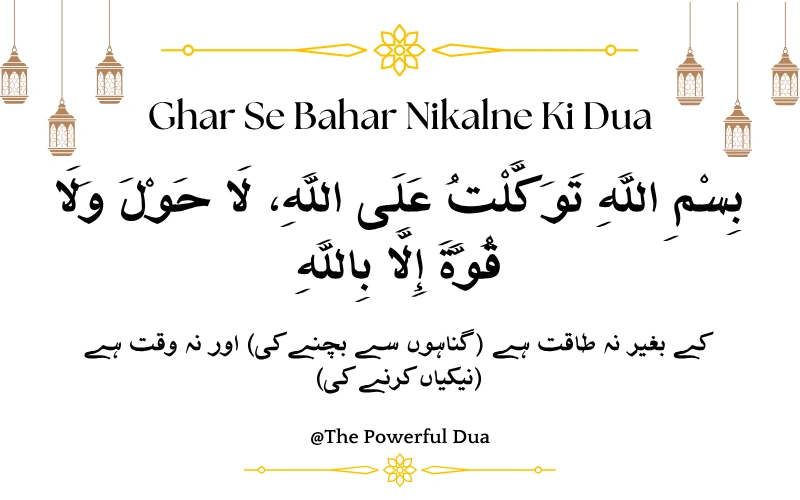
بِسْمِ اللَّهِ تَوَكَّلْتُ عَلَى اللَّهِ، لَا حَوْلَ وَلَا قُوَّةَ إِلَّا بِاللَّهِ
TRANSLITERATION (Roman English):
“Bismillah, tawakkaltu alallah, la hawla wa la quwwata illa billah”
ENGLISH TRANSLATION (Word-by-Word):
- Bismillah = In the name of Allah
- Tawakkaltu alallah = I place my trust in Allah
- La hawla = There is no strength/ability
- Wa la quwwata = And no power
- Illa billah = Except with Allah
Complete Meaning: “In the Name of Allah, I place my trust in Allah; there is no might and no power except by Allah.” wikiMuslim
WHAT YOU’RE ACTUALLY SAYING:
When you recite ghar se bahar nikalne ki dua, you’re making two statements:
- “I begin in Allah’s name” – Everything I do is under His authority, not my own control.
- “I have no independent strength” – Whatever ability I have comes from Allah alone. Without Him, I’m helpless.
This isn’t pessimism. It’s clarity.
Why This Dua Matters
The ghar se bahar nikalne ki dua addresses a psychological and spiritual reality that most people avoid: the moment you step outside your home, you lose complete control. The future is unknown. Dangers exist. You cannot guarantee your safety or success through planning alone.
When someone says “Bismillāh, tawakkaltu ‘alallāh”, they are reminding their heart to rely completely on Allah before stepping into the world. The words “lā ḥawla wa lā quwwata illā billāh” remind us that any strength, protection, or ability we have comes only from Him. Sukoonly
Islamic scholars explain that “hawla” (strength) and “quwwata” (power) encompass more than physical might. They include mental clarity, moral resilience, protection from harmful influences, and the ability to make sound decisions. By reciting ghar se bahar nikalne ki dua, you acknowledge that these cannot be manufactured through effort alone—they come from Allah.
The hadith describes the effect clearly: whoever recites this dua when leaving will be told, “You have been guided, you have been sufficed and you have been protected.” Then one devil says to another, “How can you get to a man who has been guided, sufficed and protected?” Dou3a Online
Notice what this means:
- Guided = Clarity in decisions, direction in your path
- Sufficed = Your needs are met according to Allah’s plan
- Protected = Shielded from harmful influences and destructive choices
This isn’t about accidents never happening. It’s about being spiritually centered so that when difficulties come, you face them with trust rather than despair.
When to Recite This Dua
The Right Time:
Every time you leave your home. This is the established practice from the hadith. Whether you’re going to work, school, the market, or traveling—this is your moment to recite ghar se bahar nikalne ki dua.
The Prophet ﷺ didn’t teach this for special occasions. He established it as a daily habit. The more consistent your practice, the more your heart internalizes the truth behind the words.
How It Works:
The dua works best when recited:
- Just before stepping outside – At the threshold, when you’re transitioning from the safety of home to the outside world
- With presence of heart – Not rushed, but with conscious awareness of what you’re saying
- As a habit, not an emergency tool – Build it into your routine so it becomes automatic
Important Reality Check:
This dua doesn’t replace practical wisdom. If you recite ghar se bahar nikalne ki dua and then drive recklessly, ignore safety, or make foolish choices—you’re not combining trust with intelligence. Islamic teaching encourages tawakkal ma’a al-‘amal: trust in Allah combined with practical effort and reasonable caution.
How to Recite This Dua Properly
Step-by-Step Process:
Pause Before Stepping Out – Take 2-3 seconds before leaving. This itself is an act of mindfulness.
Set Your Intention – Internally acknowledge: “I’m stepping into the world under Allah’s care.”
Recite Clearly – Say the dua once or three times. Clarity matters more than speed. The dua when leaving the house holds deep meaning—reciting it brings blessings: Allah guides a person in their decisions, protects them from harm, and appoints angels to watch over them. Shayṭān is kept away, barakah enters their efforts, and the heart feels more calm and focused.
Feel the Words – Don’t just pronounce letters. Understand: “I’m placing my trust in Allah because I’m insufficient on my own.”
Step Out with That Mindset – Carry the mental state into your day.
Common Mistakes to Avoid:
Rushing through without understanding – Words without meaning become empty ritual. If you don’t know what you’re saying, the dua loses its psychological and spiritual power.
Reciting but then ignoring the message – If you say ghar se bahar nikalne ki dua and immediately worry obsessively or act recklessly, you’re contradicting yourself. Recite, then trust.
Only reciting during crises – The dua’s benefit compounds through daily practice, not emergency use. Build the habit now.
Using incorrect Arabic – Many recite “wa la hawla wa la quwwata” (with wa-). The authentic hadith uses “la hawla wa la quwwata” (without wa-). Small difference, but it matters for authenticity.
Benefits of This Dua
Spiritual/Psychological Benefits:
The actual benefits supported by the hadith are:
Guidance – When you start your day with ghar se bahar nikalne ki dua, you’re positioning yourself to be receptive to wise choices. Your mind becomes clearer, your priorities sharper, your ability to distinguish right from wrong strengthens.
Sufficiency – This addresses anxiety about not having enough (time, resources, ability). The dua reframes your thinking: “Allah will suffice me.” This doesn’t guarantee wealth, but it shifts your mental state from scarcity to trust.
Spiritual Protection – Protection here means resistance to destructive whispers, temptations, and harmful thoughts. The hadith specifically mentions that Shaytan struggles to influence someone who has invoked Allah’s protection.
Peace of Mind – The moment you place your trust fully, your nervous system relaxes. You stop trying to control everything. This psychological shift is real and measurable.
Mental Clarity – By acknowledging you lack independent strength, you stop overestimating your power and underestimating difficulties. You think more realistically, plan more wisely.
What This Dua Does NOT Guarantee:
It doesn’t prevent all accidents – Difficulties still occur. Bad things happen to believers and non-believers alike. What changes is your response to them.
It doesn’t ensure success in worldly matters – You might still fail exams, lose business deals, face rejections. The dua addresses spiritual state, not material outcomes.
It’s not a substitute for action – Reciting ghar se bahar nikalne ki dua then staying home expecting blessings to appear is not how Islam works.
Important Disclaimer:
“This dua is for spiritual alignment and seeking Allah’s guidance, protection, and sufficiency in the Islamic sense. It is not a replacement for medical care, mental health support, legal counsel, or practical safety measures. Whenever facing specific challenges—health issues, emotional distress, legal problems—always seek professional help while maintaining spiritual practice. Islam teaches combining trust in Allah with practical effort and professional assistance.”
Real-Life Scenarios: How This Dua Changes Your Day
Instead of fictional stories, here are realistic scenarios showing what ghar se bahar nikalne ki dua actually changes:
Scenario 1: When Anxiety Rises
Without the dua: You wake up worried about a job interview. Your mind races: “What if I fail? What if they reject me? I might not be good enough.” You carry this anxiety all day.
With the dua: You recite ghar se bahar nikalne ki dua before leaving. The words “You have been guided, sufficed and protected” settle something in your mind. You still feel nervousness (that’s normal), but underneath is a baseline of calm: “Whatever happens, Allah will suffice me.” This doesn’t guarantee you’ll get the job, but it changes how you show up—more centered, less desperate.
Scenario 2: When Plans Collapse
Without the dua: You had a plan for your day. Something unexpected derails it completely. You spiral: “My whole day is ruined. I can’t handle this.”
With consistent dua practice: When unexpected challenges arise, you’ve already built a mental habit of trusting Allah. The thought surfaces faster: “This change wasn’t in my plan, but Allah suffices me. What’s the wise response now?” You adapt instead of panic.
Scenario 3: When You Feel Alone
Without the dua: You’re in a new city, new job, or new school. You feel isolated and unsupported. Fear of making mistakes grows because you feel nobody has your back.
With the dua: Ghar se bahar nikalne ki dua reminds you: “You’re not actually alone. Allah is with you.” This doesn’t eliminate loneliness, but it provides spiritual companionship that makes practical loneliness bearable. You’re more likely to reach out, make connections, take reasonable risks.
Related Duas to Combine with This Practice
If you’re building a consistent practice around ghar se bahar nikalne ki dua, consider these complementary duas:
- Dua When Entering Home – Balance your morning dua with an evening one. This creates a complete daily circle of seeking Allah’s protection.
- Dua for Seeking Guidance (Istikharah) – When facing major decisions, combine ghar se bahar nikalne ki dua with Istikharah for enhanced clarity.
- Dua for Overcoming Fear – In anxious seasons, pair this with specific duas for courage and trust.
Frequently Asked Questions on Ghar Se Bahar Nikalne Ki Dua
Q1: How long should I recite ghar se bahar nikalne ki dua—once or multiple times?
A: Once is sufficient and authentic. However, many scholars recommend three repetitions for added emphasis. What matters most is consistency. Reciting it genuinely once daily is more valuable than rushing through it ten times without presence of mind.
Q2: What if I forget to recite ghar se bahar nikalne ki dua in the morning?
A: Recite it whenever you remember—even if it’s mid-morning or afternoon. You’re not locked into a specific time window. The key is making it a regular habit, not hitting a perfect schedule. If you miss some days, don’t feel guilt; just return to the practice.
Q3: Can I recite ghar se bahar nikalne ki dua in English translation instead of Arabic?
A: The narration is found in the most authentic hadith collections and was graded Sahih by respected scholars, confirming its authenticity. Arabic is preferred because it’s the original wording, but if you don’t speak Arabic, reciting in English with understanding is permissible. Ideally, learn the short Arabic phrase—it’s only one sentence—and recite it while understanding the meaning in your language.
Q4: Does this dua work if I’m not in a state of ritual purity (wudu)?
A: Yes. While wudu is ideal and increases spiritual focus, it’s not a requirement for making dua. The dua is beneficial for the Muslim to recite every time he leaves his home to fulfill any of his religious or worldly affairs. You can recite ghar se bahar nikalne ki dua even without wudu, though doing so after ablution enhances the spiritual experience.
Q5: What if I recite this dua but still face difficulties?
A: This is where Islamic understanding becomes crucial. The dua doesn’t promise immunity from hardship. The servant of Allah is never without need of his Lord—even for the blinking of an eye—to protect/preserve him, help him, and direct him to that which is right and guide him. Difficulties are part of life. What changes is your response: instead of despair, you face challenges knowing Allah will suffice you.
Q6: Can women recite ghar se bahar nikalne ki dua?
A: Absolutely. This dua applies equally to all Muslims regardless of gender. There are no restrictions on women reciting this dua at any time—during menstruation, pregnancy, or any life stage.
Q7: Is there a specific number of times I should recite this dua daily?
A: Once per departure from home is the baseline. If you leave home multiple times daily, recite it each time. Some people, during particularly difficult periods, may recite it 3-5 times in the morning for extra spiritual reinforcement. There’s no fixed number—consistency matters more than frequency.
Q8: Can I recite ghar se bahar nikalne ki dua for someone else?
A: Yes. You can recite with the intention of seeking protection and guidance for a family member or loved one. However, ideally, teach them to recite it themselves. Their own direct invocation of Allah’s protection is most powerful.
Conclusion: Building a Daily Practice
Ghar se bahar nikalne ki dua is deceptively simple. One sentence. A few seconds of recitation. But its impact is rooted in a profound shift: from self-reliance to God-reliance.
In modern life, we’re taught to depend on ourselves—our planning, our strength, our intelligence. This dua interrupts that delusion. It says: “You’re insufficient. And that’s okay. Allah is sufficient.”
This doesn’t mean stop planning or trying. It means do those things from a place of trust, not desperation. Do your best, then release the outcome to Allah.
Three key principles to remember:
- Make it automatic – Like checking your phone, reciting ghar se bahar nikalne ki dua should happen reflexively each time you step outside.
- Understand what you’re saying – Words without meaning are just sounds. Know that you’re declaring your dependence on Allah.
- Let it change your mindset – The real benefit isn’t magical protection. It’s training your mind to trust Allah throughout your day.
Start tomorrow. Recite this dua before leaving your home. Stay consistent. After weeks of practice, you’ll notice something subtle but profound: you’re less anxious, more grounded, and more capable of handling whatever comes.
That’s the actual power of ghar se bahar nikalne ki dua.
Also Read –
Bukhar Utarne Ki Dua: The Islamic Prayer to Reduce Fever – Complete Guide (2026)
Bechaini Ki Dua: 7 Powerful Prayers to Calm Your Heart Instantly
Masjid Se Nikalne Ki Dua – संपूर्ण हिंदी गाइड और अरबी टेक्स्ट
For more Islamic guidance and spiritual insights, check out “Islamic Dua Hub”
Author Information & Source Attribution
Written by: Islamic Content Team
Sources Verified From:
- Sunan Abu Dawud 5095, At-Tirmidhi 3426 (graded Sahih by Al-Albani) Precious Gems from the Quran and Sunnah
- Islamic jurisprudence references and hadith interpretation from recognized scholars
- Contemporary Islamic teaching methodology
Disclaimer: This content is for spiritual and educational purposes. It is not a substitute for professional medical, psychological, or legal advice. When facing specific health, mental health, or legal challenges, consult qualified professionals. Islamic rulings may vary across different schools of Islamic jurisprudence (madhabs). This article represents consensus on ghar se bahar nikalne ki dua while respecting scholarly diversity.