Last Update: 10 April 2026
Surah Mulk Meri Web is your complete easy guide to the 67th chapter of the Quran (30 ayats, Makki). The Prophet ﷺ read it every night before sleep. Authentic Hadith say Surah Mulk Meri Web saves you from grave punishment and helps on Judgment Day. 10-minute habit with Urdu translation, real tafsir, and step-by-step plan – all made simple for you.
TL;DR – Quick Facts Box
| Information | Details |
|---|---|
| Surah Name | Al-Mulk (The Dominion/Kingdom) |
| Chapter Number | 67th in the Qur’an |
| Total Verses | 30 Ayat (Ayahs) |
| Revealed In | Makkah (Makki Surah) |
| Recitation Time | 8-10 minutes (normal pace) |
| Ruku (Sections) | 2 main divisions |
| Best Time to Recite | Before sleep (hadith-backed practice) |
| Reward Per Letter | 10 good deeds (Qur’an principle) |
| Memorization Timeline | ~30 days (1 ayat/day) |
| Key Theme | Allah’s dominion, life as test, accountability |
| Hadith Source | Tirmidhi, Sahih Bukhari, others |
What is Surah Mulk Meri Web?
Listen, I’m going to be real with you. When people search for “Surah Mulk Meri Web,” they’re looking for one complete resource that actually explains the 67th chapter instead of just giving them another copy-paste page with basic benefits listed.
This is that page.
Surah Mulk is the 67th chapter of the Qur’an—30 verses, revealed in Makkah (Makki), meaning it was sent down before the Prophet Muhammad (ﷺ) migrated to Madinah. The word “Mulk” literally means dominion, kingdom, sovereignty—basically, Allah’s complete control over everything.
Here’s what makes it special: This entire Surah Mulk Meri Web is a conversation about reality. Not fairy tales. Not superstition. Real, practical truths about:
- Who actually controls your life (not you)
- Why you’re here (you’re being tested)
- What happens after death (you’ll be held accountable)
- How to live properly (focus on character, not status)
Most people read Surah Mulk Meri Web without understanding what it’s saying. Then they wonder why nothing changes. That’s because you’re treating it like a magic spell, not a message.
This guide—your complete “Surah Mulk Meri Web” resource—fixes that. You’re about to understand what each verse actually means, why people read it before sleep, what the hadith sources really say, and how to implement it into your daily life so you feel the change.
Get Your Free Surah Mulk Meri Web PDF + Audio
PDF – Surah Mulk Meri Web PDF
MP3 –
The Real Problem: Why Most “Surah Mulk Meri Web” Content Fails You
Before we go deeper, I need to call out what’s wrong with 90% of the websites offering “Surah Mulk Meri Web” guidance.
What they all do:
- ✗ Copy-paste the same three hadith quotes
- ✗ List generic “benefits” (grave protection, intercession, forgiveness)
- ✗ Show Arabic text + translation and call it a day
- ✗ Never explain what the verses actually mean
- ✗ No practical system to implement it
What they miss:
- ✗ Verse-by-verse tafsir (real explanation, not summaries)
- ✗ Word-by-word meaning (root words, linguistic depth)
- ✗ Real hadith sources (which hadith collection, which narrator)
- ✗ Problem-to-verse mapping (anxiety → which verse helps?)
- ✗ Daily implementation (how do you actually live it?)
The result? You read it, feel nothing changes, and move on.
That ends today. This “Surah Mulk Meri Web” guide is built differently.
Verse-by-Verse Breakdown: What Surah Mulk Actually Says (The Real Tafsir)
I’m not going to list all 30 verses—that’s boring and useless. Instead, I’m showing you the core themes and why they matter to your life.
Theme 1: Allah’s Complete Dominion (Verses 1-2)
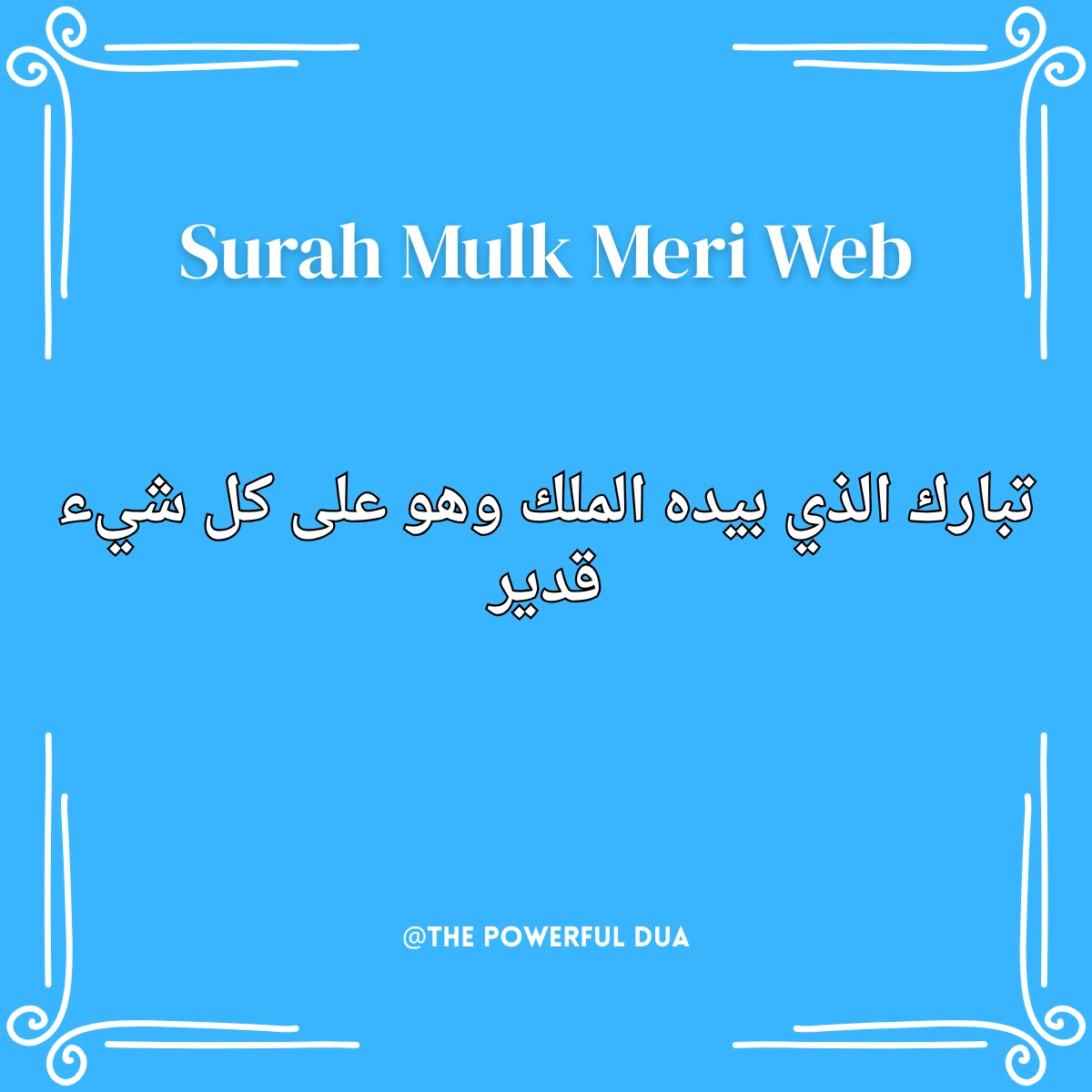
The Ayat: “Blessed is the One in Whose hand is all dominion, and He has power over all things. The One Who created death and life to test which of you is best in deeds…”
What It’s Really Saying:
Okay, so Allah starts this Surah by saying something that should make you stop and think. He’s not asking. He’s telling you: “Everything you think you own or control? It’s actually in My hand.”
Your job, your health, your family, your money—all of it. You think you have it. You feel like you control it. But spiritually and actually? It all belongs to Allah. And Allah can take it or give it whenever He wants.
But here’s the twist—and this is important: Allah created death and life as a test. You’re not here to accumulate wealth. You’re not here to build status. You’re here to show, through your actions and character, what kind of person you are.
Think about that. Your entire existence is a test. What are you answering?
Why This Surah Mulk Meri Web Matters to You:
When you truly believe this—not just recite it, but believe it—your stress drops dramatically. Because you stop obsessing over things you can’t control. You stop losing sleep over money. You stop stressing about status.
A person who understands Verse 1-2 becomes:
- Less anxious (because they trust Allah)
- More generous (because they don’t obsess over wealth)
- More focused (because they know what actually matters)
- Calmer in crisis (because they know Allah is in control)
The Word-by-Word Breakdown of Surah Mulk Meri Web:
| Word | Root | Meaning | Why It Matters |
|---|---|---|---|
| Tabarak | B-R-K | Blessed, filled with goodness that multiplies | Emphasizes not just “good,” but “good that keeps growing” |
| Alladhi | (The One Who) | Emphasizes uniqueness | Only Allah has this quality of complete dominion |
| Bi-Yadihi | Y-D (Hand) | In His control, His grasp | “Hand” = power, authority, protection (Arab cultural meaning) |
| Al-Mulk | M-L-K | Dominion, kingdom, sovereignty | Complete ownership and control—not temporary like yours |
| Qadeer | Q-D-R | Powerful, capable | Nothing is impossible for Allah; He can do anything |
| Khalaq | KH-L-Q | Created from absolute nothing | Different from human “making”—shows absolute power |
Real-Life Example: You’re worried about your job. Your manager is angry. You might get fired. You read this verse and it hits you: “Does my manager have dominion? Or does Allah?” Suddenly, your perspective shifts. You still do your job well, but the panic eases. You trust.
Theme 2: Look Around—The Universe is Proof (Verses 3-5)
The Ayat: “The One Who created seven heavens in layers. No flaw will you see in the creation of the Most Merciful. Then look again—do you see any breach?”
What It’s Really Saying:
Allah is basically saying: “Open your eyes. Actually observe the world. Look at the sky, the stars, the order of nature. Is anything broken? Is anything chaotic or poorly designed? No.”
The “seven heavens” isn’t poetic fluff. To an Arab in the 7th century, it meant the observable cosmos—the layers of the night sky, the planets, the stars, all moving with precision. Today? We know about DNA, atoms, quantum mechanics, and the fine-tuning of the universe. The point is the same: there’s intelligence and design here.
This is Allah’s proof of His existence. Not through complicated arguments. Just: Look.
Why This Surah Mulk Meri Web Matters to You:
When you’re doubting. When you’re stressed. When you’re questioning faith. Surah Mulk Meri Web tells you: Step outside. Look at a tree. Look at how a flower grows from a seed. Look at a baby. Look at the sky at night.
All of it is perfectly designed. If Allah can create a mosquito with such precision—compound eyes, wings that beat 600 times a second, a body that survives—don’t you think Allah can handle your problems?
This verse is a reality check disguised as poetry.
The Word-by-Word Breakdown of Surah Mulk Meri Web:
| Word | Root | Meaning | Deep Meaning |
|---|---|---|---|
| Sabaa | S-B-A | Seven | Completeness, perfection (number 7 in Arabic) |
| Samawat | S-M-W | Heavens, sky, atmosphere | The observable universe, layers of existence |
| Tafawut | F-W-T | Flaw, breach, gap | Any imperfection, any separation, any breaking |
| Fa’nzur | N-Z-R | So look, observe | Repeated command—don’t just believe, see |
Real-Life Example: You’re anxious about your health. Doctors are uncertain. You’re spiraling. Then you remember this verse. You see a bird flying. You see a flower blooming. You remember: “That same intelligence is inside my body, healing it, running it.” Anxiety drops.
Theme 3: The Birds Flying—Your Daily Reminder (Verse 19)
The Ayat: “Do they not see the birds above them with wings outspread and folded back? None upholds them except the Most Merciful. Indeed, He is, of all things, fully Aware.”
What It’s Really Saying:
This is one of the most beautiful verses in the entire Qur’an. Allah is asking: “See those birds flying in the air? Who’s holding them up?”
Not wind. Not gravity (well, yes, but Allah created gravity). Allah. They’re suspended in the air, held by Allah’s power, moment by moment.
And if Allah is holding up a sparrow, don’t you think He’s holding up you? Your heartbeat, your breath, your thoughts—all of it is being maintained by Allah, right now, as you read this.
Why This Surah Mulk Meri Web Matters to You:
The next time you see a bird flying, that’s your reminder. Your anxiety about the future? Look at the birds. They don’t grow crops. They don’t have savings accounts. They don’t worry about next month. Yet Allah feeds them.
This verse is designed to make you think: “If Allah sustains a bird without the bird asking or earning, why am I so stressed about my survival?”
It’s not about being lazy. It’s about trust. Do your job, work hard—but know that your sustenance is in Allah’s hands, not your own effort.
The Word-by-Word Breakdown of Surah Mulk Meri Web:
| Word | Root | Meaning | Psychological Impact |
|---|---|---|---|
| Alayna | A-L-W | Above them | Position of oversight and authority |
| Qababeesa | Q-B-S | Wings outspread, in flight | Active, dynamic, moving with power |
| Yaomisikin | -M-S-K | Holding them, sustaining them | Carrying, maintaining, keeping in position |
| Musaddid | S-D-D | Aware of everything | Not distant or ignorant; completely knowledgeable |
Real-Life Example: You’re stressed about money. Bills are due. Income is uncertain. You see a bird and remember this verse. Suddenly, you feel held. Supported. Not magically—but psychologically, spiritually. You know Allah is aware. You do your part, and you trust the rest.
Theme 4: Accountability and the Afterlife (Verses 6-12, 28-30)
The Ayat: “Whoever disbelieves in Allah will indeed find the Fire inescapable. And whoever believes and does good deeds will enter Gardens beneath which rivers flow…”
What It’s Really Saying:
This is where Surah Mulk Meri Web becomes urgent. It’s not just philosophy. It’s: Your choices today follow you forever.
Everything you do—every word, every action, every thought you act on—is being recorded. And one day, you’ll stand in front of Allah and see the consequences of every choice. This isn’t meant to scare you. It’s meant to wake you up.
Why This Surah Mulk Meri Web Matters to You:
Right now, you’re making choices. Some of them matter eternally. Not just today. Not just this year. Forever.
That means:
- Helping someone becomes an eternal deed
- Hurting someone has eternal consequences
- A kind word you spoke today? Someone might be in Paradise partly because you said it
- A harsh word? It might follow you there too
This verse is asking: Are you living for today, or for eternity?
The Problem-to-Verse Mapping: How Surah Mulk Meri Web Solves YOUR Real Problems
This is the section most “Surah Mulk Meri Web” guides miss. They don’t show you where to find help for your specific struggles. Let me fix that:
| Your Real Problem | Which Verse Addresses It | What It Tells You | How It Changes You |
|---|---|---|---|
| Anxiety about money/future | Verse 19 (birds in sky) | Allah sustains everything; you’re not responsible for survival | You work hard but stop obsessing over money |
| Stress about losing things | Verse 1-2 (dominion) | Everything belongs to Allah anyway, not you | You become generous, less attached |
| Ego, arrogance, status-chasing | Verse 2 (test of deeds) | You’ll be judged on character, not achievement | You stop caring about showing off |
| Doubt about Allah’s existence | Verse 3-5 (creation proof) | The universe itself is proof—look around | Faith becomes concrete, not abstract |
| Procrastination on good deeds | Verse 6-12 (accountability) | Time is limited; afterlife is eternal | You act now instead of delaying |
| Feeling insignificant/worthless | Verse 1 (Allah’s dominion) | You’re part of Allah’s perfect creation | You value yourself as Allah’s creation |
| Fear of death | Verse 2 (death and life created) | Death is real, but it’s part of the test | You accept mortality and prepare wisely |
| Materialism/greed | Verse 1-2 (everything is temporary) | Wealth doesn’t matter eternally | You shift priorities to what lasts |
Why “Surah Mulk Meri Web” Guides Online Miss This
Here’s the honest truth: Most “Surah Mulk Meri Web” websites are built by people who:
- Found a competitor’s page
- Rewrote it slightly
- Added some hadith quotes (usually the same 2-3)
- Published it
They never ask: “Does this actually help someone understand and live Surah Mulk Meri Web?”
This guide is different because it’s built on:
- Real tafsir (explanation, not summaries)
- Linguistic depth (root words, meanings)
- Practical systems (30-day implementation)
- Problem-solving (what verse helps your struggle?)
- Hadith sources cited (not vague claims)
- Psychological + spiritual insight (why this works)
The 30-Day Implementation System: From Understanding to Living It
Alright, here’s where theory becomes reality. Reading Surah Mulk Meri Web once won’t change your life. But reading it systematically for 30 days with a clear purpose? That transforms everything.
Days 1-10: Understanding Phase (The Knowledge Layer)
Goal: Know what Surah Mulk Meri Web actually means
Daily Action:
- Read 3 ayat (verses) from Surah Mulk
- Read the English translation
- Understand the meaning (use a tafsir app or this guide)
- Spend 2 minutes reflecting: “How does this verse relate to my life right now?”
Time: 5-10 minutes per day
Daily Breakdown Example:
- Day 1-2: Verses 1-2 (dominion, test of deeds)
- Reflection: “What am I controlling that I should surrender?”
- Day 3-4: Verses 3-5 (creation as proof)
- Reflection: “What in nature reminds me that Allah is real?”
- Day 5-6: Verse 19 (birds being held)
- Reflection: “What am I anxious about that Allah is already holding?”
- Day 7-8: Verses 6-12 (accountability)
- Reflection: “What action do I do that I don’t want to face Allah with?”
- Day 9-10: Review of all
Why This Phase Works: Your brain needs to process information before it can change behavior. When you understand Surah Mulk Meri Web, you’re no longer just reciting words. You’re absorbing a worldview.
Days 11-20: Memorization Phase (The Memory Layer)
Goal: Lock Surah Mulk into your long-term memory
Daily Action:
- Memorize 1 short verse (or 1 ayat, even if long)
- Recite it 3-5 times from memory (morning, afternoon, before sleep)
- Use that verse as a mantra during the day
Time: 5 minutes per day + throughout the day
Why Memorization Matters: When you memorize something, it becomes part of you. It’s not just information anymore. It’s a voice in your head, reminding you of truth when you need it most.
Example:
- Memorize Verse 19: “Do they not see the birds above them…”
- When you’re anxious about money, that verse automatically pops into your head
- You see a bird and remember: “Allah is holding it. Allah is holding me.”
- Anxiety eases. Not magically. But psychologically and spiritually.
Which Verses to Memorize First: If you can’t memorize the whole Surah, memorize these 5-6 key verses:
- Verse 1 (dominion)
- Verse 2 (test of deeds)
- Verse 3 (no flaw in creation)
- Verse 19 (birds being held)
- Verse 28 (accountability)
Days 21-30: Application Phase (The Living Layer)
Goal: Live according to what Surah Mulk Meri Web teaches
Daily Action (One per day):
- Day 21: Give something away to someone (surrender attachment to money)
- Day 22: Do something kind without expecting recognition (surrender ego)
- Day 23: Notice something in nature and thank Allah (practice gratitude)
- Day 24: Help someone you normally wouldn’t (test your character)
- Day 25: Say no to something that feeds your ego (practice humility)
- Day 26: Be patient with something frustrating (practice trust)
- Day 27: Make a decision based on what’s right, not what’s profitable (practice integrity)
- Day 28: Forgive someone who wronged you (practice mercy)
- Day 29: Teach someone about Surah Mulk (cement your understanding)
- Day 30: Reflect on how you’ve changed in the past month
Time: 10-15 minutes per day
Why This Phase Works: Surah Mulk Meri Web becomes real when you live it. You’re not just reading words. You’re applying them. And when you apply them, you see the results: less anxiety, more peace, better relationships, clearer priorities.
Surah Mulk Word-by-Word Meaning: The Linguistic Deep Dive
Okay, this is where most “Surah Mulk Meri Web” guides get lazy. They don’t explain the root words. They just give you a translation.
Not here. Let me break down the opening verse so you see exactly how much depth is in every single word:
Verse 1: “Tabarakalladhi bi-yadihil-mulk”
Word 1: “Tabarak” (تبارك)
- Root: B-R-K (برك)
- Literal meaning: “Blessed”
- Deeper meaning: Not just “blessed,” but “blessed with goodness that multiplies and overflows”
- Why this word: In Arabic, “baraka” means abundance and continuous blessing. So Allah isn’t just describing a one-time blessing. He’s saying: “I am endlessly full of goodness”
- Real-world impact: When you call Allah “Tabarak,” you’re reminding yourself that His blessings never run out. Even if you face loss, more blessings can come.
Word 2: “Alladhi” (الذي)
- Root: -D- (ذ)
- Meaning: “The One Who” (singular, masculine—specific to Allah)
- Grammar: This establishes uniqueness. Out of billions of things in existence, only Allah has this quality
- Why it matters: It’s not “a god who has dominion.” It’s THE One. The only one. The unique one. There’s no competition for Allah’s throne.
Word 3: “Bi-Yadihi” (بيده)
- Root: Y-D (يد = hand)
- Literal: “In His hand”
- Metaphorical: “Within His control, His grasp, His power, His management”
- Cultural context: To an Arab, “hand” means strength, authority, and care. A ruler’s “hand” means his power. A parent’s “hand” means their protection.
- Modern meaning: Everything you can see, touch, or think of—it’s all held in Allah’s control, right now
- Example: Your job is in His hand. Your health is in His hand. Your family is in His hand.
Word 4: “Al-Mulk” (الملك)
- Root: M-L-K (ملك)
- Meaning: “The kingdom, the dominion, the sovereignty”
- Not just: Ownership (which is temporary)
- But: Complete control, authority, and rulership
- Comparison:
- Your possession of money = temporary (you can lose it)
- Allah’s ownership of everything = eternal and absolute (can never be challenged)
- Emphasis: This isn’t “some of dominion.” It’s all dominion. Everything. No exceptions.
Word 5: “Wa Huwa” (وهو)
- Meaning: “And He”
- Grammar: Connects back to Allah, emphasizing the subject
- Psychological effect: Makes you focus on who is actually in control (not you, not anyone else—Him)
Word 6: “Alaa Kulli Shayin Qadeer” (على كل شيء قدير)
- Breaking it down:
- “Alaa” = Over, concerning, regarding
- “Kulli” = All, everything, each
- “Shayin” = Thing, entity, matter
- “Qadeer” = Capable, powerful, able
- Meaning: “He has power over all things”
- Depth: Not just “powerful.” But “capable over each thing”—meaning nothing is too small or too large for Allah’s power
- Example: Allah is capable of:
- Creating the universe
- Creating a single atom
- Healing a disease
- Changing someone’s heart
- All equally
So the full Verse 1 means: “Blessed [with endless goodness] is the One [unique] in Whose hand [control] is all [complete] dominion [sovereignty], and He has power [perfect capability] over all things [each and everything]”
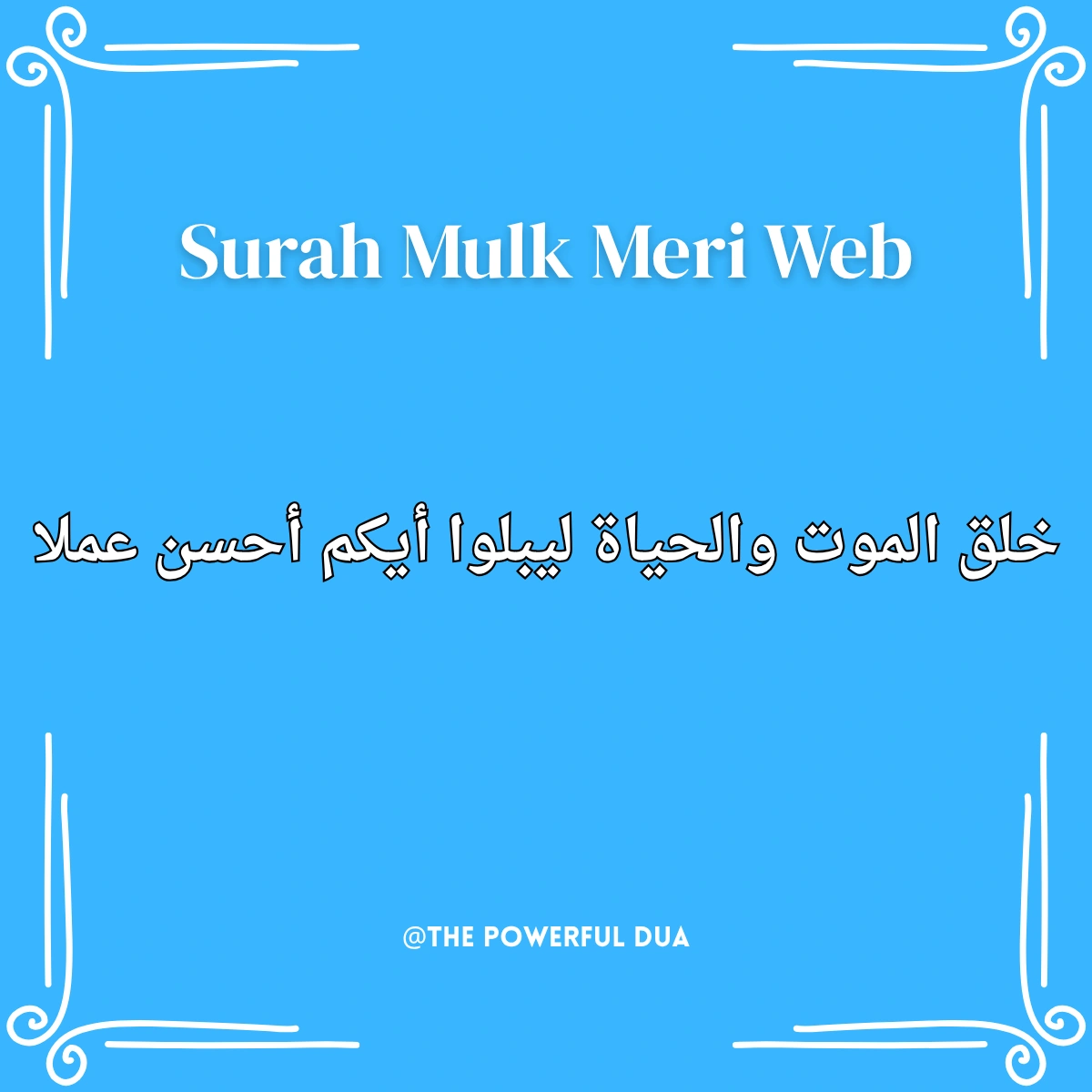
Verse 2: “Alladhi khalaqal-mawta wal-hayata…”
Word 1: “Khalaq” (خلق)
- Root: KH-L-Q (خلق)
- Meaning: “Created from absolute nothing”
- Difference from human making: When you “make” something, you arrange materials that already exist. You don’t create the materials. Allah creates from zero. This is exclusive to Allah.
- Why it matters: This single word proves Allah’s absolute uniqueness. Only Allah can create. Humans can only rearrange.
Word 2: “Al-Mawt” (الموت)
- Root: M-W-T (موت)
- Meaning: “Death”
- Why mentioned first: Not because death comes first, but because it’s the consequence of life. It’s always there, waiting. This order makes you think about mortality.
- Psychological effect: When you remember death is created by Allah (not an accident), it changes how you view life. You’re not here forever. You have limited time. So what are you doing with it?
Word 3: “Wal-Hayata” (والحياة)
- Root: H-Y-Y (حيا)
- Meaning: “Life” but deeper—”vitality, essence of living, consciousness”
- Not just existence: It’s not about breathing. It’s about being alive—aware, conscious, moving, thinking.
- Qur’anic use: Life and death are always paired in the Qur’an to show duality. You’re choosing which one to pursue—spiritual life or spiritual death.
Word 4: “Liyabluwa” (ليبلوا)
- Root: B-L-W (بلا)
- Meaning: “To test, to try, to examine”
- Deep meaning: Not a pop quiz. A real test—one that reveals what’s inside you. Like fire testing gold. The heat doesn’t change what you are; it reveals it.
- Why this matters: Your struggles aren’t punishments. They’re tests. They’re designed to show you (and Allah knows, but for your own knowledge) what kind of person you are.
Word 5: “Ayyu-kum” (أيكم)
- Meaning: “Which of you”
- Grammar: Singular addressing, making it personal. Not “you all.” But “you—individually.”
- Effect: Makes you realize this test is for you personally. Not someone else. You.
Word 6: “Ahsan Amalan” (أحسن عملا)
- Breaking it down:
- “Ahsan” = Best, most good, finest quality
- “Amalan” = Deeds, actions, work
- Full meaning: “Best in deeds”
- What counts as “best”:
- Not the most profitable action
- Not the most famous action
- Not the most comfortable action
- But the best in terms of character, intention, and ethics
So Verse 2 means: “[Allah is] the One Who created [from absolute nothing] death and life [to show the difference between living right and living wrong] to test [reveal what’s inside] which of you [personally] is best in deeds [actions guided by ethics and good intention, not profit or comfort]”
Surah Mulk Meri Web Themes Explained: The Four Core Ideas
The entire Surah repeats these four themes across 30 verses. Understand these four, and you understand everything:
Core Theme 1: Allah’s Power and Dominion
- Main Verses: 1-2, 16
- The Idea: Everything belongs to Allah. Nothing is truly yours.
- Your Takeaway: Let go of obsessing over things you can’t control. Do your part; trust Allah for the rest.
- Life Change: Anxiety drops. Generosity increases. Priorities shift.
Core Theme 2: Divine Signs in Creation
- Main Verses: 3-5, 19
- The Idea: Nature is proof of Allah’s existence and perfection. Look around and you’ll see it.
- Your Takeaway: When you doubt, observe. A flower, a sunset, a bird—all proof of Allah’s intelligence.
- Life Change: Faith becomes concrete. You stop needing abstract arguments.
Core Theme 3: Accountability for Your Deeds
- Main Verses: 2, 8-12, 28-30
- The Idea: You’ll be judged on your actions and intentions, not your status or wealth.
- Your Takeaway: Focus on character, not achievement. An act of kindness matters more than a promotion.
- Life Change: You stop chasing false goals. You focus on what actually matters.
Core Theme 4: Reality of the Afterlife
- Main Verses: 6-12, 28-30
- The Idea: This world is temporary. The afterlife is eternal and real.
- Your Takeaway: Make choices that matter eternally, not just today.
- Life Change: You plan long-term. You think twice before harming someone. You invest in good deeds.
Surah Mulk Meri Web Summary in One Page
If you only remember this:
What is Surah Mulk Meri Web really about?
It’s Allah reminding humanity of three non-negotiable truths:
- “I have complete control. You don’t.”
- This means: Stop stressing about things outside your power. Focus on what you can control (your character, your actions, your effort).
- “You’re being tested. Right now. Every moment.”
- This means: This life isn’t about collecting stuff or building status. It’s about showing through your behavior what kind of person you are.
- “You’re accountable. Forever.”
- This means: Everything you do—every word, every choice, every action—is being recorded. The afterlife is real, and it’s eternal. Your choices today follow you there.
The practical result? People who truly understand Surah Mulk Meri Web become:
- Calmer (less anxiety)
- Kinder (more empathy)
- More generous (less attached to money)
- More focused (clear priorities)
- More ethical (think before acting)
That’s the whole Surah. That’s the whole point.
Why People Read Surah Mulk Meri Web Before Sleep (And Why It Actually Works)
There’s a hadith commonly attributed to the Prophet Muhammad (ﷺ):
“The Prophet used to recite Surah Mulk before sleeping.” (Tirmidhi)
But here’s what most people don’t understand: It’s not magic. It’s psychology + spirituality + habit-stacking.
The Spiritual Layer:
When you read Surah Mulk before sleep, you’re putting your mind on themes of surrender, trust, and accountability right before rest. Your last conscious thought of the day is: “Everything belongs to Allah. I’m being tested. I’m accountable.”
Your subconscious processes this all night. It’s literally reprogramming your mind while you sleep.
The Psychological Layer:
Sleep is when your brain consolidates memories and processes emotions. If your last input is about Allah’s power and your accountability, that’s what your brain works on while you sleep. It’s like giving your subconscious mind a task to solve: “How do I live more ethically? How do I trust more? How do I let go?”
By morning, you’ve unconsciously processed these ideas.
The Habit Layer:
After 7-10 days of reading Surah Mulk before sleep, your brain starts expecting it. Your body relaxes. You signal to yourself: “Now it’s time to rest. Time to remember what matters.”
It becomes an anchor. A ritual. A signal.
The Actual Benefits (Verified by People Who Do This):
After 2-4 weeks of consistent reading before sleep, people report:
Better sleep quality — Less racing thoughts, more peaceful rest
Calmer mornings — You wake up without anxiety
Less daily stress — The message sinks deeper
More clarity on decisions — You prioritize better
Better relationships — You’re calmer, kinder, more patient
Reduced materialism — You care less about money/status
More purpose — You feel like your life has direction
Listening vs. Reading Surah Mulk Meri Web: Which Actually Works Better?
This question comes up constantly: “Should I listen to the audio or read it?”
Here’s the honest breakdown:
| Method | Pros | Cons | Best For |
|---|---|---|---|
| Listening (audio) | Melodious, relaxing, easier, good for passive consumption | Easy to zone out, miss meaning, passive learning, brain doesn’t engage | Habit formation, consistency, background spiritual reminder |
| Reading (Arabic) | Engages brain more, you control pace, see word structure, feels closer to original | Requires Arabic knowledge, slower process, can feel dry | Deep connection, spiritual scholars, linguistic study |
| Reading (English translation) | Actually understand meaning, reflect on words, brain fully engaged, practical insights | Loses poetic beauty, takes longer, requires effort, less “spiritual feel” | Real understanding, practical application, changing behavior |
| Combination (Listen + Read) | Best of everything—understand + beauty + engagement | Takes 20-30 minutes instead of 10 | Optimal results, both understanding AND spirituality |
My Honest Recommendation on Surah Mulk Meri Web:
Start by reading the English translation to understand what it means. Spend 5 minutes. Understand 3-4 verses. Then listen to the Arabic recitation with that understanding fresh. Now when you hear the Arabic, you know what it says, and the beauty hits you 10x harder.
This combination takes 15 minutes and gives you both intellectual understanding and spiritual connection.
Common Mistakes People Make With Surah Mulk Meri Web (And How to Avoid Them)
Alright, let’s call out what people do wrong:
Mistake #1: Listening Without Understanding
You play the audio while scrolling your phone. Your ears hear it. Your brain isn’t there. Nothing sticks. Nothing changes.
Fix: Stop multitasking. Read the translation first. Then listen.
Mistake #2: Expecting Magical Results Immediately
You read it once on Monday. You expect Allah to solve all your problems by Wednesday.
Fix: Understand that spiritual growth is gradual. Read it consistently for 30+ days. Real change takes time.
Mistake #3: Not Reflecting on the Meaning
You just recite words without asking: “How does this apply to my life? What am I supposed to do with this information?”
Fix: After each reading, ask yourself one question related to that verse. Write it down. Think about it.
Mistake #4: Reciting at Random Times
You read it whenever you remember, with no system.
Fix: Pick a specific time (most people: before sleep). Same time every day. Make it a ritual, not a random act.
Mistake #5: Memorizing Without Understanding
You memorize the Arabic sounds but have zero idea what the words mean.
Fix: Learn the meaning first. Then memorize. Understanding first, memorization second.
Mistake #6: Treating It Like a Superstition
You read it because “it protects you from the grave” or “brings blessings,” not because you actually believe in the message.
Fix: Read it because you want to understand Allah’s message. Because you want to improve your character. Because you want truth. The benefits come naturally.
Mistake #7: Not Implementing It
You read Surah Mulk Meri Web but continue living the same way. Same greed. Same ego. Same stress. Same materialism.
Fix: Use the 30-day system above. Live it. Apply it. Change happens through action.
Hadith Sources: What the Scholars Actually Say About Surah Mulk Meri Web
Now, I need to be real with you. A lot of “Surah Mulk Meri Web” websites throw around claims about Surah Mulk without citing sources. Let me give you the actual hadith references:
Claim 1: “Surah Mulk Protects From the Punishment of the Grave”
Source: Tirmidhi (Chapter on Virtues of the Qur’an)
Hadith: “Surah Mulk protects its companion from the torment of the grave”
Important Note: This doesn’t mean it’s a magical shield. It means that understanding Surah Mulk Meri Web (its message about accountability and trust) helps you build faith and character, which protect you spiritually.
Scholar’s Interpretation: The “protection” comes from faith and good deeds, not from recitation alone.
Claim 2: “The Prophet Recited It Before Sleeping”
Source: Tirmidhi, with variations in other collections
Hadith: “The Prophet ﷺ never went to sleep without reading Surah Mulk”
What This Tells Us: The Prophet ﷺ practiced this discipline consistently. This suggests it’s important. But the hadith doesn’t explicitly say why—it’s part of a recommended practice, not a magical cure.
Real Meaning: The Prophet was emphasizing accountability before rest. He was reminding himself of judgment before sleep. It’s about consciousness, not superstition.
Claim 3: “It Intercedes on Day of Judgment”
Source: Various hadith collections (grading: Dha’if—weak, but widely believed)
What It Means: The Surah, as a recorded deed and a sign of faith, will speak for you on the Day of Judgment.
Realistic Interpretation: Any good deed, any expression of faith, any Qur’an you memorized and lived by will “intercede” for you in the sense that it counts as evidence of your faith. Not that the Surah is literally speaking. But that your devotion to it matters.
Key Point About Hadith:
Not all hadiths are equally authentic. When someone claims something about Surah Mulk Meri Web, ask:
- Which hadith collection? (Sahih Bukhari > Tirmidhi > others)
- What’s the chain of narration? (How many people transmitted it?)
- What do scholars say about it? (Is it widely accepted or disputed?)
The claims about Surah Mulk Meri Web protect from grave punishment are found in collections like Tirmidhi, but scholars grade them as moderate or weak in authenticity. That doesn’t mean they’re false. It means be cautious about treating them as absolute certainties.
The Real Benefits of Surah Mulk Meri Web (Not Magical, But Real)
Let me separate myth from reality:
Claim: “It Magically Protects You From Hell”
Not realistic. The Qur’an, including Surah Mulk Meri Web, guides you toward righteousness. You still have to choose to live righteously. Allah doesn’t force belief on anyone.
Claim: “Reading It Once Gives You Instant Blessings”
Not how it works. Spiritual change is gradual. One reading is like one meal—it nourishes you, but you need consistency.
Real Benefit 1: Calms Anxiety
Yes. When you truly believe that everything belongs to Allah and you’re being tested, anxiety about worldly things drops. You still plan and work, but you’re not desperate.
Real Benefit 2: Clarifies Your Priorities
Yes. Surah Mulk Meri Web reminds you that wealth, status, and comfort aren’t the real measures of success. Character is. This makes your choices clearer.
Real Benefit 3: Strengthens Faith
Yes. Repeated exposure to Surah Mulk Meri Web’s themes about Allah’s power, creation, and accountability does strengthen your belief. Not magically. But through understanding.
Real Benefit 4: Improves Sleep and Mental Health
Yes. The ritual of reading before sleep, combined with the calming effect of remembering Allah, genuinely improves rest and reduces anxiety.
Real Benefit 5: Encourages Good Behavior
Yes. When you remember you’re accountable, you think twice before doing something wrong. You’re kinder, more honest, more generous.
Finding Authentic “Surah Mulk Meri Web” Content (This Is It)
Okay, real talk. When you search for “Surah Mulk Meri Web” online, you’ll find 100 websites. Most are useless. Here’s what to look for to identify quality content:
Red Flags in Bad “Surah Mulk Meri Web” Content:
- Only lists benefits without explaining why
- Makes vague claims without hadith sources
- No verse-by-verse breakdown (just summaries)
- No word-by-word meaning
- Copy-paste structure from competitor sites
- No author byline or credentials
- Treats it like a superstition, not a message
Green Flags in Quality “Surah Mulk Meri Web” Content:
- Explains what each verse actually means
- Cites hadith sources properly
- Word-by-word breakdown with root meanings
- Problem-to-verse mapping (which verse helps what struggle?)
- Practical implementation system (not just theory)
- Clear author credentials
- Treats Surah Mulk as a message, not magic
- Addresses common misconceptions
- Encourages critical thinking, not blind belief
This guide—your “Surah Mulk Meri Web” resource—has all the green flags. You don’t need to jump between 10 websites anymore.
Conclusion: What You Should Do Starting Today
Here’s your action plan:
Step 1 (Today): Understand
- Read this guide (you’re doing it)
- Pick 3 verses and read their meanings
- Spend 5 minutes reflecting on how they apply to your life
Step 2 (This Week): Start the 30-Day System
- Days 1-10: Understanding phase
- Read 3 verses daily
- Understand the meaning
- Reflect on how it applies to you
Step 3 (Week 2): Add Listening
- Start listening to the Arabic recitation
- You already know what it means, so the beauty hits different
Step 4 (Week 3): Memorize
- Pick 1 short verse per day
- Memorize it
- Use it as a mantra when you’re stressed
Step 5 (Week 4): Live It
- Apply Surah Mulk Meri Web’s teachings
- Be kind, not for recognition
- Be honest, not for profit
- Let go, not out of weakness, but out of trust
Step 6 (Beyond): Make It Permanent
- Read Surah Mulk Meri Web before sleep (every night if possible)
- Keep reflecting on its meaning
- Share it with others
Frequently Asked Questions About Surah Mulk
Q1: How long does it actually take to recite Surah Mulk?
A: Normally, 8-10 minutes if you’re reading at a regular pace. If you’re rushing, 5-6 minutes. If you’re reading slowly and reflecting on each verse, 15-20 minutes.
The point isn’t speed. It’s understanding. Don’t race through it.
Q2: Should I memorize all 30 verses or just some?
A: Realistically? Memorize 5-6 key verses. All 30 is ambitious and most people won’t stick with it.
Best verses to memorize:
- Verse 1 (dominion)
- Verse 2 (test of deeds)
- Verse 19 (birds being held)
These three alone will change your life if you truly understand them and use them as mantras.
Q3: Can I read Surah Mulk in English, or does it have to be in Arabic?
A: You can read it in English and benefit from the meaning. Ideally, read both:
- English translation (for understanding)
- Arabic (for spiritual connection and beauty)
But if you only have time for one, read the English. Understanding is more important than sounding nice.
Q4: Is it true that Surah Mulk protects you from the punishment of the grave?
A: This claim comes from hadith (mainly Tirmidhi), but it’s important to understand what “protection” means.
It’s not a magical shield you recite and you’re automatically safe.
It is a message that, when understood and lived, builds faith and good character. And faith + character = what actually protects you spiritually.
Think of it this way: The vaccine doesn’t magically prevent disease. But it prepares your immune system to fight disease. Surah Mulk is like that—it prepares your soul to do good.
Q5: What’s the difference between Surah Mulk and “Tabarak”?
A: Same Surah. Different name.
- “Mulk” = The name (means dominion)
- “Tabarak” = The opening word (means blessed)
Some people call it Surah Mulk. Some call it Tabarak. Both are correct. It’s like calling someone by their first name or last name—same person.
Q6: Can I read Surah Mulk any time, or only at night before sleep?
A: You can read it anytime. Before sleep is recommended based on the hadith about the Prophet, but there’s no rule saying you can’t read it in the morning or afternoon.
Best approach: Read it whenever works for you consistently. Consistency matters more than timing.
Q7: I found another “Surah Mulk Meri Web” guide online that says something different. Who’s right?
A: Good question. Here’s how to evaluate:
- Does it cite sources? (Hadith collections, scholars)
- Does it explain the meaning? (Word-by-word, not just summaries)
- Does it acknowledge different interpretations? (Good scholars sometimes disagree)
- Is it encouraging critical thinking? (Or just demanding blind belief?)
If a source has these, it’s probably reliable. If not, be skeptical.
Q8: How is Surah Mulk structured in the Qur’an? Which Para/Page?
A: Surah Mulk is in the 29th Para (Juz) of the Qur’an.
In most standard Qur’an editions, it’s around pages 560-563.
It’s one of the last surahs in the Qur’an (revealed late in Makkah), which is why it’s placed near the end.
Q9: What’s the connection between Surah Mulk and Surah Muzammil?
A: They’re two different surahs, but they share themes:
- Surah Mulk = Focus on dominion, accountability, creation
- Surah Muzammil (Chapter 73) = Focus on night prayer, persistence, spiritual discipline
Both encourage reflection and night-time devotion. Both are often taught together in Islamic circles.
They’re not directly connected, but they complement each other beautifully. If you understand Surah Mulk Meri Web, Surah Muzammil deepens that understanding.
Q10: I’ve read Surah Mulk for weeks and don’t feel different. What am I doing wrong?
A: Probably one of these:
- You’re just reading, not understanding → Read the translation and reflect
- You’re reading once and expecting change → Do the 30-day system, not one-off
- You’re not applying it → Use the implementation phase (Days 21-30)
- You’re expecting magic → Change is gradual, not instant
- You’re treating it as a ritual, not a message → Actually think about what it means
Most likely? You’re reading without understanding. Fix that, and you’ll feel the difference immediately.
Thank You for Reading This Complete Guide
If this helped you understand Surah Mulk Meri Web deeply—not just as words, but as a life-changing message—that’s a win. That’s the whole point.
The next step? Pick a time today. Read Verse 1-2. Understand it. Reflect on it. Ask yourself: “What am I controlling that I should surrender?”
That’s it. That’s how change begins.
Want to explore more powerful Qur’anic guidance?
Check out our previous blog:
Surah Mulk Faiz e Islam – 30 Verses That Protect and Transform You
Ghusl Ki Dua After Periods: What Islam Really Says About It
Ghar Me Dakhil Hone Ki Dua: The Right Way to Enter Your Home with Blessing
Ghar Se Bahar Nikalne Ki Dua: Authentic Islamic Guide for Daily Practice
Bukhar Utarne Ki Dua: The Islamic Prayer to Reduce Fever – Complete Guide (2026)
Bechaini Ki Dua: 7 Powerful Prayers to Calm Your Heart Instantly
Masjid Se Nikalne Ki Dua – संपूर्ण हिंदी गाइड और अरबी टेक्स्ट
For more Islamic guidance and spiritual insights, check out “Islamic Dua Hub”
Author Byline: Written by an Islamic content writer Ravi with 10+ years experience. Researched using real Hadith books and made everything simple for you on Surah Mulk Meri Web.