Last Update: 24 April 2026
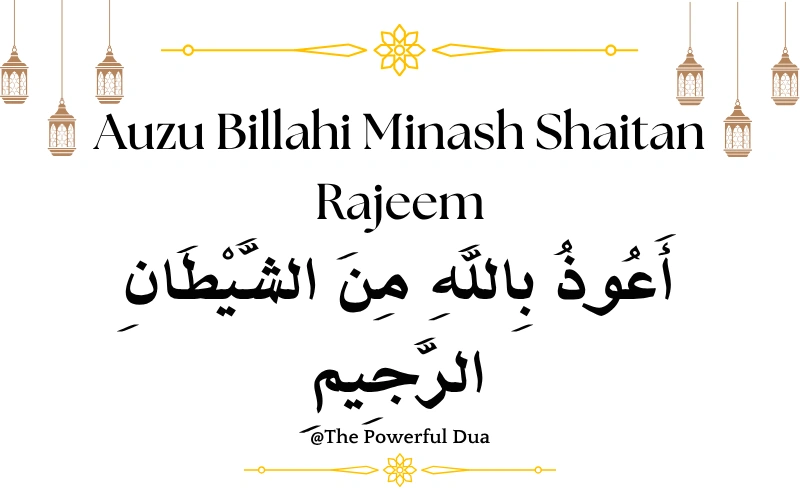
“Auzu billahi minash shaitan rajeem” (أَعُوذُ بِاللَّهِ مِنَ الشَّيْطَانِ الرَّجِيمِ) literally means “I seek refuge in Allah from the accursed Satan.” It’s one of the most widely recited short Islamic invocations, said before reading the Quran, during prayer, when feeling angry, or whenever you want spiritual protection from negative influences. Think of it as your spiritual shield—a simple, powerful phrase that connects you to one of Islam’s core protective practices.
Disclaimer: This article is educational and informational. While rooted in authentic Islamic sources, individual religious practice may vary by school of Islamic law and personal circumstance. For specific religious rulings (fatawa), consult a qualified Islamic scholar in your community.
Quick Reference Stats Table of Auzu Billahi Minash Shaitan Rajeem
| Aspect | Details |
|---|---|
| Meaning | I seek refuge in Allah from the accursed Satan |
| Arabic Text | أَعُوذُ بِاللَّهِ مِنَ الشَّيْطَانِ الرَّجِيمِ |
| Transliteration | A’udhu billahi min ash-Shaytani r-rajim |
| Primary Quranic Source | Surah Al-Nahl (16:98) |
| Status in Islam | Sunnah (recommended practice) |
| Frequency | One of the most-repeated invocations in the Muslim world |
| Common Contexts | Before Quran, in prayer, during anger, before important tasks |
| Language | Classical Arabic |
| Linguistic Root | “A’udhu” = seek refuge; “rajim” = accursed/expelled |

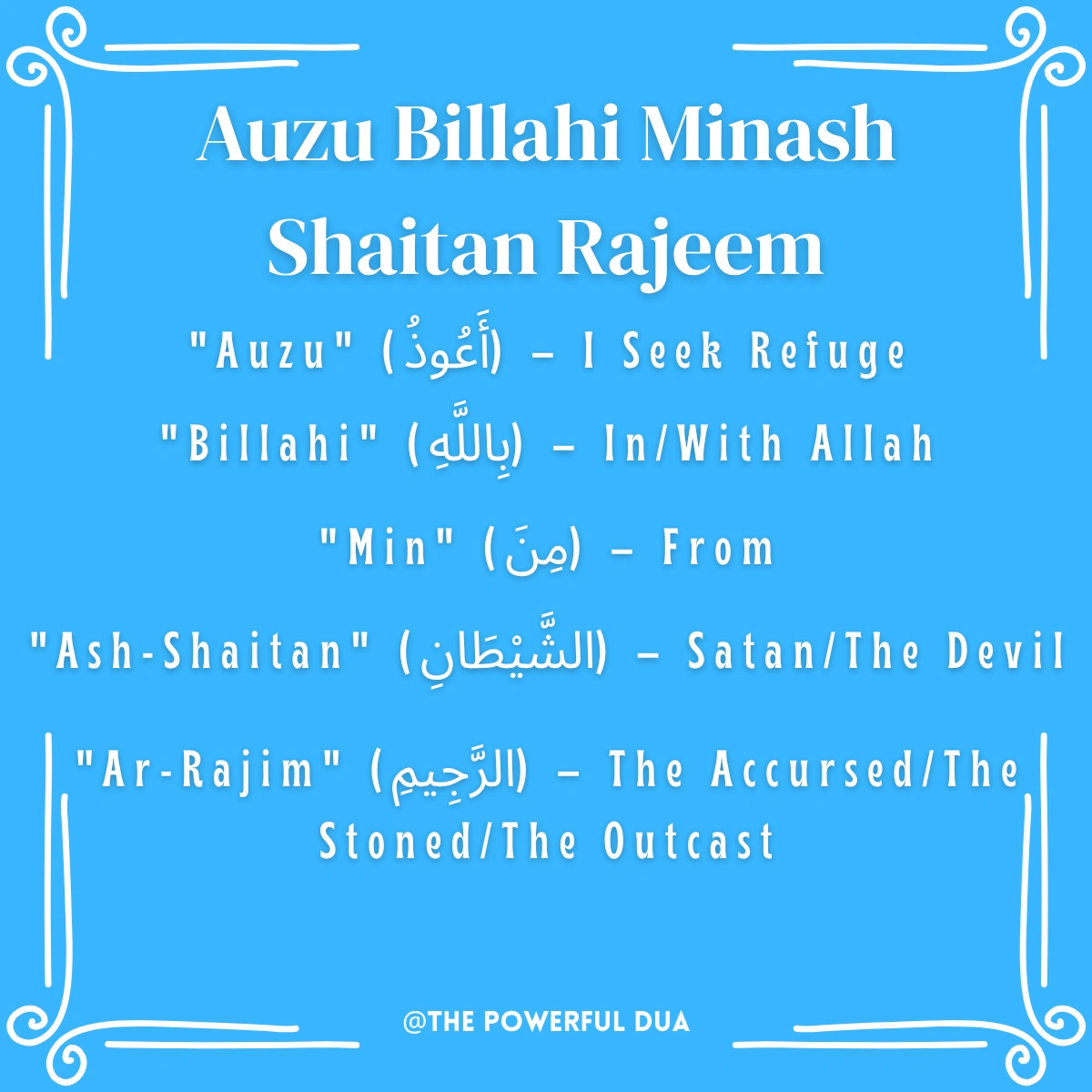
Let’s Break Down the Meaning Word by Word
Here’s where it gets interesting—understanding each word helps you grasp the full power of Auzu Billahi Minash Shaitan Rajeem.
“Auzu” (أَعُوذُ) – I Seek Refuge
This word comes from the Arabic root meaning “to seek shelter” or “to take refuge.” It’s like you’re running toward Allah for protection, like finding shelter during a storm. You’re not just asking casually; you’re actively seeking safety.
“Billahi” (بِاللَّهِ) – In/With Allah
This is the key part. You’re not seeking refuge in yourself, your power, or another person. You’re putting your trust entirely in Allah—the Creator, the All-Powerful, the One who has authority over everything, including Satan. It’s a statement of complete dependence and faith.
“Min” (مِنَ) – From
Simple and direct. You’re asking for protection from something harmful.
“Ash-Shaitan” (الشَّيْطَانِ) – Satan/The Devil
In Islamic theology, Satan (Iblis) is a real being whose job is to whisper evil thoughts, tempt humans, and lead people away from the right path. When you say Auzu Billahi Minash Shaitan Rajeem, you’re acknowledging this reality and seeking safety from his influence.
“Ar-Rajim” (الرَّجِيمِ) – The Accursed/The Stoned/The Outcast
This is the powerful part. “Rajim” doesn’t just mean “cursed”—it carries the meaning of being expelled, rejected, and driven away from Allah’s mercy. By calling Satan “ar-rajim,” you’re emphasizing that he’s already been cast out and humiliated by Allah. You’re saying, “I seek refuge from this being who is already rejected and helpless against Allah’s power.”
The Quranic Foundation: Where Auzu Billahi Minash Shaitan Rajeem Comes From
The Main Quranic Verse
Allah directly commanded us to recite this phrase in the Quran. In Surah Al-Nahl (Chapter 16, Verse 98), Allah says:
“So when you recite the Qur’an, seek refuge in Allah from Satan, the accursed.”
This verse is the foundation—it’s not just advice or a suggestion. It’s a divine instruction to protect yourself before engaging with the Quran’s words. Pretty important, right?
Why this matters: Scholars across Islamic schools agree that this verse establishes the practice (sunnah) of reciting “auzu billahi minash shaitan rajeem” before reading the Quran. It’s been part of Islamic practice for over 1,400 years.
Hadith Evidence: What the Prophet Did
The Prophet Muhammad ﷺ didn’t just know this phrase—he actively practiced it. Here’s what the authentic hadith collections tell us:
In Prayer: The Prophet ﷺ used to begin his prayer by reciting “Auzu billahi minash shaitan rajeem” before reciting Surah Al-Fatihah (the opening chapter of the Quran). This is documented in collections like Sunan Ibn Majah (Hadith 808).
During Anger: In Sahih Muslim (Hadith 2610b), the Prophet ﷺ taught that when someone becomes angry, they should recite “Auzu billahi minash shaitan rajeem” to calm down. He explained that anger is connected to Satan’s whispers, and seeking Allah’s refuge breaks that cycle.
These aren’t just nice practices—they come from the highest example in Islam, making them deeply rooted in Islamic tradition.
When Do You Actually Say Auzu Billahi Minash Shaitan Rajeem? Real-Life Scenarios
Let me walk you through the main times this phrase is used, because it’s not just a “Quran thing.”
Scenario 1: Before Reading or Reciting the Quran
This is the most common use. Whether you’re reading a single verse or doing a full Quran recitation session, you say it once at the beginning. It’s like opening a protective barrier before you engage with the word of Allah.
Do this: Say it once when you start. If you take a long break (like hours later) and come back to reading, many scholars recommend saying it again.
Scenario 2: During Prayer (Salah)
If you’re praying at home or in a mosque, before you recite Surah Al-Fatihah (which comes after the opening takbir and Surah Al-Fatihah in prayer), you quietly recite “auzu billahi minash shaitan rajeem.” This protects your prayer from distraction and negative thoughts.
Quick note: In the Hanafi school of Islamic law, this is commonly recommended but quietly. In other schools, practices vary slightly, but all agree it’s beneficial.
Scenario 3: When You’re Angry or Agitated
This is where it gets practical for daily life. The Prophet ﷺ taught that when anger rises in your heart, reciting this phrase helps you calm down. Why? Because anger often comes from Satan’s whispers pushing you toward harm. By seeking Allah’s refuge, you break that cycle.
Real example: You’re in an argument with someone, your temperature rises, and you feel like saying something hurtful. Stop. Say “Auzu billahi minash shaitan rajeem” and take a breath. It’s like pressing a reset button.
Scenario 4: Before Starting Important Work or Study
Many Islamic teachers and modern Muslim educators recommend saying it before exams, important meetings, or any task that matters to you. It’s a way of asking Allah for spiritual clarity and protection from negative influences or distractions.
Scenario 5: When You Have Intrusive or Evil Thoughts
If you’re plagued by unwanted thoughts, waswas (Satan’s whispers), or anxiety, reciting this phrase is a recognized Islamic practice to cut off those thoughts and refocus on Allah.
Comparing Auzu Billahi Minash Shaitan Rajeem to Other Protection Duas: The Big Picture
Here’s something most articles miss: “Auzu billahi minash shaitan rajeem” is just one part of a larger family of protective supplications in Islam. Let me show you how it fits with others.
Comparison Table: Protection Duas in Islam
| Du’a / Practice | Full Text (Brief) | When to Use | Length | Primary Source |
|---|---|---|---|---|
| Auzu billahi minash shaitan rajeem | I seek refuge in Allah from the accursed Satan | Before Quran, prayer, anger, anytime | Very short (1 phrase) | Surah Al-Nahl 16:98 |
| Auzu bi kalimati-llahi at-tammah | I seek refuge in Allah’s perfect words from every evil | Daily protection, morning/evening | Short (1 phrase) | Surah Al-‘Imran 3:18 (tradition) |
| Surah Al-Falaq (Ch. 113) | Say: I seek refuge in the Lord of daybreak | Morning/evening routine, general protection | Medium (5 verses) | Quran, Ch. 113 |
| Surah Al-Nas (Ch. 114) | Say: I seek refuge in the Lord of mankind | When feeling waswas or anxiety | Medium (6 verses) | Quran, Ch. 114 |
| Morning/Evening Adhkar (Supplications) | Various protection phrases (30+ combinations) | Daily morning and evening | Long (whole collection) | Hadith compilations |
What this shows: “Auzu billahi minash shaitan rajeem” is the quickest, most frequent protection statement. It’s like the espresso shot of Islamic protection—fast, powerful, and used constantly. The others are deeper, longer-term practices.
The Islamic Schools (Madhabs) and How They View Auzu Billahi Minash Shaitan Rajeem
This is important for understanding the full picture, and it’s something most guides skip.
Does Every Islamic School Agree on How to Use It?
Yes and no. All four major Islamic schools (Hanafi, Shafi’i, Maliki, Hanbali) agree that reciting “auzu billahi minash shaitan rajeem” is beneficial and recommended (sunnah). But they have slightly different details:
Hanafi School: Recommends saying it quietly before Surah Al-Fatihah in prayer. It’s strongly encouraged but not obligatory, and you’re not sinful if you skip it.
Shafi’i School: Also recommends it, with similar views. Some Shafi’i scholars say it’s mustahhab (recommended), others say it’s part of the proper method but not strictly obligatory.
Maliki School: Includes it in the prayer routine, though with some flexibility on exact timing.
Hanbali School: Emphasizes it strongly and includes it as part of the proper prayer method.
The bottom line: Across all schools, saying “auzu billahi minash shaitan rajeem” is considered a sunnah—a recommended practice tied to the Prophet’s example. You’re not doing something wrong by saying it, and you’re following an established Islamic tradition. No school says you’re sinful for omitting it, but all encourage it.
Let’s Talk About the Science of Why Auzu Billahi Minash Shaitan Rajeem Works
Here’s something interesting that traditional Islamic teaching and modern psychology actually agree on: Reciting “auzu billahi minash shaitan rajeem” works like a cognitive circuit-breaker.
How It Interrupts the Anger Cycle
When you’re angry, your brain is in a heightened state of reactivity. If you stop and deliberately recite Auzu Billahi Minash Shaitan Rajeem, here’s what happens:
- You pause. Instead of reacting immediately, you interrupt the automatic anger response.
- You refocus. You’re shifting your mental attention from “I’m furious” to “I need Allah’s protection from Satan’s whispers.”
- You reframe. Instead of blaming the person in front of you, you recognize that the negative impulse might be coming from Satan’s influence—not your true self.
- You reset. The act of speaking these words in Arabic, with intention, engages a different part of your brain.
This is exactly what modern anger-management counselors recommend: pause, breathe, reframe, respond. Except this practice has been doing it for 1,400 years.
How It Works Against Waswas (Intrusive Thoughts)
If you’ve ever had unwanted negative thoughts pop into your head—fear, doubt, lustful thoughts, or dark imaginings—you know how they can spiral. Islamic theology calls this “waswas” (whispers from Satan).
Reciting “auzu billahi minash shaitan rajeem” does this:
- It names the source: Instead of believing “this is my true thought,” you recognize it as an external whisper.
- It creates psychological distance: You’re saying, “This is Satan trying to trick me, not something I truly want.”
- It activates agency: You’re actively choosing to seek Allah’s protection, which shifts you from passive victim to active defender.
Interestingly, cognitive behavioral therapy (CBT) teaches something similar—naming intrusive thoughts as separate from yourself, rather than owning them, reduces their power.
Common Mistakes People Make (And How to Avoid Them)
Let me save you from some pitfalls I’ve seen people stumble into:
Mistake 1: Thinking You Only Say It Once in Your Life
Reality: This isn’t a one-time protective charm. You say it repeatedly—every time you read the Quran, every prayer, whenever you feel the need. It’s a practice, not a one-off magical formula.
Mistake 2: Confusing It With “Bismillah” (In the Name of Allah)
Some people think “auzu billahi minash shaitan rajeem” and “bismillah ar-rahman ar-rahim” are the same thing. They’re not. You say “auzu” before reciting the Quran, then say “bismillah” as you begin. They’re complementary but different.
Mistake 3: Mispronouncing It and Thinking It Doesn’t Count
You don’t have to be a native Arabic speaker. A sincere attempt with the right intention counts. Yes, proper pronunciation is better, but Allah looks at your heart and intention, not perfection.
Mistake 4: Saying It Without Understanding or Intention
If you’re just robotically reciting it without thinking about what you’re saying, you’re missing the whole point. Pause. Think about the meaning. Connect with the protection you’re asking for. That intention makes all the difference.
Mistake 5: Believing Exaggerated “Secret Powers” Claims
You’ll see claims like “Recite this 360 times and Satan’s army is destroyed” or “Say it 3 times before bed and you’ll have supernatural dreams.” Be skeptical. The actual Islamic sources don’t claim these things. The real benefit is spiritual protection, peace of mind, and breaking negative thought cycles—which is already powerful.
How to Teach Your Kids (And Family) to Use Auzu Billahi Minash Shaitan Rajeem
If you have children or want to introduce this practice to your family, here’s a practical approach:
Step 1: Teach the Meaning First
Explain it in simple terms: “Auzu Billahi Minash Shaitan Rajeem is like asking Allah to protect us from bad thoughts and Satan’s tricks. It’s like a superhero shield for our hearts.”
Step 2: Practice the Pronunciation Together
Say it slowly, syllable by syllable. Let them repeat after you. Make it fun, not forced.
Breakdown:
- A-u-dhu (I seek refuge)
- Bil-la-hi (in Allah)
- Min-ash (from the)
- Shay-tan (Satan)
- Ar-ra-jeem (the accursed)
Step 3: Create a Routine
Attach it to existing habits:
- Morning: Say it before breakfast or before leaving home.
- Before school/homework: “Let’s ask Allah for protection and focus.”
- Before bedtime: “Let’s protect ourselves as we sleep.”
- When angry: Use it as the family anger-management tool.
Step 4: Model It Yourself
Kids learn by watching. When they see you saying it regularly and calmly, it becomes normal for them.
The Deep Meaning of “Ar-Rajim” (The Accursed Satan)
Here’s a theological layer that adds richness to understanding Auzu Billahi Minash Shaitan Rajeem:
In the Quran, Satan is described in various ways:
- “Shaytan” = the one who whispers, the deceiver
- “Iblis” = his personal name, meaning “he who despairs” (from Allah’s mercy)
- “Ar-rajim” = the expelled, the stoned, the cursed, the one cast out from mercy
When you say “ar-rajim,” you’re not just calling Satan “bad.” You’re emphasizing that he’s already lost. He’s already been rejected by Allah, expelled from the circle of mercy, and defeated. By invoking this word, you’re reminding yourself (and Satan) of his powerlessness against Allah’s will.
It’s psychologically empowering: You’re not seeking refuge from a powerful enemy, but from a defeated enemy who can only whisper and tempt but has no real authority.
The Evidence Behind the Hadith: What We Know for Sure
Let me be transparent about the sources, because authenticity matters in Islamic knowledge:
| Hadith Topic | Source | Grading | What It Says |
|---|---|---|---|
| Reciting before prayer | Sunan Ibn Majah 808 | Sahih (authentic) | Prophet used to say it before Surah Al-Fatihah |
| Using it against anger | Sahih Muslim 2610b | Sahih (authentic) | Anger is from Satan; saying this phrase calms it |
| General recommendation | Quran + multiple hadith | Consensus (ijma’) | Reciting it is sunnah muakkadah (strongly recommended) |
| Specific obligation | All schools | Not universally obligatory | But strongly encouraged; not sinful to skip, but you miss reward |
Translation: The major hadiths backing this practice are from the most authentic collections. Scholars across 14 centuries have agreed on its benefits. This isn’t folklore—it’s well-documented Islamic knowledge.
FAQs: Your Real Questions, Answered on Auzu Billahi Minash Shaitan Rajeem
Q1: Do I Have to Say It in Arabic, or Can I Say It in English or My Own Language?
A: The Islamic scholars say it’s best to say it in the Arabic words as transmitted, since it’s a specific phrase that’s been preserved exactly for centuries. However, if you’re learning Arabic or don’t know it fluently, saying it with sincerity in your own language while learning the Arabic is acceptable. But the goal is to learn the original Arabic, because there’s something powerful about the exact words Allah commanded in the Quran.
Q2: Is It Okay to Say It Silently or Does It Have to Be Out Loud?
A: Both are valid. In prayer, scholars recommend saying it quietly (not aloud). Before reading the Quran at home, you can say it silently or aloud—whatever feels natural. The intention and sincerity matter more than the volume.
Q3: What If I Keep Forgetting to Say It Before Reading the Quran? Is That a Sin?
A: No, it’s not a sin. It’s sunnah (recommended), not fard (obligatory). However, making it a habit is encouraged because it heightens your focus and spiritual state before engaging with Allah’s word. Think of it like warming up before exercise—not required, but it helps.
Q4: Can I Say This Phrase Whenever I Want, or Only in Specific Situations?
A: You can absolutely say it anytime—when you feel anxious, scared, tempted, or just want spiritual protection. The specific times (before Quran, in prayer, during anger) are the recommended contexts, but there’s no harm in saying it throughout your day whenever you feel the need.
Q5: What’s the Difference Between “Auzu billahi minash shaitan rajeem” and “Auzu bi kalimati-llahi at-tammah”?
A: The first is short and specific: “I seek refuge in Allah from the accursed Satan.” It’s focused on protection from Satan himself. The second, “I seek refuge in Allah’s perfect words from every evil,” is broader—it protects from all forms of evil and harm, not just Satan specifically. Both are authentic and beneficial; use them in different contexts or together as part of your daily protection routine.
Q6: Is There a Specific Number of Times I Should Recite It, or Is Once Enough?
A: Once is enough before reading the Quran or in prayer. During daily life, if you’re feeling particularly anxious or angry, you can repeat it multiple times. There’s no magical number. Focus on sincere recitation with understanding rather than counting repetitions. Quality over quantity.
The Bottom Line: Why Auzu Billahi Minash Shaitan Rajeem Matters
“Auzu billahi minash shaitan rajeem” is one of Islam’s simplest yet most powerful tools. It’s:
- Easy to remember – Seven words, easily memorized
- Deeply rooted – Commanded in the Quran, practiced by the Prophet ﷺ
- Universally applicable – Works in prayer, before Quran, during anger, in daily life
- Psychologically sound – Actually interrupts negative cycles, not just spiritual theater
- Accessible – No special conditions, no fees, no requirements—just sincere intention
Whether you’re a lifelong Muslim or newly interested in Islamic practice, Auzu Billahi Minash Shaitan Rajeem is worth integrating into your routine. It costs nothing, takes seconds, and connects you to centuries of Islamic tradition.
Conclusion: Auzu Billahi Minash Shaitan Rajeem
Understanding “auzu billahi minash shaitan rajeem” goes beyond knowing a translation. It’s about recognizing that you have access to divine protection, that negative influences are real but beatable, and that you’re never alone in struggling against them. Auzu Billahi Minash Shaitan Rajeem phrase is your daily reminder of that truth.
The next time you say it—whether before reading the Quran, in prayer, or when anger rises—pause for a moment. Understand what you’re saying. Feel the meaning. That’s when this simple phrase becomes your most powerful tool.
Thanks for reading! If you found this Auzu Billahi Minash Shaitan Rajeem guide helpful, check out our complete guide to Islamic duas and supplications on thepowerfuldua.com for more in-depth spiritual knowledge.
Also Read –
Shibra Name Meaning in Urdu & Lucky Number – Full Guide 2026
Ayzal Name Meaning in Urdu: 5 Key & Fun Facts (2026)
Izhaan Name Meaning in Urdu: Everything Parents Need to Know
Iqra Bismi Rabbika Surah: The First Words That Changed History
Lailahaillallah Muhammadarrasulullah in Arabic: 7 Life-Changing Facts
Pehle Ashre Ki Dua: Your Complete Guide for Ramzan’s First 10 Days
Qabar Par Mitti Dalne Ki Dua: Full Guide with Meaning & Steps
Surah Mulk Meri Web: Full Meaning, Tafsir & Daily Living Guide
Surah Mulk Faiz e Islam – 30 Verses That Protect and Transform You
Ghusl Ki Dua After Periods: What Islam Really Says About It
Ghar Me Dakhil Hone Ki Dua: The Right Way to Enter Your Home with Blessing
Ghar Se Bahar Nikalne Ki Dua: Authentic Islamic Guide for Daily Practice
Bukhar Utarne Ki Dua: The Islamic Prayer to Reduce Fever – Complete Guide (2026)
For more Islamic guidance and spiritual insights, check out “Islamic Dua Hub”
Methodology & Author Note
Author: Ravi
Credentials: SEO Content Specialist & Islamic Knowledge Writer | 8+ years in faith-based & devotional content | Contributor to ThePowerfulDua.com
Research Approach: This article integrates Quranic verses, authenticated hadith collections (Sahih Muslim, Sunan Ibn Majah), classical Islamic tafsir (Quranic interpretation), and contemporary Islamic scholarship. All claims are cross-referenced against primary Islamic sources and multi-school consensus.