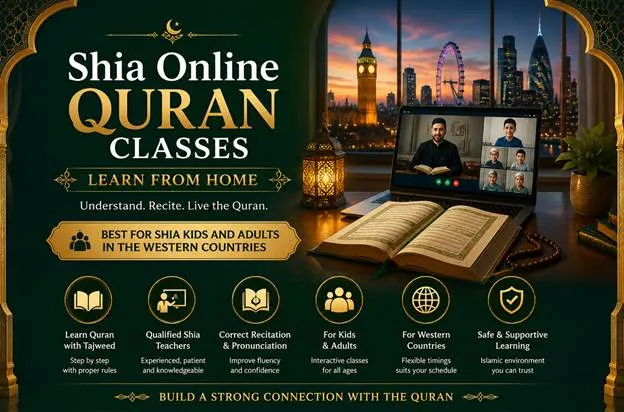
I’ve noticed something over the past few years talking to Shia families: almost everyone has the same worry. They want their kids, or honestly themselves, to learn the Quran properly, but the nearest mosque is either too far, too crowded, or doesn’t really have a teacher who understands Shia beliefs the way they’d like. It’s a small frustration that quietly builds up until someone finally asks, “wait, can’t we just do this online?”
Turns out, yes, you can, and a lot of families already are. This isn’t some trendy shortcut either. It’s genuinely changed how people approach religious learning at home, whether that’s a mom in Toronto trying to get her seven-year-old to sit still for fifteen minutes, or a grown adult in Riyadh who never got the chance to learn Tajweed properly as a kid and finally wants to fix that.
Why So Many Families Are Making the Switch
Think about how things used to work. You’d send your child to a local madrassa, hope the teacher was decent, and just deal with whatever schedule they offered. If you happened to live somewhere without a strong Shia community nearby, you were mostly out of luck, or stuck with a teacher who taught in a way that didn’t quite match your beliefs.
Now that whole picture has shifted. A family with no Shia mosque anywhere near them can sit down, open a laptop, and connect with an actual qualified ustad or ustadha who knows Shia Aqaid inside and out, teaches correct Tajweed, and takes the time to explain things properly instead of rushing through a lesson. For Shia communities scattered across the diaspora, this has honestly been a bit of a lifeline. You’re no longer limited by geography.
What Separates a Decent Program From a Great One
Not all setups are created equal, and it’s worth knowing what you’re actually looking for. A solid curriculum usually kicks off with the fundamentals, things like Noorani Qaida or Yassarnal Quran, before easing into fluent reading, proper Tajweed rules, and eventually Hifz for students who want to memorize. The better programs don’t stop at recitation either. They fold in real Islamic studies too, covering Shia Aqaid, stories and teachings from the lives of the Ahlul Bayt, and enough basic fiqh that a student walks away with more than just reading skills.
Pacing matters more than people realize. A six-year-old and a forty-year-old don’t learn the same way, and a good teacher notices that instead of forcing everyone through the same rigid lesson plan. That’s really where one-on-one classes shine, since the teacher can slow down, speed up, or repeat something three times without anyone feeling rushed. That said, small group sessions work well too, especially for siblings who’d rather learn together than separately.
Why a Real Shia Quran Academy Makes the Difference
Here’s the thing people sometimes overlook. Not every online tutoring platform actually understands the difference between Sunni and Shia teaching styles, and honestly, some don’t bother distinguishing at all. That’s exactly why a dedicated Shia Quran Academy matters so much. When an academy builds its entire program around Shia beliefs, recitation traditions, and scholarly references from day one, parents stop having to second-guess what their kids are being taught.
A genuinely good academy usually offers a free trial class before you commit to anything, keeps its fees transparent, works around different time zones without a fuss, and stays in touch through something simple like WhatsApp so parents actually know how their child is progressing. Little things like progress updates, occasional certificates, and a teacher who checks in with parents now and then, these are the details that tell you an academy is serious rather than just someone teaching on the side.
A Few Honest Questions Before You Enroll
Before signing up anywhere, ask yourself a few things. Does the teacher actually have solid Tajweed training, or are they just reading fluently without understanding the rules themselves? Can you find real reviews from other Shia families, not just polished testimonials on a homepage? Will they let you try a class first before asking for payment? And is the video call quality actually reliable, because nothing kills a lesson faster than a frozen screen every two minutes.
Price is worth thinking about too, but don’t let it be the deciding factor. Paying a bit more for someone who genuinely knows what they’re doing beats saving a few dollars on a teacher who can’t explain a single Tajweed rule properly. Most established platforms these days offer multiple currencies and flexible payment options anyway, so budgeting across countries isn’t as painful as it used to be.
So Why Are Shia Online Quran Classes Winning Families Over
If I’m being honest, the appeal really comes down to one thing: you don’t have to trade convenience for correctness anymore. Shia online Quran classes let a child in Canada, a student in France, or a nervous adult beginner in Germany all get the same quality of teaching, rooted properly in Shia tradition, without anyone needing a mosque down the street.
It’s also opened a door for adults who quietly missed out on this growing up. There’s a real sense of relief that comes with learning one-on-one as an adult, away from a classroom full of kids, at your own pace, with a teacher who isn’t going to judge you for mixing up a letter. A lot of people who start later in life, guided by someone patient and genuinely knowledgeable about Shia recitation, end up saying it’s one of the better decisions they’ve made as an adult.
At the end of the day, picking a proper Shia-focused program means your kids, or you, get taught the right way. Correct Tajweed, authentic Shia teachings, and a connection to the Quran that actually fits into how people live now.
Frequently Asked Questions
1. What age is best to start Quran classes online? Most academies accept students as young as five or six, once they can sit through a short lesson and follow basic instructions. Adults of any age are welcome too, and many programs design separate tracks for beginners versus more advanced learners.
2. How long does it take to learn proper Tajweed? This varies by student, but with consistent classes two to three times a week, most learners see noticeable improvement in pronunciation and fluency within three to six months, with full Tajweed mastery often taking a year or more of regular practice.
3. Are female teachers available for girls and women? Yes, reputable academies typically offer both male and female teachers, and most allow parents to specifically request a female instructor for daughters or for adult women who prefer that arrangement.
4. What do I need at home to join classes? A stable internet connection, a smartphone, tablet, or laptop with a camera, and a quiet space are usually all that’s required. Most platforms use simple video call apps, so no special software installation is needed.
5. Can memorization (Hifz) be done through online classes? Absolutely. Many students complete partial or full Hifz through consistent online sessions, daily revision routines, and regular testing by their teacher, following the same structured approach used in traditional in-person Hifz programs.