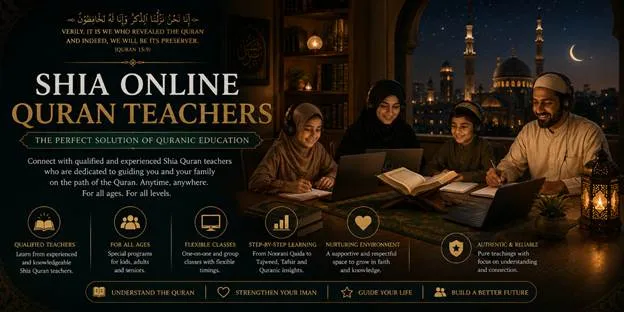
Late at night, after the kids are finally in bed, a lot of Shia parents end up doing the same thing — sitting with their phone, typing “Shia online Quran teachers” into Google, hoping something useful comes up. If that’s you, you’re in good company. Families across the UK, the US, Canada, and Australia are all chasing the same thing: someone they can actually trust to teach their kids the Quran properly, with correct Shia tajweed, a real grounding in akhlaq, and a personality the kids don’t dread logging in for.
On paper it sounds like a five-minute task. In practice, it rarely is. Type that search into Google and you’ll get a wall of academies, all claiming to teach Shia Quran classes, and most of them blending together after the third or fourth website. Very few actually get what matters to our community — recitation rooted in Shia tradition, an understanding of our fiqh, and a space where a kid can ask an honest question about their faith and get an honest answer back.
So this article is less “top 10 list” and more a straight conversation about what to actually look for, what a decent online Quran academy should look like day to day, and where families tend to go wrong the first time around.
Why So Many Shia Families Are Moving to Online Quran Academies
Go back ten or fifteen years, and most Shia families leaned on the local mosque or a community madrasa to teach their kids Quran and Islamic studies. For anyone living near a strong Shia community, that setup still works fine. But a lot of us don’t live near one anymore. Shia Muslims have scattered into smaller cities and quieter suburbs across North America and Europe, and in a lot of those places, there simply isn’t a Shia Quran teacher within driving distance.
That gap is exactly what online Shia Quran academies have ended up filling, almost without anyone announcing it. A qualified Shia Quran tutor sitting in one location can now teach a kid in Toronto at 5pm, then a kid in Manchester an hour later, then one in Melbourne the next morning — same curriculum, same standard, no compromise on authenticity. For parents, that means skipping the after-work drive across town. For kids, it usually means real one-on-one attention instead of getting lost as one of twenty students in a packed classroom.
What Actually Separates a Good Shia Quran Tutor From the Rest
Here’s the honest part: not every online Quran teacher is a good fit for a Shia household, even if their website looks polished. Families need to be a bit more selective than they might expect going in. A genuinely good Shia Quran tutor tends to bring a few things to the table that a lot of generic Quran academies just don’t think about.
Real Shia tajweed, not just correct Arabic. Pronunciation matters, obviously, but there’s also a specific recitation style passed down through Shia scholars over generations. A tutor trained in that tradition corrects a child’s tajweed in a way that stays true to it, rather than defaulting to whatever’s most common online.
A real grounding in Shia fiqh and the Ahlul Bayt. Quran lessons have a way of opening doors — a kid reciting a verse might suddenly ask about Imam Ali, or Karbala, or why we pray the way we do. A tutor who actually knows this material doesn’t brush the question off or give a vague, one-size-fits-all answer. They just talk about it, naturally, as part of the lesson.
Genuine patience with beginners and kids. Online Quran classes for kids live or die on this one thing. If a teacher doesn’t actually enjoy working with children, it shows within the first two classes. The good ones can hold a seven-year-old’s attention for thirty straight minutes without the child losing interest — or worse, losing their love for the Quran altogether.
Willingness to work around time zones, not the other way around. Shia families are spread out across the globe now, and a solid academy builds its Shia Quran classes around the student’s actual schedule instead of forcing families to rearrange their lives for a single teacher.
What a Typical Shia Online Quran Class Actually Looks Like
Most reputable Shia Quran academies follow roughly the same structure, even if the pace shifts from student to student. Absolute beginners usually start with Noorani Qaida, then move into proper Quran reading with tajweed rules, and eventually into hifz (memorization) for the ones who want to take it further.
Recitation isn’t the whole story, though. Most academies weave in basic Islamic studies alongside it — short lessons on Shia beliefs, the Ahlul Bayt, daily duas, and akhlaq. Honestly, this is probably the biggest reason parents search specifically for Shia Quran teachers instead of just typing “Quran tutor” into Google. They want their kids learning the Quran inside their own tradition, not a generic, watered-down version that skips over what actually makes it theirs.
Classes usually happen one-on-one, or occasionally in small groups, over video call, with a shared digital Quran so teacher and student can follow the same page in real time. Almost every decent academy offers a free trial class before you commit to anything, and it’s genuinely worth using — it’s the fastest way to find out whether a teacher’s style clicks with your child, or doesn’t.
How to Actually Pick the Right Academy (Without Guessing)
When you’re comparing a few options, it helps to just ask directly instead of relying on the website copy. Is the teacher a native Arabic speaker, or specifically trained in Shia tajweed? What curriculum are they using, and does it go beyond plain Quran reading into Shia-specific content? How flexible are they about time zones? And maybe most importantly — is there a trial class, and what actually happens if the fit isn’t right?
A trustworthy Online Shia Quran academy answers all of this without hesitation, and it won’t pressure you into a long-term package before you’ve even sat through one class. It’s also worth reading reviews from other Shia families, since they tend to mention the small things a website never will — how patient a teacher actually is, whether they run late, how they communicate outside of class.
Final Thoughts
At the end of the day, finding the right Shia online Quran teacher isn’t really about who reads Arabic the most fluently. It’s about finding someone who gets your community, respects what you believe, and can pass that on to your kids in a way that feels personal instead of like another homework assignment. Try the trial class, ask the questions that actually matter to you, and trust your gut about whether a teacher is the right fit for your family.
Frequently Asked Questions
1. Are Shia online Quran teachers different from regular online Quran tutors? Yes. Shia Quran teachers are trained specifically in Shia recitation traditions, Fiqh Jaffari, and the teachings of the Ahlul Bayt, which many generic Quran academies don’t cover in depth.
2. What age can a child start Shia online Quran classes? Most academies accept children as young as five, starting with Noorani Qaida before moving into full Quran recitation and Tajweed.
3. How long does it take to learn proper Quran recitation online? This varies by student, but with consistent classes two to three times a week, most beginners develop solid recitation skills within six months to a year.
4. Is it possible to learn Quran online with correct Shia Tajweed as an adult? Absolutely. Many Shia Quran academies offer dedicated adult programs, recognizing that plenty of parents want to relearn or refine their own recitation alongside their children.