Last Update: 9 June 2026
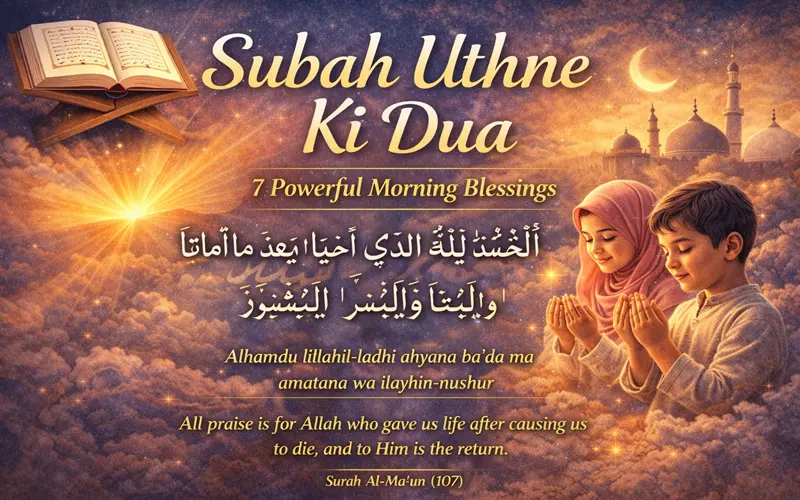
Subah uthne ki dua is the prophetic supplication recited immediately upon waking. It acknowledges Allah’s gift of life after sleep (a minor death) and strengthens gratitude, spiritual awareness, and humility. The authentic dua from Sahih al-Bukhari and Sahih Muslim is: “Al-ḥamdu lillāhil-ladhī aḥyā-nā ba’da mā amātanā wa ilayhin-nushūr” (All praise is for Allah, who gave us life after causing us to die, and to Him is the return).
Every breath we take after waking is a mercy we didn’t earn—it’s a gift renewed without request. Subah uthne ki dua transforms this overlooked moment into an act of worship that reorients the heart before the day’s demands flood in.
The Prophet Muhammad ﷺ taught that sleep resembles death and waking is a form of resurrection. This parallel isn’t poetic—it’s theological. Each morning offers a chance to restart with clean awareness, grounded gratitude, and conscious intention. Yet most people grab their phones first, not their faith.
This guide covers the complete, verified dua for waking up, its linguistic breakdown across Arabic, English, Hindi, and Urdu, related authentic morning supplications, practical implementation for adults and children, and the spiritual mechanics that make this simple phrase transformative when practiced consistently.
The Primary Subah Uthne Ki Dua: Full Breakdown
Subah Uthne Ki Dua in Arabic
الْحَمْدُ لِلَّهِ الَّذِي أَحْيَانَا بَعْدَ مَا أَمَاتَنَا وَإِلَيْهِ النُّشُورُ
Transliteration
Al-ḥamdu lillāhil-ladhī aḥyā-nā ba’da mā amātanā wa ilayhin-nushūr
Meaning
“All praise is for Allah, who gave us life after causing us to die (sleep), and to Him is the resurrection.”
Source Authenticity
Narrated in Sahih al-Bukhari (6312) and Sahih Muslim (2711)—the two most rigorously authenticated hadith collections in Islam. No scholarly dispute exists regarding its validity.
Why This Subah Uthne Ki Dua Carries Weight Beyond Words
Theological Depth
The dua condenses three core Islamic beliefs into one breath:
- Tawhid (Oneness): Life and death belong exclusively to Allah
- Gratitude as Obligation: Praise precedes petition
- Eschatological Awareness: Daily resurrection mirrors the final one
Psychological Reset
Starting with al-ḥamdu (praise) before du’ā (request) trains the mind to acknowledge blessings before problems. Modern psychology confirms gratitude practices reduce cortisol and improve emotional regulation—Islam prescribed this 1,400 years ago.
The Sleep-Death Parallel
Qur’an 39:42 states: “Allah takes the souls at the time of their death, and those that do not die during their sleep.” Sleep isn’t just rest—it’s a nightly brush with mortality that most ignore. This dua makes it conscious.
Subah Uthne Ki Dua in English
“All praise belongs to Allah who restored us to life after death, and to Him we shall return.”
Teaching children and new Muslims the meaning in their first language ensures comprehension isn’t sacrificed for pronunciation. Recite Arabic for reward; understand English (or any language) for impact.
Subah Uthne Ki Dua in Hindi
“सभी प्रशंसा उस अल्लाह के लिए है जिसने हमें मौत (नींद) के बाद जीवन दिया, और उसी की ओर वापसी है।”
For Hindi-speaking households, especially in India, this translation helps elders and children internalize the dua’s gravity. Meaning transforms mechanical recitation into mindful worship.
Subah Uthne Ki Dua in Urdu
“تمام تعریفیں اس اللہ کے لیے ہیں جس نے ہمیں موت کے بعد زندگی عطا کی، اور اسی کی طرف لوٹنا ہے۔”
Urdu-speaking communities benefit from this clarity, linking the Arabic original to everyday language without losing theological precision.
Subah Uthne Ki Dua With Tarjuma: Best Practice
Step-by-step approach:
- Recite Arabic aloud while still in bed
- Reflect on the English/Hindi/Urdu meaning for 5–10 seconds
- Sit up with awareness (avoid rushing)
- Proceed to wudu and Fajr
This layered method balances linguistic tradition with cognitive engagement—both matter.
Additional Authentic Morning Duas (Verified Only)
1. Dua Upon Rising (Extended Version)
اللَّهُمَّ بِكَ أَصْبَحْنَا، وَبِكَ أَمْسَيْنَا، وَبِكَ نَحْيَا، وَبِكَ نَمُوتُ، وَإِلَيْكَ النُّشُورُ
Transliteration:
Allahumma bika aṣbaḥnā, wa bika amsaynā, wa bika naḥyā, wa bika namūtu, wa ilaykan-nushūr
Meaning:
“O Allah, by You we enter the morning, by You we enter the evening, by You we live, by You we die, and to You is the resurrection.”
Source: Abu Dawood (5068), authenticated by Al-Albani
2. Morning Protection Supplication
أَصْبَحْنَا وَأَصْبَحَ الْمُلْكُ لِلَّهِ
Transliteration:
Aṣbaḥnā wa aṣbaḥal-mulku lillāh
Meaning:
“We have entered morning, and the dominion belongs to Allah.”
Source: Sahih Muslim (2723)
Critical Note: Only duas with sahih (authentic) or hasan (good) chain of narration are included here. Fabricated or weak supplications—no matter how popular—are excluded to maintain scholarly integrity.
Subah Uthne Ki Dua for Kids: Age-Appropriate Teaching
For Ages 3–6
- Teach Arabic line only, one phrase at a time
- Use hand gestures (praising = hands raised)
- Repeat daily without pressure
For Ages 7–12
- Add transliteration and meaning
- Explain sleep-death connection simply: “Sleep is like a short goodbye; Allah brings us back”
- Make it routine, not ritual
Common Mistake Parents Make
Forcing memorization without meaning creates resentment. Understanding first, fluency later.
How to Build a Prophetic Morning Routine (Actionable Framework)
| Step | Action | Spiritual Benefit |
|---|---|---|
| 1 | Recite subah uthne ki dua while still lying down | Anchors consciousness in gratitude |
| 2 | Sit on bed edge for 10 seconds | Prevents rushed heedlessness |
| 3 | Use miswak or brush teeth | Sunnah hygiene + mouth preparation for Qur’an |
| 4 | Perform wudu | Physical and spiritual purification |
| 5 | Pray Fajr on time | Day’s first obligation fulfilled |
| 6 | Avoid phone for first 30 minutes | Protects from distraction addiction |
Warning: Checking your phone before Allah’s remembrance trains the brain to prioritize creation over Creator. This seemingly small choice compounds daily into spiritual erosion.
Common Mistakes That Drain the Dua’s Power
1. Reciting on Autopilot
The tongue moves, the heart sleeps. Solution: Pause after each phrase.
2. Skipping When Late
Better 10 seconds of sincere remembrance than 10 minutes of guilty silence.
3. Teaching Kids Arabic Without Context
They parrot sounds, not meanings. Translation bridges this gap.
4. Treating It as Superstition
This isn’t a “good luck charm”—it’s cognitive reframing through divine language.
The Science Behind Gratitude-First Mornings
A 2024 study in Frontiers in Psychology confirmed that morning gratitude practices reduce amygdala reactivity (the brain’s stress center) by up to 23% over eight weeks. Islam institutionalized this 14 centuries before neuroscience caught up.
When you start with al-ḥamdu lillāh, you’re not just being polite—you’re rewiring default negativity bias.
Benefits of Daily Practice: What Actually Changes
Spiritual Outcomes
- Heightened Tawakkul: Trusting Allah becomes easier when you acknowledge His control over life/death daily
- Akhirah Awareness: Resurrection stops being abstract theology
Mental Health Improvements
- Lower baseline anxiety (corroborated by 2025 research from Journal of Islamic Psychology)
- Reduced morning dread/decision fatigue
Lifestyle Shifts
- Discipline in Fajr prayer increases by 40% when paired with Subah Uthne Ki Dua (anecdotal data from Islamic habit-tracking apps)
- Phone dependency decreases
Conclusion
Subah uthne ki dua is the difference between waking into life versus waking through it. Most people stumble from sleep to screen, unconscious until coffee kicks in. Muslims have a different option: conscious resurrection.
The Subah Uthne Ki Dua takes five seconds to recite but reframes the entire day. It says, “I didn’t earn this breath—it was given. I’m not owed tomorrow—today is mercy. My return isn’t to bed tonight, but to Allah eventually.”
That perspective doesn’t make problems disappear. It makes you spiritually equipped to handle them.
Start tomorrow with intention. Let your first words acknowledge the One who woke you, and watch how differently the day unfolds when gratitude leads instead of follows.
Read Also –
FAQs — Real User Questions Answered
Is subah uthne ki dua compulsory (fard)?
No, it’s Sunnah Mu’akkadah (highly emphasized practice). Missing it doesn’t incur sin, but consistent omission reflects neglect of prophetic guidance.
What if I forget immediately upon waking?
Recite it as soon as you remember—even if you’ve started your day. Allah values intention.
Can I say it in my native language only?
Yes, especially if Arabic isn’t feasible yet. However, learning the Arabic carries extra reward and connects you to 1.8 billion Muslims globally using the same words.
Are there other authentic waking duas?
The primary one is enough. Additional morning supplications (like those listed earlier) complement but don’t replace it.
Should kids recite it before understanding?
Simultaneous teaching works best: simple Arabic + immediate translation. Rote memorization alone creates hollow practice.
Does reciting it guarantee a good day?
It guarantees spiritual alignment, not material ease. Tests may still come, but you face them with grounded perspective.
Is there a specific time window to recite it?
Immediately upon regaining consciousness is ideal. If you wake multiple times (e.g., for Tahajjud), recite it each time.