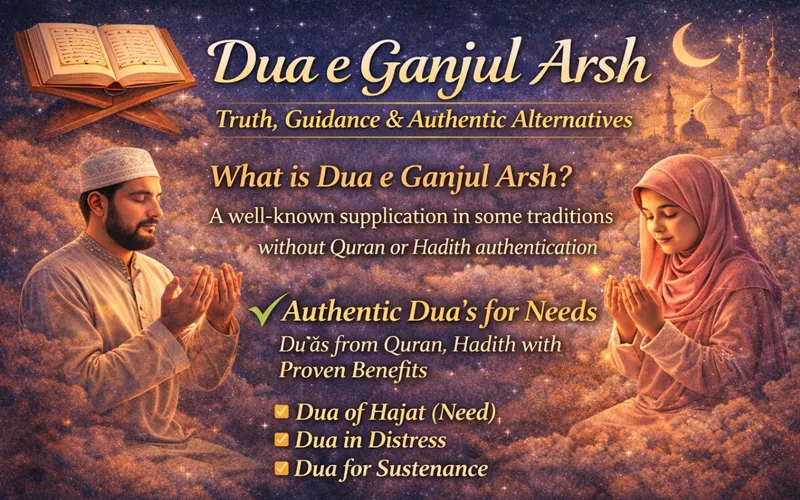
Dua e Ganjul Arsh is widely searched but lacks authentic Islamic sources. This guide clarifies its status according to Islamic scholarship, provides verified alternatives from Qur’an and Hadith, and equips you with powerful, authentic supplications for your needs, protection, and spiritual growth.
Introduction: The Search for Powerful Supplications
When facing hardship, uncertainty, or deep spiritual longing, Muslims instinctively turn to Allah through supplication. Among the many prayers circulating online and in devotional apps, dua e ganjul arsh appears frequently—often presented as a spiritually potent invocation for blessings, protection, and fulfillment of needs.
But here’s what most sources won’t tell you upfront: Islamic scholars have examined this supplication thoroughly, and their verdict is clear. The wording attributed to “dua e ganjul arsh” and its claimed virtues do not trace back to the Qur’an or any authentic Hadith. This doesn’t mean your spiritual needs are unmet—it means you deserve better, stronger, and authentically verified supplications that carry the weight of Prophetic tradition.
What Exactly Is Dua e Ganjul Arsh?
The phrase “dua e ganjul arsh” (دُعَاءُ جَنْجُلِ العَرْش) translates loosely to “the supplication of the treasure of the Throne.” In popular religious literature—particularly across South Asian Muslim communities—it’s described as a prayer taught by Angel Jibril (Gabriel) to Prophet Muhammad ﷺ.
Various websites and devotional books attribute extraordinary benefits to this supplication:
- Fulfillment of urgent needs
- Protection from enemies and evil
- Increase in sustenance and wealth
- Spiritual elevation and divine favor
The appeal is obvious. Who wouldn’t want a supplication promising such comprehensive blessings?
The Scholarly Verdict: Authenticity Matters
Here’s the critical issue Islamic scholars emphasize: authentication.
In Islam, not every circulating prayer carries equal weight. For a supplication to be considered reliably Prophetic—meaning the Prophet ﷺ actually taught it—it must appear in either:
- The Qur’an itself
- Authentic Hadith collections (Sahih Bukhari, Sahih Muslim, Sunan compilations, etc.)
After thorough examination, scholars specializing in Hadith authentication have concluded:
- No Qur’anic evidence exists for dua e ganjul arsh
- No authentic Hadith chain supports its transmission
- The style and structure of the commonly circulated text exhibit characteristics inconsistent with verified Prophetic supplications
- Detailed virtue claims associated with it cannot be substantiated through reliable Islamic sources
According to fatawa (religious rulings) from established Islamic scholarship platforms, this supplication falls into the category of fabricated or extremely weak narrations. IslamWeb and various Hanafi and Shafi’i scholars have specifically addressed this, cautioning believers against attributing guaranteed spiritual outcomes to unverified prayers.
This doesn’t make the reciter sinful, but it does mean the specific promised benefits lack Islamic backing.
Why Does Dua e Ganjul Arsh Remain Popular?
Despite scholarly clarifications, dua e ganjul arsh continues circulating widely. Several factors explain this:
Cultural Transmission: In communities where oral tradition and devotional literature pass down through generations, certain prayers become embedded regardless of authentication status.
Emotional Resonance: The language often sounds spiritually elevated, and desperate circumstances make people grasp at anything promising relief.
Digital Amplification: Apps, YouTube videos, and websites present it alongside authentic supplications without clear distinction, creating confusion about its status.
Sincere Intention: Many recite it with pure hearts, genuinely seeking Allah’s help. The intention is praiseworthy even when the source is questionable.
However, Islam provides a better path: relying on what’s definitively established.
Authentic Alternatives: Powerful Duas from Qur’an and Sunnah
Rather than clinging to unverified texts, Islamic tradition offers an abundance of authenticated supplications addressing every conceivable need. These carry the Prophet’s ﷺ direct endorsement and Allah’s acceptance.
1. Dua for Urgent Needs (Salat al-Hajah)
When facing a pressing necessity, this supplication is Prophetically prescribed:
Arabic: اللَّهُمَّ إِنِّي أَسْأَلُكَ وَأَتَوَجَّهُ إِلَيْكَ بِنَبِيِّكَ مُحَمَّدٍ نَبِيِّ الرَّحْمَةِ
Transliteration: Allahumma inni as’aluka wa atawajjahu ilayka binabiyyika Muhammadin nabiyyir-rahmah
Meaning: “O Allah, I ask You and turn to You through Your Prophet Muhammad, the Prophet of Mercy.”
This dua is recited after performing two units of prayer (Salat al-Hajah) when seeking Allah’s assistance with a specific need.
2. Dua in Times of Distress and Anxiety
The Prophet ﷺ taught this powerful invocation for moments of overwhelming difficulty:
Arabic: يَا حَيُّ يَا قَيُّومُ بِرَحْمَتِكَ أَسْتَغِيثُ
Transliteration: Ya Hayyu Ya Qayyum, birahmatika astaghith
Meaning: “O Ever-Living, O Sustainer of All, by Your Mercy I seek relief.”
This supplication directly addresses Allah by two of His most comprehensive names, acknowledging His eternal existence and complete control over all creation.
3. Dua for Sustenance and Provision
For those seeking halal income, career success, or financial stability:
Arabic: اللَّهُمَّ اكْفِنِي بِحَلَالِكَ عَنْ حَرَامِكَ وَأَغْنِنِي بِفَضْلِكَ عَمَّنْ سِوَاكَ
Transliteration: Allahumma-kfini bihalalika ‘an haramika wa aghnini bifadlika ‘amman siwak
Meaning: “O Allah, suffice me with what You have made lawful instead of what You have forbidden, and make me independent by Your Grace from all besides You.”
This dua emphasizes seeking provision through halal means while maintaining spiritual independence through reliance on Allah alone.
4. Comprehensive Supplication for Protection
The Prophet ﷺ would regularly recite this for comprehensive protection:
Arabic: اللَّهُمَّ إِنِّي أَعُوذُ بِكَ مِنَ الْهَمِّ وَالْحَزَنِ وَأَعُوذُ بِكَ مِنَ الْعَجْزِ وَالْكَسَلِ وَأَعُوذُ بِكَ مِنَ الْجُبْنِ وَالْبُخْلِ وَأَعُوذُ بِكَ مِنْ غَلَبَةِ الدَّيْنِ وَقَهْرِ الرِّجَالِ
Transliteration: Allahumma inni a’udhu bika minal-hammi wal-hazan, wa a’udhu bika minal-‘ajzi wal-kasal, wa a’udhu bika minal-jubni wal-bukhl, wa a’udhu bika min ghalabatid-dayni wa qahrir-rijal
Meaning: “O Allah, I seek refuge in You from anxiety and grief, from weakness and laziness, from cowardice and miserliness, and from being overcome by debt and overpowered by people.”
This addresses psychological, spiritual, financial, and social vulnerabilities comprehensively.
5. The Master Supplication (Sayyidul-Istighfar)
Considered the most superior form of seeking forgiveness:
Arabic: اللَّهُمَّ أَنْتَ رَبِّي لَا إِلَهَ إِلَّا أَنْتَ خَلَقْتَنِي وَأَنَا عَبْدُكَ وَأَنَا عَلَى عَهْدِكَ وَوَعْدِكَ مَا اسْتَطَعْتُ أَعُوذُ بِكَ مِنْ شَرِّ مَا صَنَعْتُ أَبُوءُ لَكَ بِنِعْمَتِكَ عَلَيَّ وَأَبُوءُ بِذَنْبِي فَاغْفِرْ لِي فَإِنَّهُ لَا يَغْفِرُ الذُّنُوبَ إِلَّا أَنْتَ
Transliteration: Allahumma anta rabbi la ilaha illa ant, khalaqtani wa ana ‘abduk, wa ana ‘ala ‘ahdika wa wa’dika mastata’t, a’udhu bika min sharri ma sana’t, abu’u laka bini’matika ‘alayya wa abu’u bidhanbi faghfirli fa innahu la yaghfirudh-dhunuba illa ant
Meaning: “O Allah, You are my Lord, there is no deity except You. You created me and I am Your servant, and I am faithful to my covenant and promise to You as much as I can. I seek refuge in You from the evil I have done. I acknowledge Your favor upon me and I acknowledge my sin, so forgive me, for none forgives sins except You.”
The Prophet ﷺ said whoever recites this with conviction during the day and dies that day will enter Paradise, and likewise for the night.
Proper Etiquette When Making Dua
Authentication of the words is one aspect; how you supplicate matters equally. The Prophet ﷺ taught specific etiquettes:
Begin with Praise: Start by glorifying Allah and sending blessings upon the Prophet ﷺ.
State Your Need Clearly: Be specific about what you’re asking for, whether in Arabic or your own language.
Choose Optimal Times: After obligatory prayers, during the last third of the night, while fasting, on Fridays.
Maintain Ritual Purity: Perform wudu (ablution) when possible.
Face the Qiblah: Though not obligatory for all duas, it demonstrates focus and reverence.
Raise Your Hands: The Prophet ﷺ would raise his hands when supplicating.
Persist and Have Certainty: Don’t say “if You will,” but rather ask with conviction in Allah’s ability and mercy.
End Appropriately: Conclude with praise of Allah and salutations upon the Prophet ﷺ.
Understanding Dua e Ganjul Arsh in Different Languages
Searches for “dua e ganjul arsh in English” and “dua e ganjul arsh in hindi” are common, reflecting diverse linguistic communities seeking this prayer.
The challenge remains consistent across languages: the original Arabic text being circulated lacks authenticated Islamic sourcing. Translations into English, Hindi, Urdu, or other languages don’t change the fundamental authentication issue.
What differs in these contexts is cultural practice. In South Asian Muslim communities, certain supplications—including this one—circulate through family tradition, local scholars, or popular religious literature without rigorous authentication checks that academic Islamic scholarship demands.
This doesn’t question anyone’s sincerity. Rather, it highlights the importance of verifying sources, especially when specific spiritual benefits are claimed.
Claimed Benefits vs. Verified Outcomes
Let’s address this honestly through a comparison:
| Aspect | Unverified Supplications | Authenticated Prophetic Duas |
|---|---|---|
| Source | Popular books, apps, oral tradition | Qur’an and Sahih Hadith collections |
| Guaranteed Benefits | Cannot be Islamically confirmed | Established through Prophetic teaching |
| Spiritual Safety | Risk of innovation (bid’ah) | Protected by tradition |
| Scholarly Consensus | Cautioned against | Unanimously endorsed |
| Acceptance by Allah | Based on sincerity alone | Based on sincerity AND Prophetic model |
When you recite duas the Prophet ﷺ himself used, you’re following a confirmed path. The dua e ganjul arsh benefits promoted online—protection from harm, wealth increase, enemy defeat—are better sought through authenticated means.
Edge Cases and Honest Warnings
What if I’ve been reciting it for years? Your sincerity and connection to Allah weren’t wasted. Simply transition to authenticated supplications moving forward. Allah judges intention.
Can it still be recited as personal words to Allah? Making dua in any sincere language or words is permissible. The issue arises when specific Prophetic status or guaranteed outcomes are attributed to unverified texts.
What about other popular duas online? Always verify. Websites, apps, and even printed books sometimes include weak or fabricated narrations. Cross-reference with established Islamic fatwa sites or consult knowledgeable scholars.
Is this issue only with dua e ganjul arsh? No. Many widely circulated supplications lack authentication. Examples include certain “40 Durood” collections or prayers promising specific material outcomes within set timeframes.
Conclusion: Choose Certainty Over Uncertainty
Your relationship with Allah deserves the strongest foundation possible. When you call upon your Creator, you want confidence that your method follows the path He revealed and His Messenger ﷺ demonstrated.
Dua e ganjul arsh may have reached you through sincere channels, but Islamic scholarship has shown it lacks the authentication required for us to attribute specific virtues to it. This isn’t about dismissing anyone’s devotion—it’s about directing that devotion toward what’s unquestionably sound.
The authentic supplications from Qur’an and Sunnah aren’t just replacements—they’re upgrades. They carry prophetic endorsement, scholarly consensus, and the weight of divine acceptance. When you raise your hands and recite words the Prophet ﷺ himself used, you’re tapping into a spiritual lineage stretching back 1,400 years.
Start today. Replace uncertainty with conviction. Memorize one authentic supplication this week. Teach it to your family. Watch how your spiritual life transforms when rooted in what’s verified and true.
Allah hears every sincere call. Make yours count by ensuring it follows the best example—that of Muhammad ﷺ.
Frequently Asked Questions
Q1: Is dua e ganjul arsh mentioned in the Qur’an?
No, it does not appear anywhere in the Qur’an.
Q2: Did the Prophet Muhammad ﷺ teach dua e ganjul arsh?
No authentic Hadith confirms the Prophet ﷺ taught this specific supplication.
Q3: Will reciting it bring harm?
Reciting it doesn’t cause harm, but attributing unverified spiritual benefits to it is problematic from an Islamic scholarship perspective.
Q4: What should I recite instead for urgent needs?
Perform Salat al-Hajah (prayer of need) and use the authenticated duas provided in this article, particularly the supplication beginning with “Allahumma inni as’aluka…”
Q5: Why do many Muslims still recite it?
Cultural transmission, lack of awareness about authentication issues, and the genuine desire for Allah’s help all contribute to its continued use.
Q6: Are there any circumstances where its recitation is acceptable?
If you understand it’s not Prophetically authenticated and don’t claim guaranteed benefits, using it as personal words to Allah is permissible—though authenticated duas are always preferable.
Q7: How can I verify if other duas are authentic?
Consult reputable Islamic scholarship websites, Hadith databases, or ask qualified scholars. Check if the supplication appears in recognized Hadith collections with sound chains of narration.
Read Also –