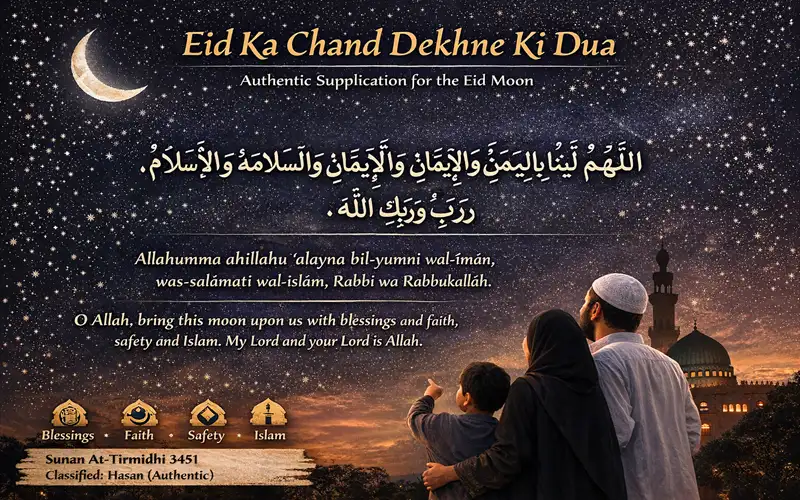
When you see the moon of Eid, the authentic dua taught by Prophet Muhammad ﷺ is:
Arabic
اللَّهُمَّ أَهِلَّهُ عَلَيْنَا بِالْيُمْنِ وَالْإِيمَانِ، وَالسَّلَامَةِ وَالإِسْلَامِ، رَبِّي وَرَبُّكَ اللَّهُ
Transliteration
Allahumma ahillahu ‘alayna bil-yumni wal-īmān, was-salāmati wal-islām, rabbī wa rabbukallāh.
Meaning (English)
O Allah, bring this moon upon us with blessings and faith, safety and Islam. My Lord and your Lord is Allah.
This dua is reported in Sunan al-Tirmidhi (3451) and graded Hasan by scholars including Imam al-Tirmidhi and later authenticated by scholars of hadith.
This is the authentic eid ka chand dekhne ki dua recited when sighting the new moon for Eid or any Islamic month.
Eid Ka Chand Dekhne Ki Dua – Complete Authentic Guide
The moment of moon sighting marks one of the most emotional nights in the Islamic calendar. Whether it is Ramzan Eid ka chand dekhne ki dua for Eid ul-Fitr or the moon of Dhul Hijjah for Eid ul-Adha, Muslims across the world look toward the sky with hope and gratitude.
The Prophet ﷺ never let this moment pass without remembrance of Allah. Instead of cultural sayings or unauthenticated phrases, he taught a specific, beautiful supplication rooted in Tawheed and gratitude.
This article presents:
-
Authentic dua in Arabic
-
Transliteration
-
Meaning in English
-
eid ka chand dekhne ki dua in Hindi
-
eid ka chand dekhne ki dua in Urdu
-
Practical guidance
-
Related authentic duas
-
Scholarly insights
-
Common mistakes to avoid
All content is based strictly on verified Islamic sources.
📖 The Authentic Eid Moon Sighting Dua

1️⃣ Eid Ka Chand Dekhne Ki Dua in Arabic
اللَّهُمَّ أَهِلَّهُ عَلَيْنَا بِالْيُمْنِ وَالْإِيمَانِ، وَالسَّلَامَةِ وَالإِسْلَامِ، رَبِّي وَرَبُّكَ اللَّهُ
2️⃣ Transliteration
Allahumma ahillahu ‘alayna bil-yumni wal-īmān, was-salāmati wal-islām, rabbī wa rabbukallāh.
3️⃣ Meaning in English (eid ka chand dekhne ki dua in English)
O Allah, bring this moon upon us with blessings and faith, safety and Islam. My Lord and your Lord is Allah.
This is the complete and authentic eid ka chand dekhne ki dua in English meaning. It is short, powerful, and deeply spiritual.
4️⃣ Eid Ka Chand Dekhne Ki Dua in Urdu
اے اللہ! اس چاند کو ہم پر برکت اور ایمان، سلامتی اور اسلام کے ساتھ طلوع فرما۔ میرا اور تیرا رب اللہ ہے۔
5️⃣ Eid Ka Chand Dekhne Ki Dua Hindi
ऐ अल्लाह! इस चाँद को हम पर बरकत, ईमान, सलामती और इस्लाम के साथ प्रकट कर। मेरा और तेरा रब अल्लाह है।
Why This Dua Is So Powerful
Most people treat moon sighting as a celebration moment only. But the Prophet ﷺ connected it to:
-
Yumn (Blessing & Good Fortune)
-
Iman (Faith Stability)
-
Salamah (Protection)
-
Islam (Submission & Guidance)
This shows that Eid is not just festivity — it is renewal of faith.
Authenticity & Scholarly Validation
This supplication is reported in:
-
Sunan al-Tirmidhi (Hadith 3451)
-
Classified as Hasan by Imam al-Tirmidhi
-
Declared authentic by later hadith scholars including Shaykh al-Albani
There are no stronger or longer authentic versions specific to Eid moon sighting than this one. Any additional poetic additions often circulated on social media are not established in reliable hadith collections.
When Exactly Should You Recite It?
Step-by-Step Sunnah Practice
-
Look at the crescent moon.
-
Say the dua once (you may repeat if desired).
-
Face the moon naturally (no specific qiblah requirement).
-
Reflect on Allah’s power over time and creation.
There is no requirement to raise hands, nor is there a fixed number of repetitions mentioned in authentic narrations.
Ramzan Eid Ka Chand Dekhne Ki Dua – Is It Different?
No.
The same dua applies for:
-
Ramadan moon
-
Shawwal moon (Eid ul-Fitr)
-
Dhul Hijjah moon (Eid ul-Adha)
-
Any Islamic month
There is no separate narration exclusively labeled for Ramzan Eid ka chand dekhne ki dua. The Prophet ﷺ used this same supplication for new moons generally.
Eid Mubarak Eid Ka Chand Dekhne Ki Dua – Cultural vs Sunnah
Many families say:
“Eid Mubarak”
“Chand Mubarak”
These greetings are permissible and widely accepted by scholars. However:
-
They are greetings.
-
They are not prophetic duas for moon sighting.
The authentic dua remains the one cited above.
Related Authentic Duas for Eid Night & Eid Day
To deepen your worship, here are verified supplications connected to Eid and the end of Ramadan.
1️⃣ Dua After Completing Ramadan
Arabic
اللَّهُمَّ تَقَبَّلْ مِنَّا
Transliteration
Allahumma taqabbal minna
Meaning
O Allah, accept from us.
This was reported from the Sahabah when completing acts of worship.
2️⃣ Takbeer of Eid
Arabic
اللَّهُ أَكْبَرُ اللَّهُ أَكْبَرُ، لَا إِلَهَ إِلَّا اللَّهُ، وَاللَّهُ أَكْبَرُ اللَّهُ أَكْبَرُ، وَلِلَّهِ الْحَمْدُ
Transliteration
Allahu Akbar Allahu Akbar, La ilaha illa Allah, Allahu Akbar Allahu Akbar wa lillahil-hamd.
Meaning
Allah is the Greatest, Allah is the Greatest, there is no deity except Allah. Allah is the Greatest, Allah is the Greatest, and all praise belongs to Allah.
This is established from companions such as Ibn Mas‘ud (RA).
Common Mistakes People Make
| Mistake | Why It’s Incorrect |
|---|---|
| Reciting long unverified poetic duas | Not found in authentic hadith |
| Thinking it must be read 3 times | No fixed number mentioned |
| Believing different dua for Eid & Ramadan | Same authentic narration applies |
| Adding phrases without evidence | Worship must be based on proof |
Modern Moon Sighting vs Traditional Sighting (2024–2025 Context)
Recent discussions in fiqh councils (including global moon sighting debates 2024–2025) revolve around:
-
Astronomical calculations
-
Local vs global sighting
-
Digital verification systems
However, regardless of method adopted by your local authority, the dua remains the same. The spiritual act is independent of technical confirmation systems.
Scholars emphasize unity with local masjid announcements to avoid division.
Deep Reflection: Why Mention “My Lord and Your Lord is Allah”?
The Prophet ﷺ addressed the moon directly:
“My Lord and your Lord is Allah.”
This eliminates superstition.
Pre-Islamic Arabs sometimes attributed power to celestial bodies. This phrase reinforces Tawheed:
-
Moon is creation.
-
It has no independent power.
-
It operates under Allah’s command.
This subtle theological clarity makes the eid ka chand dekhne ki dua in Arabic exceptionally profound.
Practical Spiritual Advice for Eid Moon Night
-
Pause for 2 minutes in reflection.
-
Make personal dua after the Sunnah supplication.
-
Seek forgiveness.
-
Renew intention for next month.
-
Teach children the authentic wording.
Small consistent Sunnah practices build strong spiritual identity.
Conclusion – A Moon That Brings Faith, Not Just Celebration
The sighting of the crescent is more than a calendar shift. It is a reminder that time moves, opportunities pass, and faith must be renewed.
The authentic eid ka chand dekhne ki dua is short yet spiritually complete. It asks for:
-
Blessings
-
Faith
-
Safety
-
Islam
Every Eid night becomes meaningful when the Sunnah replaces cultural habit.
As the crescent appears in the sky, let your heart rise with it — in gratitude, submission, and hope.
May Allah bring every new moon upon us with Iman, peace, and acceptance.
Ameen.
Read Also:
FAQs – Most Asked Questions
❓ Is the eid ka chand dekhne ki dua compulsory?
No. It is Sunnah (recommended), not obligatory.
❓ Can I read eid ka chand dekhne ki dua in English?
Yes. Arabic is best, but reading the meaning in English is permissible, especially for understanding.
❓ Is there a separate eid ka chand dekhne ki dua in Urdu?
The dua remains Arabic. Urdu is only translation for understanding.
❓ How many times should I recite it?
There is no specific number mentioned in authentic sources.
❓ Can women read this dua?
Yes. It applies to all Muslims.
❓ What if I miss seeing the moon?
You can still recite it when hearing confirmed sighting.
❓ Is there any weak hadith about Eid moon dua?
Some narrations add extra wording, but scholars classify them as weak. The shortest version quoted earlier is authentic and sufficient.