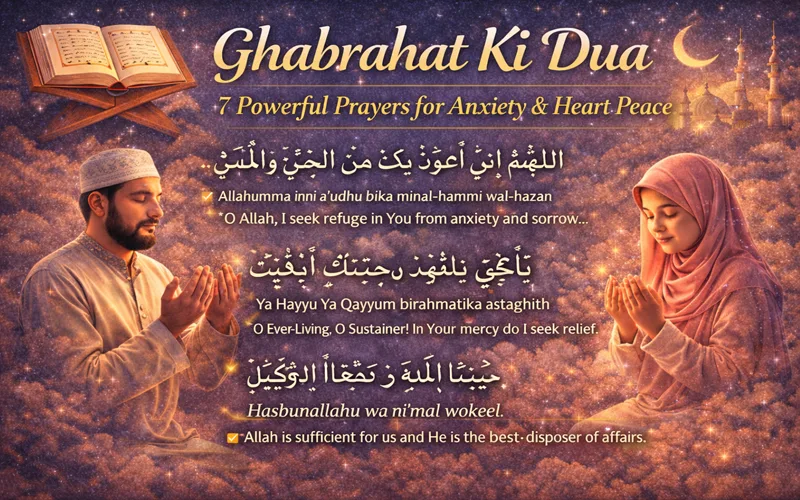
Ghabrahat ki dua refers to authentic Islamic supplications for anxiety, fear, and restlessness taught by Prophet Muhammad ﷺ. This guide provides verified prayers from Qur’an and Hadith—complete with Arabic text, transliteration, and meanings—plus actionable steps to reclaim emotional peace through faith. Skip the uncertainty; these are the exact duas Islamic scholarship confirms.
Introduction: When Your Heart Races and Faith Must Anchor You
That crushing weight on your chest at 3 AM. The spiral of “what ifs” that won’t stop. The knot in your stomach before a difficult conversation. Ghabrahat ki dua—supplications for anxiety and emotional distress—address these exact moments when your heart needs something stronger than reassurance.
Here’s what you need to know immediately: Islam doesn’t dismiss anxiety as weak faith. The Prophet ﷺ himself experienced moments of deep concern and taught specific, authenticated prayers to navigate them. These aren’t vague spiritual platitudes—they’re precise words that have steadied Muslim hearts for fourteen centuries.
The Master Supplication: Most Comprehensive Ghabrahat Ki Dua
The single most powerful and broadly applicable supplication for anxiety comes from Sahih Hadith, where the Prophet ﷺ regularly sought Allah’s protection from multiple forms of distress:
Arabic: اللَّهُمَّ إِنِّي أَعُوذُ بِكَ مِنَ الْهَمِّ وَالْحَزَنِ، وَالْعَجْزِ وَالْكَسَلِ، وَالْجُبْنِ وَالْبُخْلِ، وَضَلَعِ الدَّيْنِ وَغَلَبَةِ الرِّجَالِ
Transliteration: Allahumma inni a’udhu bika minal-hammi wal-hazani, wal-‘ajzi wal-kasali, wal-jubni wal-bukhl, wa dhala’id-dayni wa ghalabatir-rijal
Meaning: “O Allah, I seek refuge in You from anxiety and sorrow, from weakness and laziness, from cowardice and miserliness, from the burden of debt and from being overpowered by people.”
Source: Sahih al-Bukhari (6369)
Why This Dua Works on Multiple Levels
Notice how this supplication doesn’t just address emotional symptoms—it targets root causes:
Hamm (anxiety) – Future-oriented worry Hazan (sorrow) – Past-oriented grief ‘Ajz (weakness) – Physical or capability limitations Kasal (laziness) – Spiritual lethargy preventing action Jubn (cowardice) – Fear paralyzing decision-making Bukhl (miserliness) – Scarcity mindset affecting generosity Dhala’ al-dayn (debt burden) – Financial stress Ghalabat al-rijal (overpowering by people) – Social/political pressure
This covers the spectrum of pareshani ghabrahat ki dua (worry-based anxiety) and dar aur ghabrahat ki dua (fear-based distress). The Prophet ﷺ taught this regularly—meaning it’s designed for daily use, not just crisis moments.
Quranic Foundation: Where Peace Actually Comes From
Before jumping to more supplications, anchor yourself in what Allah directly reveals about anxiety:
Qur’anic Verse (Surah Ar-Ra’d 13:28): اَلَّذِينَ آمَنُوا وَتَطْمَئِنُّ قُلُوبُهُم بِذِكْرِ اللَّهِ ۗ أَلَا بِذِكْرِ اللَّهِ تَطْمَئِنُّ الْقُلُوبُ
Transliteration: Alladhina amanu wa tatma’innu qulubuhum bidhikri Allah, ala bidhikri Allahi tatma’innu al-qulub
Meaning: “Those who believe and whose hearts find peace in the remembrance of Allah—indeed, in the remembrance of Allah do hearts find rest.”
This isn’t metaphorical comfort. The Arabic word tatma’innu implies settling, stabilizing, becoming tranquil. Ghabrahat ki dua in English often translates this as “hearts find peace,” but the original carries stronger connotations of emotional anchoring.
The clinical implication: Dhikr (remembrance) isn’t escapism—it’s reorientation. When anxiety hijacks your amygdala with catastrophic thinking, Quranic recitation and supplication interrupt the spiral by redirecting focus to divine sovereignty.
Targeted Supplications for Specific Anxiety Types
1. For Acute Panic and Overwhelming Fear
When you’re in the grip of bechaini ghabrahat ki dua (restless anxiety) or panic:
Arabic: يَا حَيُّ يَا قَيُّومُ بِرَحْمَتِكَ أَسْتَغِيثُ
Transliteration: Ya Hayyu Ya Qayyum, birahmatika astaghith
Meaning: “O Ever-Living, O Sustainer of all existence, by Your Mercy I seek help.”
Source: Sunan at-Tirmidhi (3524) – authenticated as Hassan
Why it works for panic: The names Al-Hayy (Ever-Living) and Al-Qayyum (Self-Sustaining) remind you that while your emotions fluctuate wildly, Allah’s existence and control remain constant. This dua was specifically reported for moments of severe distress.
2. For Heart-Centered Anxiety (Dil Ki Ghabrahat)
When anxiety manifests as chest tightness, racing heart, or emotional heaviness—classic dil ki ghabrahat ki dua situations:
Arabic: اللَّهُمَّ مُصَرِّفَ الْقُلُوبِ صَرِّفْ قَلْبِي عَلَى طَاعَتِكَ
Transliteration: Allahumma musarrifal-qulub sarrif qalbi ‘ala ta’atik
Meaning: “O Allah, Controller of hearts, direct my heart toward Your obedience.”
Source: Sunan at-Tirmidhi (2140) – Sahih
This acknowledges what neuroscience confirms: you don’t have complete conscious control over your emotional state. But the One who created your heart’s electrical system and neurochemistry does. This supplication hands control back to the only Being who actually has it.
3. For Confusion and Mental Fog (Uljhan Ghabrahat)
When anxiety creates decision paralysis or mental confusion—uljhan ghabrahat ki dua:
Arabic: اللَّهُمَّ إِنِّي أَسْتَخِيرُكَ بِعِلْمِكَ وَأَسْتَقْدِرُكَ بِقُدْرَتِكَ
Transliteration: Allahumma inni astakhiruka bi’ilmika wa astaqdiruka biqudratik
Meaning: “O Allah, I seek Your guidance through Your knowledge and I seek ability through Your power.”
Source: Opening of Salat al-Istikhara, Sahih al-Bukhari (1162)
While the full Istikhara prayer is for decision-making, this portion addresses the cognitive aspect of anxiety—when you can’t think clearly enough to make choices. It acknowledges that Allah’s knowledge exceeds your limited, anxiety-distorted perception.
4. For Trust and Letting Go
When you need bechaini aur ghabrahat ki dua that releases control:
Arabic: حَسْبُنَا اللَّهُ وَنِعْمَ الْوَكِيلُ
Transliteration: Hasbunallahu wa ni’mal wakil
Meaning: “Allah is sufficient for us, and He is the Best Disposer of affairs.”
Source: Quran 3:173, spoken by companions facing battle
This phrase is brief but psychologically powerful. Hasbuna means “enough for us”—implying that divine sufficiency covers whatever gap your anxiety perceives. The Prophet Ibrahim’s ﷺ followers recited this when thrown into fire. Your metaphorical fires deserve the same response.
5. For Nighttime Anxiety (Neend Ghabrahat Ki Dua)
When neend ghabrahat disrupts sleep with racing thoughts:
Arabic: بِاسْمِكَ رَبِّي وَضَعْتُ جَنْبِي وَبِكَ أَرْفَعُهُ، إِنْ أَمْسَكْتَ نَفْسِي فَارْحَمْهَا وَإِنْ أَرْسَلْتَهَا فَاحْفَظْهَا بِمَا تَحْفَظُ بِهِ عِبَادَكَ الصَّالِحِينَ
Transliteration: Bismika Rabbi wada’tu janbi wa bika arfa’uh, in amsakta nafsi farhamha, wa in arsaltaha fahfazha bima tahfazu bihi ‘ibadaka as-salihin
Meaning: “In Your name, my Lord, I lie down and in Your name I rise. If You take my soul, have mercy on it, and if You send it back, protect it as You protect Your righteous servants.”
Source: Sahih al-Bukhari (6320)
Recited before sleep, this dua addresses the existential anxiety that often worsens at night—acknowledging mortality while trusting divine care. It’s clinically sound: naming your fear (“what if I don’t wake up”) and placing it in a larger context of divine mercy.
Actionable Protocol: How to Use These Supplications Effectively
Immediate Response Protocol (During Acute Anxiety)
Step 1: Interrupt the physical spiral
- Perform wudu (ablution). The cold water on your face activates the mammalian dive reflex, slowing heart rate.
Step 2: Ground yourself physically
- Sit or stand facing Qiblah if possible. Physical orientation creates mental focus.
Step 3: Recite with breath control
- Ya Hayyu Ya Qayyum, birahmatika astaghith (repeat 3-11 times)
- Match each phrase to slow, deep breathing
Step 4: Follow with the comprehensive supplication
- The full Allahumma inni a’udhu bika minal-hammi wal-hazan…
Step 5: Physical prostration (sujud)
- If able, go into sujud and repeat: Ya Rabb, Ya Rabb (O Lord, O Lord)
- This posture physiologically signals submission and reduces cortisol
Daily Prevention Protocol
Morning (within 30 minutes of Fajr):
- Recite Ayat al-Kursi (Quran 2:255)
- 3x Hasbunallahu wa ni’mal wakil
Evening (after Maghrib):
- Recite the last two verses of Surah al-Baqarah (2:285-286)
- Allahumma musarrifal-qulub sarrif qalbi ‘ala ta’atik
Before sleep:
- Full bedtime supplication protocol from Sahih al-Bukhari
- 3x Qul Huwa Allahu Ahad (Surah 112)
Critical Distinctions Most Articles Skip
When Dua Needs Professional Support
Islamic spirituality and clinical intervention aren’t competing approaches—they’re complementary. Recite ghabrahat ki dua while also:
Seeking therapy when:
- Anxiety persists for weeks despite consistent spiritual practice
- You experience panic attacks (sudden, intense fear with physical symptoms)
- Daily functioning is impaired (can’t work, maintain relationships, care for yourself)
- You have thoughts of self-harm
The Prophet ﷺ said, “Make use of medical treatment, for Allah has not made a disease without appointing a remedy for it” (Sunan Abi Dawud 3855).
Edge Case: When Anxiety Feels Like Weak Faith
Many Muslims experience secondary anxiety about their anxiety—”If I had stronger iman, I wouldn’t feel this way.” This is both theologically wrong and psychologically harmful.
The Prophet ﷺ experienced worry. The Qur’an describes him as mushfiq (anxious/concerned) for his community (9:128). Prophets felt fear—Musa ﷺ felt khifah (fear) when his staff turned into a snake (20:67).
Anxiety is a human neurological response. What matters is your response to it: turning to Allah versus turning away.
Understanding Context: Ghabrahat Ki Dua Across Languages
Ghabrahat Ki Dua in Hindi
For Hindi-speaking Muslims, the emotional vocabulary matters:
“दिल की घबराहट की दुआ” (dil ki ghabrahat ki dua) – Heart anxiety supplication “बेचैनी और घबराहट की दुआ” (bechaini aur ghabrahat ki dua) – Restlessness and anxiety prayer
The Hindi-Urdu term ghabrahat captures nuances English “anxiety” misses—it includes elements of panic, restlessness, and heart-based distress simultaneously.
Ghabrahat Ki Dua in Urdu
In Urdu devotional literature:
“دل کی گھبراہٹ کی دعا” – Supplication for heart disturbance “پریشانی اور گھبراہٹ کی دعا” – Prayer for worry and anxiety
The key advantage of understanding these terms: they help you identify which specific supplication addresses your exact emotional state.
Comparison Table: Choosing the Right Supplication
| Anxiety Type | Primary Dua | When to Use | Expected Outcome |
|---|---|---|---|
| General worry | Allahumma inni a’udhu bika minal-hammi… | Daily, preventive | Comprehensive protection |
| Acute panic | Ya Hayyu Ya Qayyum… | Crisis moments | Immediate stabilization |
| Heart-centered | Allahumma musarrifal-qulub… | Physical chest anxiety | Emotional reorientation |
| Decision paralysis | Istikhara opening | Before important choices | Mental clarity |
| Release of control | Hasbunallahu wa ni’mal wakil | When ruminating | Trust and surrender |
| Nighttime anxiety | Bedtime prophetic dua | Before sleep | Peaceful rest |
Conclusion: The Spiritual Architecture of Calm
Ghabrahat ki dua isn’t a magical anxiety eraser—it’s a reorientation tool. When your nervous system screams danger and your thoughts spiral into catastrophe, these authenticated supplications interrupt the pattern and redirect your attention to the only constant that actually exists: Allah’s sovereignty, mercy, and sustaining power.
Every time you recite Ya Hayyu Ya Qayyum, birahmatika astaghith, you’re not just making noise with your tongue. You’re training your brain to recognize that the Ever-Living, Self-Sustaining Being who controls every atom in the universe is also intimately aware of the electrical impulses causing your chest to tighten.
The Prophet ﷺ gave us these exact words because he knew—both as a Messenger and as a human who experienced worry—that we’d need them. They’ve steadied hearts through wars, plagues, personal tragedies, and the quiet 3 AM anxiety that hits when everything should be fine but feels unbearably heavy.
Start tonight. Memorize one supplication. When the next wave of bechaini aur ghabrahat hits, you’ll have prophetic words ready—not as a substitute for professional help when needed, but as the spiritual foundation upon which everything else rests.
May Allah grant you sukun (tranquility), remove your gham (sorrow), and replace your khawf (fear) with tawakkul (trust). Ameen.
Frequently Asked Questions
Q1: Is there one specific ghabrahat ki dua I should memorize first?
Start with Allahumma inni a’udhu bika minal-hammi wal-hazani… from Sahih al-Bukhari. It’s comprehensive, prophetically authenticated, and addresses multiple anxiety dimensions simultaneously.
Q2: Can I recite ghabrahat ki dua in my own language instead of Arabic?
You can make personal supplication in any language. However, the prophetic duas carry specific blessings when recited in their original Arabic form. Best practice: recite the Arabic, then add your personal requests in your language.
Q3: How many times should I recite each dua?
Prophetic tradition suggests odd numbers (3, 7, 11). However, during acute anxiety, repeat until you feel psychological settling. Quality and sincerity matter more than quantity.
Q4: What if I recite these duas but still feel anxious?
Dua changes your relationship with anxiety, not necessarily its immediate presence. It shifts your locus of control from internal rumination to divine trust. If anxiety persists severely, seek clinical support—this is islamically recommended, not a sign of weak faith.
Q5: Are there specific times when ghabrahat ki dua is more effective?
The last third of the night (before Fajr), during sujud in prayer, after obligatory salah, and on Fridays are times when supplications are especially answered. But in acute distress, make dua immediately—Allah hears at all times.
Q6: Can women recite these during menstruation?
Yes. All these supplications can be recited without wudu and during menstruation. The restriction applies to Quranic recitation and salah, not general dua and dhikr.
Q7: What’s the difference between dil ki ghabrahat and regular anxiety?
Dil ki ghabrahat specifically refers to heart-centered anxiety—manifesting as chest tightness, palpitations, or emotional heaviness in the heart region. The dua addressing the “Controller of hearts” is particularly relevant here.
Q8: Should I stop anxiety medication if I start making these duas regularly?
Never discontinue prescribed medication without consulting your physician. Spiritual practice and medical treatment work together. The Prophet ﷺ encouraged both seeking cures and having faith.
Read Also: