Last Updated: 7 April 2026
Simple Answer: When you enter your home, say “Bismillahi walajna, wa bismillahi kharajna, wa ‘ala rabbina tawakkalna” (In the name of Allah we enter, in His name we leave, and upon our Lord we rely) — this Ghar Me Dakhil Hone Ki Dua protects your home from negativity and invites Allah’s blessing into your space.
Disclaimer: This is general guidance based on authentic hadith. For any personal questions about your practice, please speak with a knowledgeable scholar.
Quick Information Table: Ghar Me Dakhil Hone Ki Dua
| Aspect | Details |
|---|---|
| Focus Keyword | Ghar me dakhil hone ki dua |
| Best Time to Recite | Right when entering your home |
| Language | Arabic (with transliteration available) |
| Authenticity Level | Sahih (authentic) – Sahih Muslim & Sunan Abu Dawood |
| Duration of Practice | Quick (5-10 seconds) |
| Number of Versions | 2 main versions (short & full) |
| Primary Benefit | Home protection & barakah (blessing) |
| Who Should Practice | Anyone entering their home regularly |
What Exactly Is Ghar Me Dakhil Hone Ki Dua & Why Should You Care?
Let me be real with you: your home is more than just four walls and a roof. It’s your sanctuary — the place where your family comes together, where you rest, where you feel safe. But what if I told you that a simple, 15-second Islamic practice could completely shift the energy of your entire home?
This Ghar Me Dakhil Hone Ki Dua is that practice.
Ghar me dakhil hone ki dua is a small but powerful supplication you recite when entering your home. Think of it like a spiritual welcome ritual. Instead of just walking in and closing the door, you’re consciously inviting Allah’s protection, blessings, and peace into your space.
The beautiful part? It’s not complicated, it’s not time-consuming, and it’s deeply rooted in Islamic teachings. But here’s the thing — most people either don’t know about it, or they know about it but don’t understand why it actually matters.

The Authentic Arabic Ghar Me Dakhil Hone Ki Dua (Both Versions Explained)
Here’s where we separate the real deal from the copied-and-pasted versions floating around the internet.
Short Version (Most Commonly Recited)
Arabic:
بِسْمِ اللَّهِ وَلَجْنَا وَبِسْمِ اللَّهِ خَرَجْنَا وَعَلَى اللَّهِ رَبِّنَا تَوَكَّلْنَا
Transliteration:
Bismillahi walajna, wa bismillahi kharajna, wa ‘ala rabbina tawakkalna
Translation:
“In the name of Allah we enter, in the name of Allah we leave, and upon our Lord we rely.”
Full Version (Extended – Stronger Narration)
Arabic:
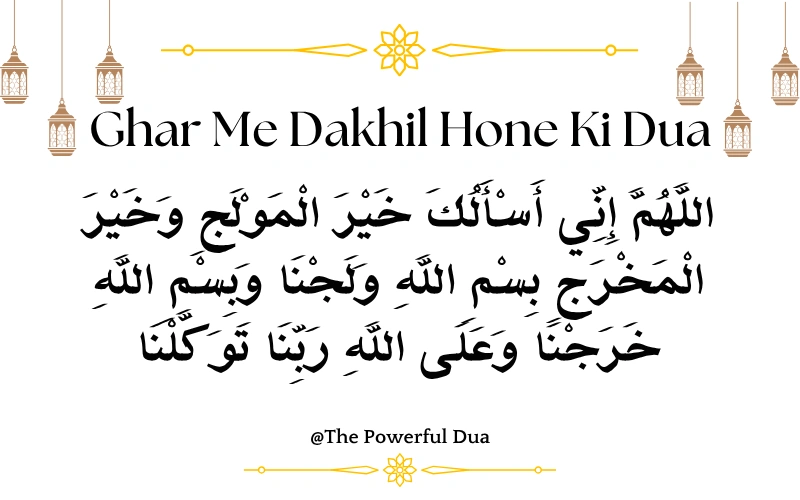
اللَّهُمَّ إِنِّي أَسْأَلُكَ خَيْرَ الْمَوْلَجِ وَخَيْرَ الْمَخْرَجِ بِسْمِ اللَّهِ وَلَجْنَا وَبِسْمِ اللَّهِ خَرَجْنَا وَعَلَى اللَّهِ رَبِّنَا تَوَكَّلْنَا
Translation:
“O Allah, I ask You for the goodness of entry and the goodness of exit. In the name of Allah we enter, in the name of Allah we leave, and upon our Lord we rely.”
The Hadith Evidence: Why This Actually Works
You might be wondering: “Okay, but is this just some spiritual suggestion, or is there actual evidence?”
Great question. The evidence is strong — and it comes from the most authentic Islamic sources.
Hadith 1: Shaytan’s Reaction (Sahih Muslim 2018)
There’s a hadith recorded in Sahih Muslim that explains what happens when you properly enter your home with Ghar Me Dakhil Hone Ki Dua:
When you enter your home and remember Allah while eating, Shaytan (Satan) says to his companions: “There is no meal for you and no place to stay here.”
This isn’t just poetic language. What it’s really saying is: When you consciously bring Allah’s remembrance into your home, negativity leaves. Shaytan represents everything destructive — anger, gossip, wastefulness, conflict. When you establish the habit of remembering Allah as you enter, you’re literally blocking that negativity from settling in.
Hadith 2: The Complete Sunnah (Sunan Abu Dawood 5095/5096)
Sunan Abu Dawood gives us the full picture of how to enter a home properly:
- Recite the dua
- Greet your family (say Assalamu Alaikum)
- Sit down
Notice the sequence here. It’s not random. You enter, you remember Allah, and then you engage with your family. This creates a completely different atmosphere than just walking in and immediately diving into your phone or turning on the TV.
The Three-Step Sequence That Most People Get Wrong
Here’s where 90% of people mess up: they know the Ghar Me Dakhil Hone Ki Dua, but they don’t understand the complete sequence.
| Step | Action | Why It Matters |
|---|---|---|
| Step 1 | Say “Bismillah” as you cross the threshold | Marks the moment you’re entering with Allah’s name |
| Step 2 | Recite the full Ghar Me Dakhil Hone Ki Dua (or short version if in a rush) | Invites protection and blessing into the space |
| Step 3 | Say “Assalamu Alaikum” (greet your family/home) | Establishes peace and connection immediately |
This sequence works together. One without the other is incomplete.
Think about it like this: saying Bismillah is you announcing your intention. The Ghar Me Dakhil Hone Ki Dua is you asking for Allah’s help. The Salam is you establishing peace. Together, they create a ritual that transforms a simple door-entry into a spiritual moment.
What Happens in Your Home When You Start This Practice?
Okay, let’s get practical. What actually changes when you make this a daily habit?
1. Shaytan’s Influence Decreases
This sounds dramatic, but it’s the foundation of the teaching. When Shaytan can’t settle into a space, fights become less frequent, negativity loses its grip, and family relationships naturally become more peaceful.
Real-life example: A mother who started this practice noticed her kids stopped bickering as much within a week. Why? Not because anything magically changed, but because she was entering with a calm, intentional mindset instead of stress and frustration.
2. Barakah (Blessing) Increases
Barakah is an Islamic concept that means increase, growth, and blessedness. When you invite Allah’s remembrance, blessings naturally multiply — your food feels more nourishing, your family time feels more meaningful, and your home feels like an actual sanctuary.
3. Mindfulness Becomes Automatic
Every time you enter, you’re hitting a mental “reset button.” Instead of carrying the stress of the day right into your home, you’re pausing, remembering Allah, and recalibrating your mindset.
4. Your Family Notices the Shift
When they see you doing this consistently, even without you saying anything, they start to feel the difference in the home’s atmosphere. Kids especially pick up on intentionality.

The Real-Life Scenarios: When Do You Actually Say This?
Let me give you the situations where this Ghar Me Dakhil Hone Ki Dua fits naturally into your life:
Scenario 1: Entering Your Home Normally
You come back from work, school, or running errands. You reach your door, insert the key, and as you step inside, you quietly recite the Ghar Me Dakhil Hone Ki Dua. This is the standard practice.
Tip: You don’t need to announce it loudly. A quiet, sincere recitation is perfect.
Scenario 2: Entering Late at Night
Entering an empty, quiet home at night can feel a bit eerie sometimes. This Ghar Me Dakhil Hone Ki Dua is especially powerful here because it fills the space with remembrance instead of silence or negative thoughts.
Tip: Say it even more mindfully at night. Let it be your anchor.
Scenario 3: Entering After Long Travel
Coming back home after days or weeks away? This Ghar Me Dakhil Hone Ki Dua helps you re-establish your spiritual connection to your space.
Tip: Make this a moment of gratitude — thank Allah for bringing you home safely.
Scenario 4: Entering an Empty Home
If you’re the first one home, the house is quiet and might feel lonely. This Ghar Me Dakhil Hone Ki Dua transforms that quiet into peace.
Tip: Follow it up with Assalamu Alaikum anyway — you’re greeting your home and the angels in it.
Scenario 5: Entering in a Bad Mood
You’ve had a terrible day. You’re angry, frustrated, or sad. As you enter, recite this Ghar Me Dakhil Hone Ki Dua with intention. Let it be your reset.
Tip: This is where the practice shines. The Ghar Me Dakhil Hone Ki Dua becomes your healing ritual.
Common Mistakes People Make (And How to Fix Them)
Mistake 1: Saying It Without Understanding
The Problem: Just reciting transliteration mechanically without connecting to the meaning.
The Fix: Understand what you’re saying. You’re not just producing sounds — you’re inviting protection and blessing.
Mistake 2: Forgetting to Say Salam
The Problem: Reciting the dua but skipping the greeting.
The Fix: The Salam (greeting) is part of the Sunnah. Greet your family, even if no one’s home. Say it to the angels in your home.
Mistake 3: Only Entering Through One Door
The Problem: You have a front door and a garage entrance but only say the dua at the front.
The Fix: Recite it whenever you’re entering your home — from any entrance. Consistency matters more than which door you use.
Mistake 4: Treating It Like Superstition
The Problem: Believing it’s magical, or feeling like you’ve failed if something bad still happens.
The Fix: This is a Sunnah practice, not a spell. It’s about building a habit of remembrance and inviting Allah’s blessings. Life will still have challenges, but your mental and spiritual approach will be stronger.
Mistake 5: Rushing Through It
The Problem: Mumbling it quickly without presence.
The Fix: Even 5 seconds of mindful recitation is better than 30 seconds of mechanical repetition. Slow down.
How Ghar Me Dakhil Hone Ki Dua Compares to Other Daily Duas
Let me show you how this fits into the bigger picture of daily Islamic practice:
| Dua | When | Purpose | Length |
|---|---|---|---|
| Ghar Me Dakhil Hone Ki Dua | Entering home | Protection & blessing for the space | 15 seconds |
| Ghar Se Nikalne Ki Dua | Leaving home | Safe journey & protection outside | 15 seconds |
| Eating Dua (Bismillah) | Before eating | Gratitude & blessings in food | 5 seconds |
| Sleeping Dua | Before sleep | Peaceful sleep & spiritual protection | 30 seconds |
These four practices together create a complete daily spiritual ecosystem. You’re bracketing your day with remembrance — from the moment you leave home, to when you enter, to what you eat, to how you sleep.
The Spiritual Psychology: Why This Actually Changes Your Brain
Here’s something interesting that nobody talks about: Ghar Me Dakhil Hone Ki Dua isn’t just spiritual; it’s psychological.
How It Works:
Trigger: You reach your front door.
Action: You recite the dua (about 10-15 seconds).
Reward: You feel calmer, more centered, and more intentional.
This is a habit loop. Over time, your brain associates entering your home with calm and mindfulness instead of the stress of the outside world.
The Science Angle: Neuroscience shows us that when you perform a repetitive, meaningful action (reciting), your brain shifts from the “task-oriented” mode (dealing with traffic, deadlines, arguments) to the “default mode” (reflection, calm, presence). The Ghar Me Dakhil Hone Ki Dua essentially kickstarts this shift.
What Really Happens:
- Your nervous system calms down
- Your mind stops running through the day’s problems
- You become present with your family
- Your family picks up on your calm energy
- The home atmosphere shifts
This is why Shaytan “leaves” — not because of magic, but because negativity thrives in chaos and distraction. When you’re calm and present, there’s no space for it.
A Comparison: Short Dua vs. Full Dua — Which One Should You Use?
This is a practical question that doesn’t get answered clearly.
| Aspect | Short Version | Full Version |
|---|---|---|
| Time Required | 10 seconds | 20 seconds |
| Authenticity | Fully authentic | More detailed, also authentic |
| Best For | Daily, rushed mornings, quick entries | Special occasions, after travel, intentional moments |
| Ease of Memorization | Very easy (most people know it) | Requires practice |
| Impact | Strong and sufficient | Slightly more comprehensive |
| Recommendation | Use this for everyday practice | Use this when you want extra intentionality |
My suggestion? Use the short version daily for consistency. When you have time or want to be extra mindful (like after travel or during Ramadan), use the full version.
Building This Into Your Daily Routine: The 30-Day Challenge
Want to make this stick? Here’s a simple 30-day approach:
Week 1: Awareness Just notice when you’re entering your home. Don’t force anything. Just get conscious of the moment.
Week 2: Learning Memorize the short version. Spend a few minutes understanding the meaning.
Week 3: Practice Say it every time you enter, even if it feels awkward. Your family might notice, and that’s okay.
Week 4: Integration By now, it should feel natural. You’re not forcing it; it’s becoming your ritual.
Beyond 30 Days: This becomes automatic. You’ll notice you feel different entering your home without the Ghar Me Dakhil Hone Ki Dua — like something’s missing. That’s when you know it’s stuck.
FAQ: Your Real Questions Answered About Ghar Me Dakhil Hone Ki Dua
Q1: What if I forget to say the dua when entering?
A: Don’t stress. Say it anyway, even if you’re already inside. There’s no “rule” that it only works at the exact threshold. The intention and remembrance matter more than the timing.
Q2: Can I say this dua in English or Hinglish, or does it have to be in Arabic?
A: Ideally, try to say it in Arabic to follow the Sunnah exactly. But if you’re learning, reciting the transliteration with understanding is 100% valid. Once you’ve memorized it, aim for Arabic.
Q3: Do I need to say Assalamu Alaikum if I’m alone in the house?
A: Yes. Even if no one’s home, you’re greeting the angels in your home (according to Islamic belief). It’s about establishing peace in the space.
Q4: What if I live in a hostel or shared apartment? Do I still say the dua?
A: Absolutely. You can recite it quietly in your own room when you enter. Your section of the space is still your personal sanctuary.
Q5: Is there a specific dua for entering a new home for the first time?
A: The same dua works, but many people also add the longer version. If you’re moving into a new home, you might want to recite the full version the first few times with extra intentionality. Some people also perform a full prayer or Quran recitation in a new home, but the dua itself is the core practice.
Q6: My family thinks I’m weird for saying this. How do I handle that?
A: Start quietly. Live the benefits. Within a week or two, they’ll notice the shift in home atmosphere and your own calm energy. That speaks louder than any explanation. Plus, when you do it consistently and peacefully, it becomes part of the family rhythm naturally.
The Bottom Line: Why Ghar Me Dakhil Hone Ki Dua Matters
Let me wrap this up clearly:
Ghar me dakhil hone ki dua is a 15-second practice that:
- Has authentic Islamic backing (Sahih Muslim, Abu Dawood)
- Protects your home from negativity (spiritual and psychological)
- Builds a habit of mindfulness
- Creates family peace
- Invites barakah (blessing) into your space
- Costs nothing
- Takes almost no time
In a world where we’re stressed, distracted, and moving too fast, this Ghar Me Dakhil Hone Ki Dua is your home’s reset button. It’s your permission to pause, remember what matters, and shift into presence.
Start today. Just walk in, recite it with meaning, and notice the difference. It won’t take long.
Next Steps to Explore
Once you’ve established this practice, you might want to:
- Learn the ghar se nikalne ki dua (dua for leaving home)
- Establish other daily duas for eating, sleeping, and traveling
- Teach your family the practice (especially kids)
- Recite it with extra intention during Ramadan
Thank you for reading! This article builds on Islamic teachings and practical lifestyle integration. For your next deep dive, explore our guide on –
Also Read –
Ghar Se Bahar Nikalne Ki Dua: Authentic Islamic Guide for Daily Practice
Bukhar Utarne Ki Dua: The Islamic Prayer to Reduce Fever – Complete Guide (2026)
Bechaini Ki Dua: 7 Powerful Prayers to Calm Your Heart Instantly
Masjid Se Nikalne Ki Dua – संपूर्ण हिंदी गाइड और अरबी टेक्स्ट
For more Islamic guidance and spiritual insights, check out “Islamic Dua Hub”
Author Bio
Written by Abdul | SEO Content Specialist & Islamic Lifestyle Writer
I create simple, authentic Islamic content that answers real questions people ask. With a focus on verified hadith sources and practical application, my articles bridge the gap between religious teachings and everyday life. When I’m not writing, you’ll find me exploring how ancient Islamic wisdom applies to modern challenges.