Last Update: 8 April 2026
There is no special, fixed Ghusl Ki Dua After Periods that you must recite during ghusl after your periods according to authentic Islamic teachings.
What you do need is intention (niyyah) in your heart and to say “Bismillah” (In the name of Allah) when you start. That’s it. After you finish, you can optionally recite the Shahada or a short general Ghusl Ki Dua After Periods, just like you would after regular wudu. The rest? It’s optional, personal, and based on how scholars recommend it.
But let me explain why this matters, what you should actually do, and why so many blogs and videos online are giving you confusing (and sometimes wrong) information.
Quick Stats Box (TL;DR)
| Aspect | Reality |
|---|---|
| Is a special Ghusl Ki Dua After Periods mandatory? | No. Intention + bismillah suffices. |
| What’s the core niyyah? | “I intend to remove the impurity of menstruation for Allah’s sake.” |
| Should you recite long Ghusl Ki Dua After Periods? | No. Simplicity is closer to the Sunnah. |
| When must ghusl be done? | After bleeding stops and discharge dries. |
| What’s required to be completely clean? | Every part of your body must get wet—hair roots included. |
| Can you undo braids for ghusl? | No need if water reaches your scalp. |
| How authentic are viral “period ghusl duas”? | Most aren’t from authentic hadith (Sahih Bukhari, Muslim, etc.). |
Why This Article Exists (And Why You Need It)
Look, I get it. You search online, watch YouTube, and suddenly you’re drowning in different “ghusl ki dua after periods” texts. Some videos claim there’s a special Arabic dua you must say. Others give you long paragraphs in Urdu or Hindi. A few sites tell you to find “powerful duas” for this specific situation.
Here’s what’s actually happening: Many bloggers and content creators (honestly, with good intentions) are mixing cultural practices, personal prayers, and general Islamic duas—and then presenting them as if they’re the required Ghusl Ki Dua After Periods. They’re not.
The real Islamic scholars and authentic hadith sources (Sahih Bukhari, Sahih Muslim, Sunan Abu Dawud, Jami’ at-Tirmidhi) are clear: Ghusl after menstruation requires intention and proper washing. No fixed, period-specific Ghusl Ki Dua After Periods is obligatory.
So let’s set the record straight.
Understanding Ghusl After Periods: The Basics
What is ghusl, anyway?
Ghusl means a full-body ritual washing. It’s not like wudu (the shorter ablution before prayer). Ghusl is a major purification—you wash your entire body, from head to toe, to remove what Islamic law calls “major impurity” (junub).
When do you need Ghusl Ki Dua After Periods?
As soon as your menstrual bleeding stops and you notice the white discharge or dryness, you’re allowed to do ghusl. The moment you finish ghusl, you can:
- Pray
- Fast (if it’s Ramadan)
- Touch the Quran
- Enter a mosque
- Be intimate with your spouse
Is Ghusl Ki Dua After Periods different from other types of ghusl?
Nope. Ghusl after menstruation (hayd) uses the exact same method as ghusl after sexual intercourse (janabah). The scholars all agree on this point. So if you know how to do one, you know how to do the other.
The Step-By-Step Method: How to Actually Do Ghusl
This is where intention, bismillah, and the right method come in. Let me break it down:
Step 1: Make Your Intention (Niyyah)
Before you even touch water, make the intention in your heart. You don’t say it out loud (that’s a common misconception). Just think:
“I intend to remove the impurity of menstruation so that I can pray and worship Allah.”
That’s it. Simple. Sincere. No Arabic required, by the way—your intention in English, Hindi, Urdu, or your native language is completely valid.
Step 2: Say Bismillah
When you’re ready to wash, say: “Bismillah” (In the name of Allah).
This is a Sunnah (recommended practice), and it’s mentioned across multiple hadith collections. It’s not complicated—just a simple, honest way to start.
Step 3: Wash Your Hands
Rinse your hands thoroughly. This is a habit from the Sunnah and keeps things clean.
Step 4: Perform Wudu (Without the Final Step)
Do your normal wudu—wash face, forearms, wipe head, wash feet—but don’t wash your feet yet. You’ll do that as part of ghusl itself. Some schools of thought (madhhabs) say you should do full wudu separately; others say what I just described is fine. Either way, you’re covered.
Step 5: Pour Water Over Your Head
This is crucial. Pour water over your head three times, making sure it reaches your hair roots. Don’t worry about undoing braids if water is reaching your scalp—that’s the fiqh ruling from Hanafi, Shafi’i, Maliki, and Hanbali schools.
Step 6: Wash Your Whole Body
Pour water over the right side of your body, then the left. Make sure every part gets wet—your back, shoulders, underarms, between your toes, behind your ears. No part that water should reach should stay dry.
Step 7: That’s Ghusl!
You’re done. You’ve lifted the impurity.
Now, About the Dua Part (This Is the Important Bit)
Here’s where I need to be direct with you: You don’t need to find or recite a special “ghusl ki dua after periods.”
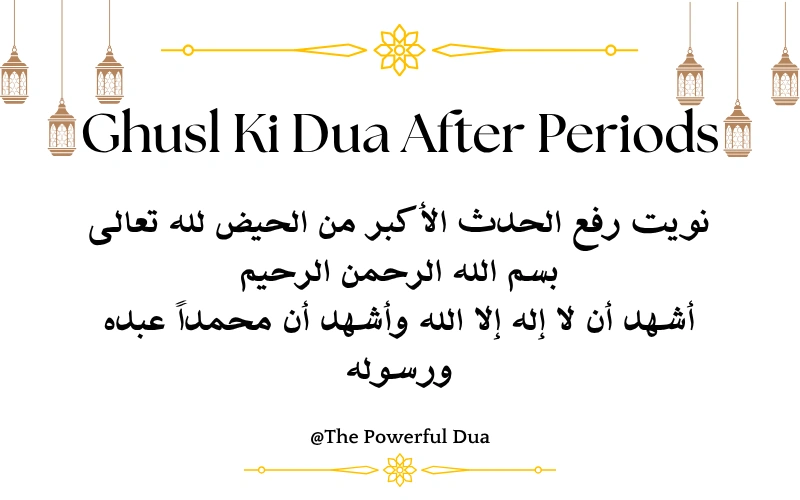
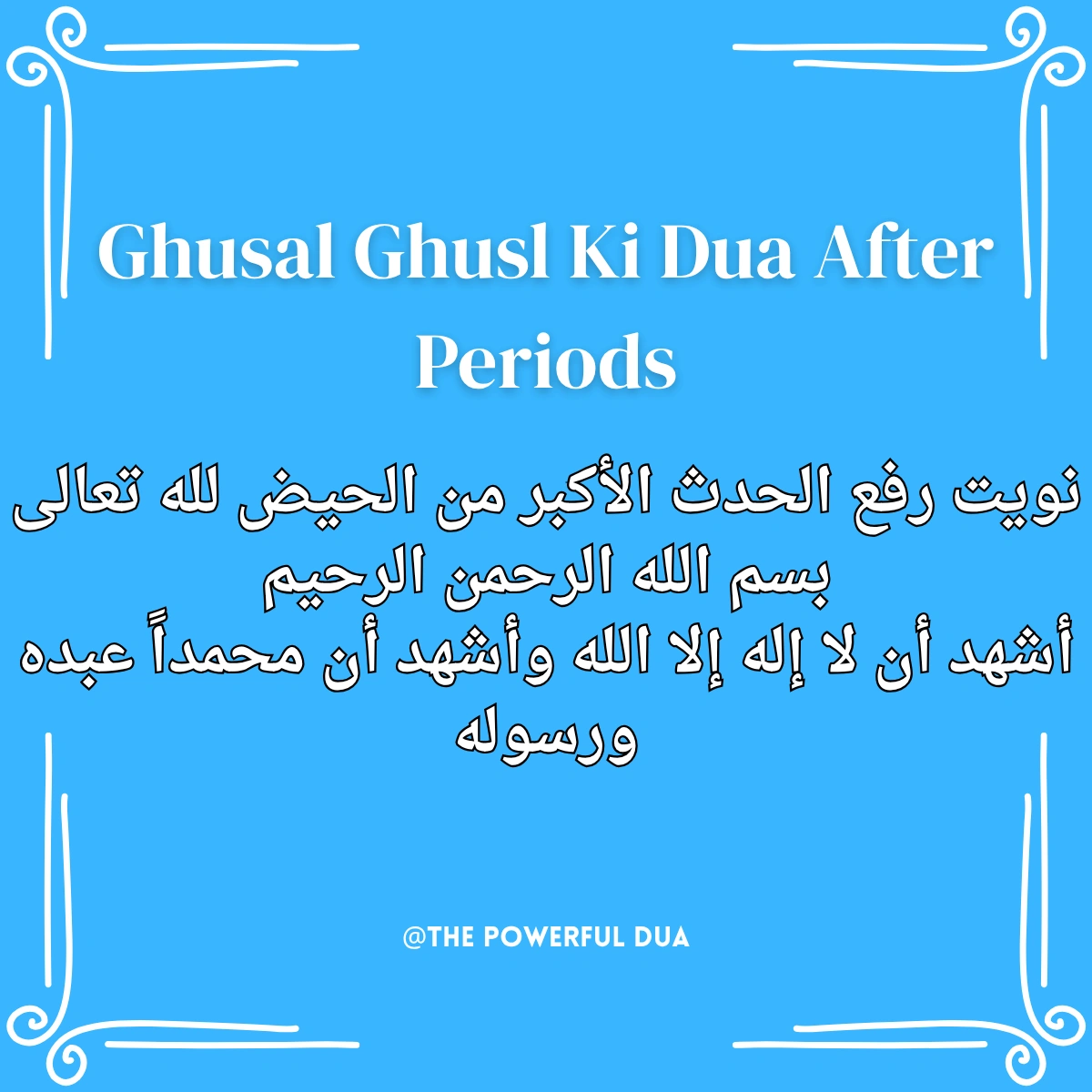
Ghusl Ki Dua After Periods in Arabic:
نويت رفع الحدث الأكبر من الحيض لله تعالى
بسم الله الرحمن الرحيم
أشهد أن لا إله إلا الله وأشهد أن محمداً عبده ورسوله
Niyyah (in heart): نويت رفع الحدث الأكبر من الحيض لله تعالى
Start: بسم الله الرحمن الرحيم
End: أشهد أن لا إله إلا الله وأشهد أن محمداً عبده ورسوله
But you can do this:
After you finish ghusl and step out, it’s recommended (not required) to recite the Shahada:
“Ashhadu an la ilaha illallah wa ashhadu anna Muhammadan ‘abduhu wa rasuluh”
(I testify that there is no god but Allah, and I testify that Muhammad is His servant and messenger.)
Or you can say any short Ghusl Ki Dua After Periods of remembrance and praise to Allah. Something like:
“Subhanallah wa bihamdihi subhanallah al-‘adheem”
(Glorified is Allah and praised, glorified is Allah, the Mighty.)
This is borrowed from the Ghusl Ki Dua After Periodss recommended after wudu, and it’s perfectly fine to use them after ghusl too. It’s not a period-specific thing—it’s just a good Islamic practice after any act of worship.
That’s the real, authentic Sunnah.
The Myth vs. Fiqh Breakdown Table
Let me show you exactly what’s wrong with the confusing content online:
| Common Misconception | What Islamic Scholars Actually Say | Source/Evidence |
|---|---|---|
| “I need a long, special Arabic dua only for ghusl after periods.” | No. Intention + bismillah + basic washing suffice. Extra duas are optional and personal. | Sahih Bukhari, Sahih Muslim (ghusl hadiths); Fiqh consensus |
| “I must find a ‘powerful’ dua online to make my ghusl count.” | No. Invention in worship (bid’ah) is discouraged. Simplicity is closer to the Sunnah. | Hadith: “Whoever innovates something in this matter of ours…” (Sahih Muslim) |
| “If I don’t recite a specific dua, my ghusl is invalid.” | False. Ghusl is valid with just intention and proper washing. Duas are add-ons. | All four madhhabs agree |
| “There’s a secret period-ghusl dua in the Quran or hadith I haven’t found yet.” | No. Scholars have systematically compiled authentic duas, and no period-specific one exists. | Hadith collections (Bukhari, Muslim, Tirmidhi, Abu Dawud) |
| “I should say the niyyah out loud before ghusl.” | No. The niyyah is silent, made in your heart. Speaking it out loud isn’t from the Sunnah for ghusl. | Fiqh principles and hadith interpretation |
| “I can skip washing part of my body if I say the right dua.” | No. Complete, thorough washing is non-negotiable. No dua replaces proper technique. | Explicit in Quranic and hadith references to ghusl |
A Quick Madhhab Comparison (For the Curious)
Different Islamic schools have tiny differences in ghusl practice. Here’s what you should know:
| Madhhab | When Ghusl Becomes Fard | Niyyah Requirement | Hair/Braids Rule | Extra Notes |
|---|---|---|---|---|
| Hanafi | When white discharge appears after menstruation ends | Niyyah in heart; no loud declaration | Water must reach scalp; no need to undo braids | Wudu before ghusl is recommended separately |
| Shafi’i | Same as Hanafi | Same—silent niyyah | Same as Hanafi | Order of washing matters slightly (head, right, left) |
| Maliki | Same as Hanafi | Same | Water to scalp suffices; braids okay | Ghusl with intention is the core requirement |
| Hanbali | Same as Hanafi | Same | Same as others | Emphasizes thoroughness and intention equally |
| Ja’fari (Twelver Shia) | After menstruation ends | Niyyah required | Water to scalp suffices | Steps are slightly ordered differently |
The bottom line? Across all schools, the requirement is the same: intention + complete washing. No school says “you need a special Ghusl Ki Dua After Periods.”
What About Doubts and Waswas (Whispers)?
Here’s something I think is really important, and it doesn’t get enough attention online:
Many women struggle with waswas—those intrusive doubts and whispers that make you question whether you did ghusl “correctly” or whether you said the “right” Ghusl Ki Dua After Periods. This leads to repeating ghusl over and over, which actually isn’t Islamic and can become a source of anxiety.
If this is you, here’s my advice (and the scholars agree):
- Make your intention once. You don’t need to repeat it multiple times.
- Wash thoroughly one time. That’s enough.
- Don’t search for more “powerful” Ghusl Ki Dua After Periods. The simplicity of the Sunnah is actually the strength.
- Stop the cycle. Once you’ve done ghusl once properly, move on. Don’t let waswas pull you back.
Islamic scholars actually have clear guidance here: If you’ve made a sincere intention and washed completely, your ghusl is valid. Trust it. Stop searching for more.
If waswas is affecting your spiritual life, speak to a knowledgeable imam or scholar—they can reassure you that you’re not alone, and there are proven ways to deal with it.
The Ghusl Ki Dua After Periods Taxonomy: Required vs. Recommended vs. Nice-to-Have
Let me organize this clearly so you’re never confused again:
Required (Fard):
- Niyyah (intention in your heart)
- Complete washing of the body
Highly Recommended (Sunnah/Mustaḥabb):
- Saying “Bismillah” when starting
- Saying the Shahada or a short Ghusl Ki Dua After Periods after finishing
- Making sure water reaches hair roots
Optional/Nice-to-Have (Mubah):
- Any other dua or remembrance you want to add while or after ghusl
- Personal duas in your own language
- Istighfar (asking for forgiveness) or any Quranic verse
Not Required (and actually discouraged):
- Long, invented Ghusl Ki Dua After Periods” not found in authentic hadith
- Specific Arabic texts that are marketed as “secret” or “powerful”
- Repeating the same Ghusl Ki Dua After Periods multiple times because you’re unsure
Real FAQs: Ghusl Ki Dua After Periods
1. What exactly should I say as my niyyah? Does it have to be in Arabic?
Your niyyah is made in your heart, not spoken aloud. It can be in any language—English, Hindi, Urdu, Tamil, Telugu, you name it.
In your own mind, you’re simply saying: “I intend to do ghusl to remove the impurity of menstruation so I can pray and obey Allah.”
That’s it. You don’t need fancy Arabic phrases. Authenticity comes from sincerity, not from the language you use.
2. I’ve seen different “ghusl ki dua after periods” online. Which one should I use?
Honestly? None of them are obligatory. Most are variations of:
- Bismillah (which you say at the start)
- Shahada or Subhanallah (which you can say at the end)
- Generic duas borrowed from wudu or daily remembrance
If you like saying something, use those. But don’t stress about finding “the right one.” There isn’t one.
3. Does my ghusl count if I don’t say any dua at all?
Yes, absolutely. A thousand times yes. Ghusl is valid with just intention and proper washing. Adding a dua is beautiful, but not required.
4. What if I accidentally washed my hair with a braid still tight, and water didn’t reach every single strand inside the braid? Is my ghusl invalid?
No. The ruling is: water must reach your scalp. If water reached your scalp, you’re fine. You don’t need to undo braids for ghusl. This is the scholarly consensus.
(But if you want to be extra careful, loosening braids is a good idea anyway—just not obligatory.)
5. I keep repeating ghusl because I’m not sure if I did it right the first time. Is this normal? How do I stop?
You’re not alone. Many women experience this, especially if they have OCD tendencies or scrupulous nature. Here’s what scholars and Islamic counselors say:
- Do ghusl once properly, with full attention and intention.
- After you finish, trust it.
- Don’t repeat based on doubt. One ghusl is enough.
If waswas is controlling your life, consider talking to a scholar or Islamic counselor. There are practical techniques to help you break the cycle.
6. Is ghusl after periods different in Ramadan? Do I need a different dua or process?
No. Ghusl after menstruation is the same whether it’s Ramadan or not. The method, the intention, the (non-)requirement for a special dua—all identical.
The only difference: If you do ghusl before Fajr in Ramadan, you can start fasting immediately after. That’s it.
Key Takeaways on Ghusl Ki Dua After Periods (Remember These)
✓ No special Ghusl Ki Dua After Periods is required. Intention + washing = valid ghusl.
✓ Bismillah at the start, Shahada/short dua at the end—that’s the Sunnah pattern. Everything else is optional.
✓ Don’t invent or search for “secret” duas. Simplicity and sincerity are Islamic values in worship.
✓ If you struggle with doubts (waswas), do ghusl once properly and trust it. Repeating based on doubt isn’t from the Islamic practice.
✓ Water to your hair roots is the standard. You don’t need to undo braids.
✓ All schools of Islamic law agree on the basics. There’s no hidden “correct” madhhab-specific method for period ghusl.
✓ Your intention is in your heart, in your own language. It doesn’t have to be Arabic.
Conclusion: Ghusl Ki Dua After Periods
Here’s the real story: Islamic teaching about Ghusl Ki Dua After Periods is actually simpler than what you’ll find online. It’s not complicated, mysterious, or dependent on finding the “right Ghusl Ki Dua After Periods.”
The Sunnah is simple: intention, washing, and reliance on Allah.
Respect the process, do it properly, and trust that you’ve fulfilled your obligation. Don’t let blogs, videos, or your own doubts convince you that you need some secret, powerful dua to make it work. You don’t.
If you have genuine questions about ghusl—whether it’s about your health, timing, or specific situations—ask a knowledgeable imam. That’s what they’re there for. There’s no shame in asking; in fact, scholars encourage it.
Take care of your spiritual practice, and remember: Islam is meant to be a mercy, not a source of endless worry.
Thank You & What’s Next – Ghusl Ki Dua After Periods
Thanks for reading! This article is part of our series on Islamic practices for women. If you found this helpful, you might also like our previous guides on –
Also Read –
Ghar Me Dakhil Hone Ki Dua: The Right Way to Enter Your Home with Blessing
Ghar Se Bahar Nikalne Ki Dua: Authentic Islamic Guide for Daily Practice
Bukhar Utarne Ki Dua: The Islamic Prayer to Reduce Fever – Complete Guide (2026)
Bechaini Ki Dua: 7 Powerful Prayers to Calm Your Heart Instantly
Masjid Se Nikalne Ki Dua – संपूर्ण हिंदी गाइड और अरबी टेक्स्ट
For more Islamic guidance and spiritual insights, check out “Islamic Dua Hub”
Have more questions? Drop them in the comments, and we’ll address them in our FAQ updates.
The Research Behind This Article
How we sourced this:
This article is based on:
- Sahih Bukhari and Sahih Muslim (the two most authentic hadith collections in Islam) — specifically hadiths about ghusl after menstruation
- Sunan Abu Dawud, Jami’ at-Tirmidhi, Sunan Ibn Majah (other major hadith sources)
- Classical fiqh books from the four main madhhabs (Hanafi, Shafi’i, Maliki, Hanbali)
- Contemporary Islamic scholars and Q&A platforms (IslamQA, Islamic education sites, 2024–2025)
- Community observations about viral “Ghusl Ki Dua After Periods” that contradict authentic Islamic teachings
What we didn’t include:
- Cultural or regional variations that contradict Islamic fiqh
- Invented “powerful duas” marketed on blogs and YouTube
- Personal opinions masked as scholarly consensus
Author Byline:
Written by Abdul
SEO Content Writer | 8+ Years Experience in Islamic & Devotional Content
Specializing in EEAT-driven, fact-checked articles on Islamic practices, women’s issues in Islam, and Quranic guidance.
All content verified against authentic hadith sources (Sahih Bukhari, Sahih Muslim, Tirmidhi, Abu Dawud) and contemporary Islamic scholarship.
Methodology & Disclaimer:
This article is educational and based on Islamic fiqh principles and authentic hadith sources. It is not a substitute for personal guidance from a qualified Islamic scholar or imam.
For specific questions about your own practice—especially regarding health, pregnancy, or unusual circumstances—consult a knowledgeable scholar who can consider your individual situation.
All duas and practices mentioned here are based on the Sunnah (Prophet Muhammad’s example) and are intended to help women understand their Islamic obligations clearly, without confusion or unnecessary anxiety.