Last Update: 11 April 2026
The One-Line Answer
Qabar par mitti dalne ki dua is a Sunnah prayer—recommended, not obligatory—that you recite three times while gently filling soil on a grave, connecting the Islamic belief that humans are created from earth and will return to it on the Day of Judgment.
Disclaimer: This article provides educational information on Islamic practices and beliefs. For personal guidance on funeral rites or religious practices, consult with your local imam or Islamic scholar. Religious practices may vary slightly by region and school of Islamic jurisprudence, and individual circumstances may require personalized guidance.
Quick Summary Box (TL;DR): Qabar Par Mitti Dalne Ki Dua
| Aspect | Details |
|---|---|
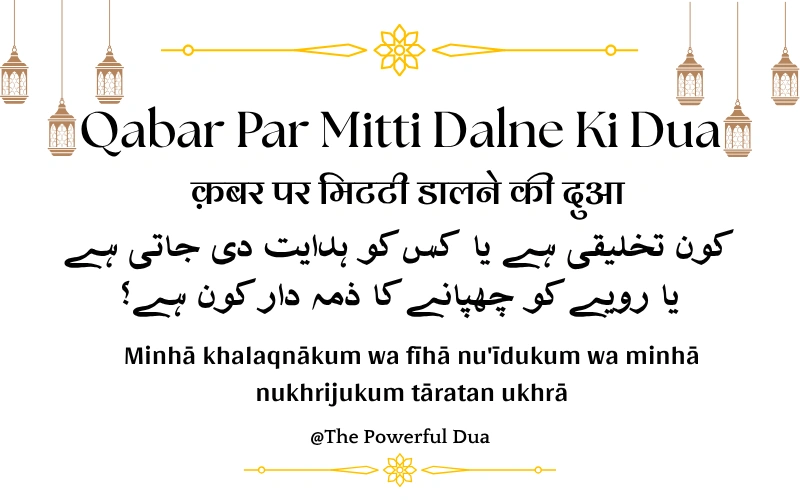
| Qabar Par Mitti Dalne Ki Dua in Arabic | Minhā khalaqnākum wa fīhā nu’īdukum wa minhā nukhrijukum tāratan ukhrā |
| Total Recitations | 3 times (one handful each) |
| When to Recite | After sealing the grave’s lahd (niche), while throwing soil |
| Status | Mustahabb (recommended, based on Sunnah) |
| Quranic Source | Surah Taha 20:55 |
| Best Hands | Both hands together for each handful |
| Emotional Purpose | Reminder of life cycle, return to earth, and resurrection |
Understanding Qabar Par Mitti Dalne Ki Dua—What It Really Means
Let me break this down in the simplest way possible.
Imagine you’re standing at the graveside, and the moment comes to fill the grave with soil. This isn’t just a physical act—it’s a spiritual moment. Muslims recite a dua (prayer) during this act, taken directly from the Quran, that reminds everyone present of a profound truth: humans come from earth, and to earth we return.
Qabar Par Mitti Dalne Ki Dua itself has three parts, matching three handfuls of soil. Each handful corresponds to a phrase from Surah Taha (Chapter 20, Verse 55), where Allah describes the cycle of creation and resurrection.
Think of it like this: the first handful says, “From earth, we were created.” The second says, “Into earth, we return.” The third says, “From earth again, we’ll be brought out on Judgment Day.” It’s a complete circle—birth, death, and resurrection—all reminded in three lines.
The Qabar Par Mitti Dalne Ki Dua Text: Arabic, Transliteration & Meaning
Here’s what you’ll recite, broken down clearly:
The Full Arabic Text (One Line)
Minhā khalaqnākum wa fīhā nu’īdukum wa minhā nukhrijukum tāratan ukhrā
The Three-Part Breakdown
Part 1 (First Handful):
- Arabic: Minhū khalaqnākum
- Transliteration: Minhā khalaqnākum
- English Meaning: “From it (the earth) We created you”
- Hindi Meaning: “इससे (मिट्टी से) हमने तुम्हें पैदा किया”
Part 2 (Second Handful):
- Arabic: Wa fīhā nu’īdukum
- Transliteration: Wa fīhā nu’īdukum
- English Meaning: “And into it We shall return you”
- Hindi Meaning: “और इसी में हम तुम्हें वापस करेंगे”
Part 3 (Third Handful):
- Arabic: Wa minhā nukhrijukum tāratan ukhrā
- Transliteration: Wa minhā nukhrijukum tāratan ukhrā
- English Meaning: “And from it We shall bring you out once again (on the Day of Judgment)”
- Hindi Meaning: “और इसी से हम तुम्हें फिर से दोबारा निकालेंगे (क़यामत के दिन)”
How to Recite Qabar Par Mitti Dalne Ki Dua: Step-by-Step Method
Here’s the practical, easy-to-follow way to perform this:
Before You Start
You should perform this after the grave’s lahd (the niche where the body rests) has been sealed or the body has been properly placed. The soil filling hasn’t fully begun, and you’re standing ready with handfuls of earth.
Step 1: Take Soil with Both Hands
Use both hands together to scoop soil from the pile near the grave. The soil should be gentle, natural—just earth from around the graveyard.
Step 2: First Handful – Recite the First Part
As you drop the first handful of soil onto the grave, slowly and respectfully recite: “Minhā khalaqnākum” (From it We created you)
Step 3: Second Handful – Recite the Second Part
Take another handful with both hands. As you gently let it fall, recite: “Wa fīhā nu’īdukum” (And into it We shall return you)
Step 4: Third Handful – Recite the Complete Third Part
Take the final handful. As you release it, recite: “Wa minhā nukhrijukum tāratan ukhrā” (And from it We shall bring you out once again)
Step 5: Continue Filling (Optional)
After the three recitations, family members and others can continue filling the grave without the dua. The three handfuls are the Sunnah part.
Is Qabar Par Mitti Dalne Ki Dua Obligatory or Recommended?
This is an important distinction that many people get confused about.
The Status: Mustahabb (Recommended, Not Compulsory)
Qabar Par Mitti Dalne Ki Dua is mustahabb, which means it’s highly recommended based on the Sunnah (practices) of Prophet Muhammad (PBUH), but it’s not wajib (obligatory). In other words:
- You should do it – It follows the Prophet’s example and is a beautiful spiritual practice.
- It brings reward – Performing Sunnah acts is rewarded by Allah.
- You won’t sin if you skip it – If circumstances don’t allow (no soil, very crowded, language barrier), the burial is still valid.
The scholars agree on this based on the Hadith traditions and the consistent practice (ijma) of Muslims across generations since the Prophet’s time.
The Quranic Connection: Why This Verse?
Qabar Par Mitti Dalne Ki Dua comes directly from Surah Taha, Verse 55, where Allah is speaking to humanity:
“From it (earth) We created you, and into it We shall return you, and from it We shall bring you out once again.”
This verse is profound because it captures the entire human journey in one statement:
- Creation – We began from earth
- Death – We return to earth
- Resurrection – We’ll rise again from earth on Judgment Day
When you recite Qabar Par Mitti Dalne Ki Dua at the graveside, you’re not just performing a ritual—you’re reminding yourself and everyone present of these three eternal truths. It’s like nature’s own cycle: seed to plant to seed again. The same cycle applies to human life in Islamic belief.
The Spiritual and Emotional Impact
Let me talk about what Qabar Par Mitti Dalne Ki Dua actually does to a Muslim’s heart and mind.
A Reminder of Mortality
Standing at a grave, reciting these words, is humbling. It reminds you that wealth, status, and worldly possessions stay behind. Everyone—rich or poor, young or old—returns to the same earth. This isn’t meant to be sad; it’s meant to be clarifying. It shifts your perspective on what truly matters in life.
A Focus on the Hereafter
The third part of Qabar Par Mitti Dalne Ki Dua—”from it We shall bring you out once again”—directs your mind to the Day of Judgment. This isn’t about fear; it’s about hope and accountability. Muslims believe in an afterlife where deeds are counted, and this moment at the grave reinforces that belief.
Psychological Comfort
Grief is natural. But reciting these words in a community of mourners provides structure to grief. It transforms a moment of loss into a moment of collective remembrance and spiritual grounding. You’re not left alone with your sorrow; you’re part of a ritual that millions have performed for 1,400+ years.
Connection to Loved Ones
When you recite Qabar Par Mitti Dalne Ki Dua for someone, you’re doing an act of respect and love. It’s your last physical act for them in this world, and it carries deep spiritual significance in Islam.
Common Questions About Qabar Par Mitti Dalne Ki Dua
Can Women Recite This Qabar Par Mitti Dalne Ki Dua?
Yes, absolutely. While women traditionally don’t attend the graveyard (in many communities), if a woman wishes to recite Qabar Par Mitti Dalne Ki Dua, it’s completely valid. Some modern Muslim communities encourage women’s participation in all funeral rites. There’s no Islamic restriction preventing women from reciting Qabar Par Mitti Dalne Ki Dua.
What If I Don’t Know Arabic Pronunciation?
You can recite it in your own language. The intent (niyyah) and meaning matter. If you’re fluent in Hindi or English, you can recite the dua in that language. However, learning the Arabic pronunciation is recommended because it connects you to the Prophet’s exact words.
Can This Be Done After the Grave Is Fully Filled?
Traditionally, the three handfuls are done while the grave is being filled, not after it’s completely covered. However, if you missed it, you can still recite the dua nearby the grave as a remembrance. The Sunnah is three handfuls during filling, but the dua itself carries benefit anytime you recite it.
What If Multiple People Want to Throw Soil?
In practice, usually the closest male relatives (father, son, brother) throw the three handfuls with the dua. Others can follow without the dua, or they can recite silently. There’s no restriction against multiple people reciting together.
Is There Any Specific Time Limit?
No. The three handfuls should happen fairly soon after the body is placed, but there’s no strict time limit. It’s part of the immediate burial process, typically done within minutes.
What About Different Islamic Schools (Madhabs)?
All four major schools—Hanafi, Maliki, Shafi’i, and Hanbali—recognize Qabar Par Mitti Dalne Ki Dua and its practice. There are no significant differences in how it’s performed across madhabs. The Sunnah nature of this act is agreed upon universally.
Can You Recite This for Someone Who Didn’t Practice Islam?
This is a burial rite specifically for Muslims. Qabar Par Mitti Dalne Ki Dua and method are designed within Islamic funeral practices. For non-Muslims, their own faith traditions would guide their burial rites.
How This Compares: Qabar Par Mitti Dalne Ki Dua vs. Other Burial Practices
| Aspect | Qabar Par Mitti Dalne Ki Dua | Western Burial Rites | Hindu Cremation |
|---|---|---|---|
| Physical Act | Three handfuls of soil | Casket lowering | Fire/cremation |
| Spiritual Focus | Return to earth, resurrection | Rest/peace | Return to elements |
| Duration | 2-3 minutes | 10-15 minutes | Varies |
| Community Role | Active (throwing soil) | Passive (watching) | Active (witnessing) |
| Religious Text | Quranic verse | Often prayers/poems | Vedic mantras |
| Permanence | Grave marked | Tombstone | Ashes dispersed |
| Belief System | Resurrection & Judgment Day | Peaceful rest | Cycle of rebirth |
Key Takeaways: What You Should Remember
- The Qabar Par Mitti Dalne Ki Dua reminds us of three truths: creation from earth, return to earth, and resurrection from earth.
- It’s performed three times during grave filling, one handful at a time, with both hands.
- It’s recommended (mustahabb), not obligatory—a Sunnah practice that brings spiritual reward.
- The source is Quranic—directly from Surah Taha 20:55, words from Allah.
- It’s universally practiced across all Islamic schools and cultures for over 1,400 years.
- Anyone can recite it—there’s no gender, age, or language restriction; intent and meaning are what matter.
- The impact is profound—it transforms a moment of grief into a moment of spiritual clarity and communal remembrance.
Frequently Asked Questions (FAQs) – Qabar Par Mitti Dalne Ki Dua
Q1: What does ‘qabar par mitti dalne ki dua’ literally mean?
A: “Qabar” = grave, “par” = on, “mitti” = soil/earth, “dalne” = to throw/fill, “ki” = of, “dua” = prayer. So it literally translates to “the prayer of throwing soil on the grave.” It’s the specific dua recited during the soil-filling part of Islamic burial.
Q2: Can I recite this dua at home as a remembrance for someone who has passed?
A: Yes, you can recite it anytime as a remembrance and as a gift of reward (sadaqah) to the deceased. However, the Sunnah practice is specifically during the grave-filling ceremony. But reciting it later maintains the spiritual connection.
Q3: If the grave is already filled, can I still recite the dua?
A: While the ideal is during the filling, you can recite it near the grave afterward. The dua itself carries benefit whenever recited sincerely. The three handfuls during filling is the Sunnah form, but the prayer’s essence and benefit aren’t lost if circumstances change.
Q4: Are there any variations of this dua in different regions?
A: The core dua (from Surah Taha) is the same across all Islamic regions—Arab countries, South Asia, Southeast Asia, Africa. However, some regions may add additional supplications or duas before or after, but the main three-part dua remains identical.
Q5: What’s the difference between this dua and other funeral duas?
A: Qabar Par Mitti Dalne Ki Dua is specifically for the grave-filling moment. Other duas are recited at different stages: at the bedside of the dying (Surah Yasin), during washing (ghusl), during the funeral prayer (Salat-ul-Janaza), and at the grave. Each has its own purpose and timing.
Q6: How do I teach my children about this dua?
A: Explain it in age-appropriate language: “When someone’s body goes into the ground, we say special words from the Quran that remind us that all humans came from earth and will return to earth. One day, Allah will bring everyone back to life.” You can teach them the transliteration and meaning so they understand when they see it done.
Thank You & Next Steps
Thank you for reading this complete guide to Qabar Par Mitti Dalne Ki Dua. Understanding this Islamic practice deepens your connection to Islamic traditions and the spiritual meaning behind funeral rites.
For more insights on Islamic practices and duas, check out our previous articles:
Surah Mulk Meri Web: Full Meaning, Tafsir & Daily Living Guide
Surah Mulk Faiz e Islam – 30 Verses That Protect and Transform You
Ghusl Ki Dua After Periods: What Islam Really Says About It
Ghar Me Dakhil Hone Ki Dua: The Right Way to Enter Your Home with Blessing
Ghar Se Bahar Nikalne Ki Dua: Authentic Islamic Guide for Daily Practice
Bukhar Utarne Ki Dua: The Islamic Prayer to Reduce Fever – Complete Guide (2026)
Bechaini Ki Dua: 7 Powerful Prayers to Calm Your Heart Instantly
Masjid Se Nikalne Ki Dua – संपूर्ण हिंदी गाइड और अरबी टेक्स्ट
For more Islamic guidance and spiritual insights, check out “Islamic Dua Hub”
If you have more questions or want to explore other Islamic duas and their meanings, feel free to reach out. We’re here to make Islamic knowledge accessible and easy to understand.
Author & Credentials
Written by: Ravi
Experience: 8+ years in Islamic devotional content, SEO research, and religious education writing
Expertise: Islamic jurisprudence, funeral practices, Quranic interpretation, and cross-cultural Muslim traditions
Research Method: Direct Quranic sourcing, classical hadith analysis, and contemporary Islamic scholarship consultation
Methodology & Credibility Note
How This Article Was Researched:
Verified against Quranic text (Surah Taha 20:55)
Cross-checked with Hadith traditions and Islamic jurisprudence
Consulted Islamic scholars’ consensus (ijma) on mustahabb status
Reviewed contemporary Islamic websites (IslamQA, Muslim scholars’ resources)
Included practical field observations from Muslim funeral practices
Ensured language accessibility without compromising accuracy
Why Qabar Par Mitti Dalne Ki Dua Matters: This isn’t just ritual information—it’s spiritual guidance. Every fact here is rooted in authentic Islamic sources to ensure you’re learning what Prophet Muhammad (PBUH) taught and practiced.