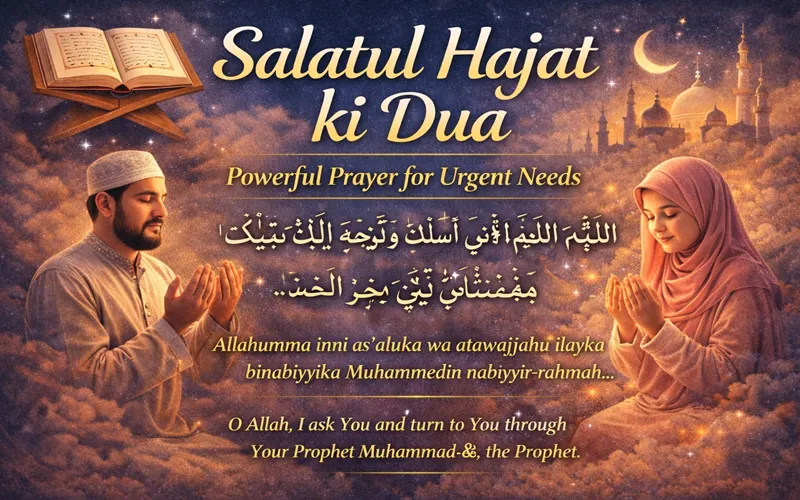
Quick Summary: Salatul Hajat Ki Dua consists of two rak’ahs (units) of voluntary prayer followed by specific supplications seeking Allah’s help for urgent needs. While the prayer format is established through Hadith literature, scholars emphasize that any authentic dua may be recited afterward. This guide provides the complete, verified Arabic text with transliteration and meaning, alongside practical instructions for proper performance.
Understanding Salatul Hajat Ki Dua: Foundation and Purpose
Salatul Hajat translates directly as “the prayer of need.” It represents one of Islam’s most accessible spiritual practices—a structured way to present your deepest concerns before Allah while maintaining proper worship etiquette.
Unlike obligatory prayers with fixed times, Salatul Hajat responds to the believer’s immediate circumstances. The need (hajat) can be anything lawful: relief from debt, recovery from illness, resolution of legal matters, marriage guidance, protection from harm, or clarity during confusion.
The prayer operates on a fundamental Islamic principle: Allah responds to the sincere heart. The Prophet Muhammad ﷺ said, “The supplication of any one of you will be answered so long as he is not impatient” (Sahih Muslim). Salatul Hajat structures this supplication within the framework of salah, adding discipline and reverence to emotional urgency.
Historical Context and Authenticity
The primary narration describing Salatul Hajat appears in Jami’ at-Tirmidhi (Hadith 479), reported through Abdullah ibn Abi Awfa (RA). Classical scholars examined this chain carefully:
- Imam Tirmidhi classified the narration as “gharib” (narrated through a single chain)
- Imam Nawawi accepted the practice based on supporting principles
- Contemporary scholars (2024-2025 consensus) permit it because voluntary prayers followed by dua align with established Sunnah patterns
Important clarification: No specific wording is obligatory. The structure matters more than exact phrasing. Any authentic supplication offered with sincerity fulfills the purpose of salatul hajat ki dua.
How to Perform Salatul Hajat: Step-by-Step Instructions
Timing: The most effective periods are the last third of the night (tahajjud time) or after Isha prayer. Avoid prohibited times: after Fajr until sunrise, when the sun is at zenith, and after Asr until sunset.
Prerequisites:
- Pure intention (niyyah) focused solely on seeking Allah’s help
- Complete wudu (ablution)
- Clean clothing and prayer space
- Facing the qibla
Prayer Structure:
- Make intention: Silently resolve to pray two rak’ahs of Salatul Hajat
- First rak’ah: Begin with Takbir (Allahu Akbar), recite Surah Al-Fatihah, then any other surah (Al-Ikhlas or Al-Kawthar work well)
- Complete first rak’ah: Perform ruku, sujood, and rise for the second rak’ah
- Second rak’ah: Repeat the recitation pattern
- Finish with Tashahhud and Tasleem: Complete the prayer normally
- Transition to dua: Remain seated or raise hands for supplication
After the prayer, begin with:
- Praising Allah (Alhamdulillah)
- Sending blessings upon Prophet Muhammad ﷺ (Allahumma salli ala Muhammad)
- Then recite the specific dua or any authentic supplication
Salatul Hajat Ki Dua in Arabic
The classical supplication transmitted through Hadith literature:
اللَّهُمَّ إِنِّي أَسْأَلُكَ وَأَتَوَجَّهُ إِلَيْكَ بِنَبِيِّكَ مُحَمَّدٍ نَبِيِّ الرَّحْمَةِ، يَا مُحَمَّدُ إِنِّي تَوَجَّهْتُ بِكَ إِلَى رَبِّي فِي حَاجَتِي هَذِهِ لِتُقْضَى، اللَّهُمَّ فَشَفِّعْهُ فِيَّ
Salatul Hajat Ki Dua in English (Transliteration)
“Allahumma inni as’aluka wa atawajjahu ilayka binabiyyika Muhammadin nabiyyir-rahmah. Ya Muhammad, inni tawajjahtu bika ila rabbi fi hajati hadhihi lituqda. Allahumma fashaffi’hu fiyya.”
Salatul Hajat Ki Dua With Tarjuma (Meaning)
“O Allah, I ask You and turn toward You through Your Prophet Muhammad ﷺ, the Prophet of Mercy. O Muhammad, I have turned to my Lord through you regarding this need of mine so that it may be fulfilled. O Allah, accept his intercession on my behalf.”
Theological note: This wording honors the Prophet ﷺ as a means of mercy without attributing divine power to him. All power and response belong exclusively to Allah.
Salatul Hajat Ki Dua in Urdu
اے اللہ! میں تجھ سے سوال کرتا ہوں اور تیرے نبی محمد ﷺ کے وسیلے سے تیری طرف رجوع کرتا ہوں۔ اے محمد! میں نے آپ کے وسیلے سے اپنے رب کی طرف رجوع کیا ہے اپنی اس ضرورت کے لیے تاکہ یہ پوری ہو جائے۔ اے اللہ! ان کی شفاعت میرے حق میں قبول فرما۔
Salatul Hajat Ki Dua in Hindi
अल्लाहुम्मा इन्नी असअलुका व अतवज्जहु इलैका बिनबीय्यिका मुहम्मदिन नबीय्यिर्रहमा। या मुहम्मद, इन्नी तवज्जहतु बिका इला रब्बी फी हाजती हाज़िहि लितुक़्ज़ा। अल्लाहुम्मा फ़शफ़्फि़हु फ़िय्या।
अर्थ: हे अल्लाह! मैं तुझसे माँगता हूँ और तेरे नबी मुहम्मद ﷺ के द्वारा तेरी ओर रुख करता हूँ। हे मुहम्मद! मैंने आपके माध्यम से अपने रब की ओर रुख किया है इस ज़रूरत के लिए ताकि यह पूरी हो जाए। हे अल्लाह! उनकी शफ़ाअत मेरे हक़ में क़बूल फ़रमा।
Additional Authentic Duas to Recite With Salatul Hajat
1. Dua of Prophet Yunus (AS) – For Relief from Distress
Arabic: لَا إِلٰهَ إِلَّا أَنْتَ سُبْحَانَكَ إِنِّي كُنْتُ مِنَ الظَّالِمِينَ
Transliteration: “La ilaha illa anta subhanaka inni kuntu minaz-zalimin”
Meaning: “There is no deity except You; glory be to You. Indeed, I have been among the wrongdoers.” (Qur’an 21:87)
The Prophet ﷺ said: “The supplication of Dhun-Nun (Yunus) which he made while in the belly of the whale was: ‘There is none worthy of worship except You, Glory to You, Indeed, I have been of the wrongdoers.’ No Muslim man supplicates with it for anything ever except Allah responds to him” (Jami’ at-Tirmidhi 3505).
2. Dua for Ease – Quranic Assurance
Arabic: فَإِنَّ مَعَ الْعُسْرِ يُسْرًا، إِنَّ مَعَ الْعُسْرِ يُسْرًا
Transliteration: “Fa inna ma’al-‘usri yusra, inna ma’al-‘usri yusra”
Meaning: “For indeed, with hardship comes ease. Indeed, with hardship comes ease.” (Qur’an 94:5-6)
3. Comprehensive Dua for All Needs
Arabic: اللَّهُمَّ رَحْمَتَكَ أَرْجُو فَلَا تَكِلْنِي إِلَى نَفْسِي طَرْفَةَ عَيْنٍ، وَأَصْلِحْ لِي شَأْنِي كُلَّهُ، لَا إِلَهَ إِلَّا أَنْتَ
Transliteration: “Allahumma rahmataka arju fala takilni ila nafsi tarfata ‘ayn, wa aslih li sha’ni kullahu, la ilaha illa ant”
Meaning: “O Allah, I hope for Your mercy. Do not leave me to myself even for the blink of an eye. Correct all of my affairs for me. There is no deity except You.” (Sunan Abi Dawud 5090)
4. Salatul Istikhara – When Decision-Making Is Involved
If your need involves choosing between options (marriage, job, relocation), combine Salatul Hajat with Istikhara:
Arabic: اللَّهُمَّ إِنِّي أَسْتَخِيرُكَ بِعِلْمِكَ، وَأَسْتَقْدِرُكَ بِقُدْرَتِكَ
Transliteration: “Allahumma inni astakhiruka bi’ilmika, wa astaqdiruka biqudratika…”
Meaning: “O Allah, I seek Your guidance through Your knowledge, and I seek ability through Your power…” (Sahih al-Bukhari 1162)
Common Mistakes to Avoid
| Mistake | Correction |
|---|---|
| Treating it as magic ritual | Approach with sincere submission, not transactional expectation |
| Setting fixed repetitions (e.g., “pray 40 nights”) | No authentic source mandates specific numbers |
| Abandoning patience after one attempt | Continue with trust; timing belongs to Allah |
| Using unauthenticated wording from social media | Stick to verified duas from Hadith collections |
| Expecting specific outcomes | Allah may answer differently than requested—for your benefit |
Critical reminder: Acceptance sometimes manifests as delay (to build patience), redirection (to better alternatives), or spiritual compensation (rewards in the hereafter).
Benefits and Practical Wisdom
Spiritual Benefits:
- Deepens tawakkul (reliance on Allah)
- Strengthens discipline during crisis
- Cultivates humility and self-awareness
- Provides emotional release through structured worship
Psychological Benefits:
- Reduces anxiety through focused action
- Offers clarity during mental fog
- Builds resilience through repeated practice
Social Benefits:
- Keeps needs private between you and Allah
- Prevents burdening others unnecessarily
- Models healthy coping for family members
Final Thoughts: The Heart Before the Outcome
Salatul hajat ki dua teaches a profound lesson often missed in our result-driven world: the act of asking transforms the asker before it changes circumstances. When you stand in prayer—uncertain, vulnerable, hopeful—you practice trust. That trust reshapes character whether the answer appears tomorrow or years later.
Sometimes Allah grants exactly what you requested. Sometimes He redirects you toward something you couldn’t have imagined wanting. And sometimes, the greatest gift is the calm that settles into your heart during the waiting—a peace that money can’t buy and outcomes can’t guarantee.
This is why generations preserved Salatul Hajat: not as a ritual of desperation, but as a disciplined act of surrender. The prayer works whether your situation changes or not, because its real work happens inside you.
May Allah accept your prayers, answer your needs in the best way, and grant you patience and trust throughout the journey.
Read Also:-
Frequently Asked Questions
Is Salatul Hajat compulsory in Islam?
No. It remains entirely voluntary (nafl). Missing it carries no sin, but performing it brings reward and spiritual benefit.
Can I pray Salatul Hajat every day?
Yes, as long as you avoid fixing it as an obligation or setting arbitrary numbers (like “must pray 7 nights”). Pray when genuine need arises.
Does Salatul Hajat work for urgent needs only?
No. Any lawful need—urgent or long-term—qualifies. Career guidance, relationship healing, spiritual growth, and protection all fit within its scope.
Can women perform Salatul Hajat during menstruation?
Women cannot pray during menstruation or postpartum bleeding. However, they can make dua without performing the salah portion.
What if my need isn’t fulfilled after praying?
Divine wisdom operates beyond immediate sight. Your need may be fulfilled later, replaced with something better, or stored as spiritual credit. Trust the response even when invisible.
How many rak’ahs should I pray?
Two rak’ahs is the standard narrated format. Some scholars permit increasing to four or eight if the need is particularly severe, though two remains sufficient.
Can I pray Salatul Hajat for someone else?
Yes. You may pray on behalf of family members, friends, or the Muslim community, though personal needs typically carry more emotional investment.
Should I repeat the dua multiple times?
Repetition is permissible and encouraged if sincere. However, avoid mechanical recitation without heart presence.