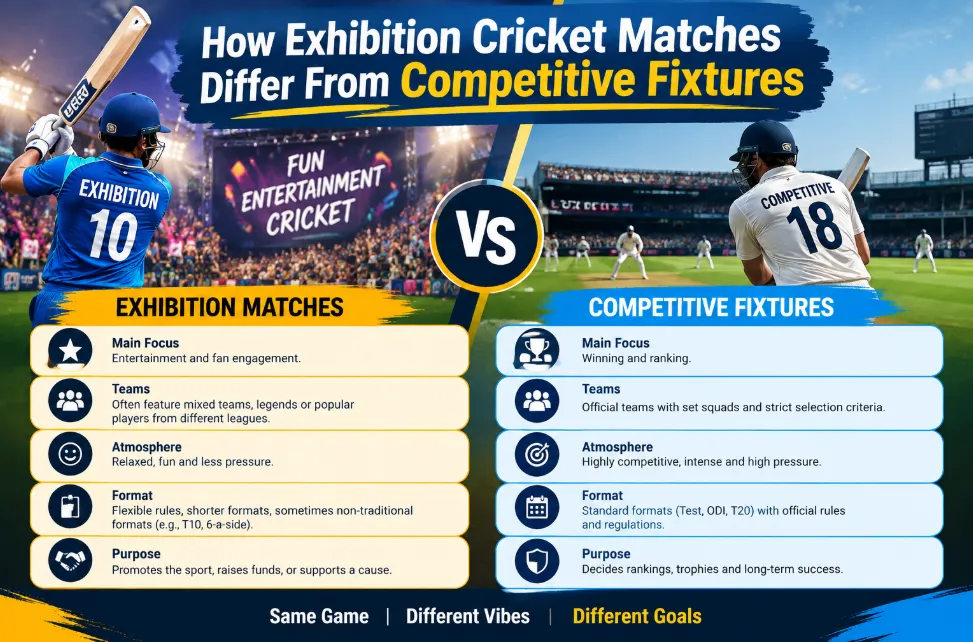
Cricket matches can be played for very different purposes. While competitive fixtures are designed around results, rankings, qualification, and tournament success, exhibition matches are often organised for entertainment, charity, promotion, celebration, or special events.
Both formats may feature recognised cricketers and follow familiar cricket rules, but the intensity, player selection, tactics, and importance of the result can differ significantly.
Understanding these differences helps fans evaluate performances in the right context. This article explores how exhibition cricket matches compare with competitive fixtures and why their classification matters.
What Is an Exhibition Cricket Match?
An exhibition cricket match is generally organised for entertainment, promotion, charity, celebration, or a special occasion rather than as part of a recognised competitive tournament.
These matches can feature professional cricketers, former players, celebrities, local talent, or specially assembled teams. Although the format may resemble a standard cricket match, organisers can modify certain aspects depending on the purpose of the event.
An exhibition match may be organised to:
-
Raise funds for charity
-
Celebrate a cricketing milestone
-
Promote an organisation or tournament
-
Bring popular players together
-
Support a community event
-
Showcase emerging or retired players
-
Provide entertainment for spectators
In most cases, the overall experience is more important than the competitive significance of the final result.
What Is a Competitive Cricket Fixture?
A competitive cricket fixture is played as part of an organised tournament, league, series, or recognised cricket schedule. The result can influence points, rankings, qualification, league positions, or the outcome of a series.
Competitive fixtures include international matches, domestic competitions, league games, knockout matches, and championship contests.
Because the result carries sporting importance, teams generally approach these matches with greater tactical preparation and intensity. Every decision, from team selection to bowling changes, can influence a team’s wider objectives.
How Do Their Main Objectives Differ?
The biggest difference between exhibition and competitive cricket is their primary purpose.
An exhibition match is generally designed around entertainment, promotion, celebration, or participation. Winning may still matter to players, but the result usually does not affect a wider tournament or league campaign.
Competitive cricket has a clear sporting objective. Teams are focused on winning because the outcome can influence their position in a competition.
For readers who follow recognised fixtures and changing cricket markets, a betting id cricket can be relevant when exploring platforms associated with different cricket match formats and market options.
|
Factor |
Exhibition Match |
Competitive Fixture |
|
Primary purpose |
Entertainment or special event |
Competition and results |
|
Result importance |
Usually limited |
Often significant |
|
Tournament points |
Usually not applicable |
Often applicable |
|
Player selection |
Can be flexible |
Based on competitive needs |
|
Tactical intensity |
Can vary |
Generally high |
|
Rules |
May be customised |
Usually standardised |
|
Statistics |
May have limited recognition |
Often officially recorded |
How Does Player Selection Differ?
Player selection in exhibition cricket can be highly flexible.
Organisers may invite players who would not normally play together. Former international cricketers might appear alongside active professionals, while local players or celebrities may also participate.
Competitive fixtures usually involve a more structured selection process. Teams are selected based on factors such as:
-
Current form
-
Fitness
-
Playing conditions
-
Opposition strengths
-
Team balance
-
Tournament requirements
-
Tactical roles
-
Player availability
A competitive team is therefore usually built around the specific demands of the match. Exhibition teams may prioritise participation, entertainment, or unique player combinations instead.
Can Rules Be Different in Exhibition Matches?
Yes. Exhibition matches can use modified playing conditions depending on the event.
Organisers may change the number of overs, squad size, substitutions, retirement rules, bowling restrictions, or match duration. Some exhibition matches may closely follow standard cricket laws, while others introduce unique rules to create a more entertaining experience.
Competitive fixtures generally follow established playing conditions determined by the relevant governing body or competition organiser. This creates consistency and allows performances to be compared within recognised formats.
Why Is Match Intensity Different?
Competitive fixtures usually involve greater pressure because players have meaningful objectives at stake.
A league match can affect qualification, while a knockout fixture may determine whether a team progresses. Similarly, an international match can influence a series result or rankings.
These consequences encourage teams to maintain maximum concentration and tactical discipline.
Exhibition matches can still be competitive, particularly when well-known players participate. However, players may have more freedom to experiment.
A batter might attempt aggressive shots, a bowler may try unusual deliveries, or a captain may use creative field placements. The level of intensity depends largely on the purpose of the event.
How Does Strategy Differ?
Strategy is another major difference.
In competitive cricket, teams develop plans specifically to improve their chances of winning. Captains and coaches consider opposition strengths, pitch conditions, player matchups, scoring patterns, and possible match situations.
A team might preserve wickets early before accelerating later, while bowlers may be assigned specific matchups against particular batters.
Exhibition matches can encourage experimentation. Teams may:
-
Use unusual batting positions
-
Rotate bowlers frequently
-
Give inexperienced players opportunities
-
Encourage attacking cricket
-
Experiment with field settings
-
Allow players to perform unfamiliar roles
This does not mean exhibition cricket lacks strategy. Instead, the strategic objective may be different from a result-focused competitive match.
What Happens to Player Roles?
Player roles are often more flexible during exhibition matches.
A regular opening batter may bat in the middle order, while a specialist bowler may receive fewer overs than usual. Former players may participate primarily to entertain spectators rather than perform a specific tactical role.
Competitive cricket generally requires clearer responsibilities within the team.
Typical roles can include:
-
Opening batters
-
Middle-order batters
-
Finishers
-
All-rounders
-
New-ball bowlers
-
Spin bowlers
-
Death-over specialists
-
Wicketkeepers
These roles are usually assigned according to the team’s tactical requirements and the conditions of the fixture.
Are Exhibition Match Statistics Official?
Not always.
Statistics from recognised competitive fixtures can contribute to official career records depending on the status of the match and the relevant governing authority.
Exhibition matches may not receive the same recognition, even when professional or international players participate.
For example, a century scored in an exhibition match may not necessarily count as an official century in a player’s recognised career statistics.
Fans should therefore check the official classification of a match before comparing performances or using statistics for career analysis.
How Important Is the Final Result?
The result of a competitive fixture can have significant consequences.
A single match may influence:
-
League standings
-
Tournament qualification
-
Series results
-
Knockout progression
-
Team rankings
-
Player selection
-
Season objectives
An exhibition match generally does not carry the same sporting consequences.
The event may still be important for charities, organisers, sponsors, players, and supporters, but the result usually has less impact on a team’s wider competitive record.
How Do Spectators Experience the Two Formats?
Exhibition cricket often focuses heavily on the spectator experience.
Events may include special appearances, entertainment activities, promotional events, music, or unusual player combinations. The atmosphere can therefore feel more relaxed and celebratory.
Competitive matches are generally centred on the contest itself.
Spectators may closely follow tactical decisions, required run rates, bowling changes, points tables, qualification scenarios, and individual performances because the outcome has greater sporting significance.
Both formats can be entertaining, but the source of that entertainment is different.
Can Exhibition Matches Help New Players?
Yes. Exhibition matches can provide opportunities for players who may not regularly appear in major competitive fixtures.
Young players can gain exposure to experienced cricketers and larger audiences. Local talent may receive opportunities to play alongside recognised names, while former players can return for special events.
However, an exhibition appearance should not automatically be considered equivalent to participation in an official competitive fixture.
The level of competition, playing conditions, and statistical recognition may all be different.
How Should Fans Interpret Exhibition Performances?
Performances should always be viewed in context.
A high score or impressive bowling spell in an exhibition match can demonstrate genuine skill, but the circumstances may differ significantly from those of a competitive fixture.
Important factors to consider include:
-
Opposition quality
-
Pitch conditions
-
Match format
-
Playing restrictions
-
Player roles
-
Bowling limitations
-
Fielding conditions
-
Competitive importance
For this reason, exhibition performances should not automatically be compared directly with performances in recognised international or domestic competitions.
Why Is Match Classification Important?
Match classification matters because official cricket records depend on the recognised status of a fixture.
Not every match involving professional cricketers is considered an official international or domestic contest. A game can feature famous players and still be classified as an exhibition or unofficial match.
This is particularly important when discussing career statistics.
Before claiming that a performance changed a player’s official record, it is important to confirm the status of the match through the relevant cricket authority or competition records.
Exhibition Cricket vs Competitive Fixtures at a Glance
|
Area |
Exhibition Cricket |
Competitive Cricket |
|
Main goal |
Entertainment, charity, or promotion |
Winning and competition objectives |
|
Competitive consequences |
Usually limited |
Often substantial |
|
Player selection |
Flexible |
Formally structured |
|
Rules |
Can be modified |
Usually standardised |
|
Strategy |
Experimental |
Result-focused |
|
Player roles |
More flexible |
Clearly defined |
|
Pressure |
Often lower |
Usually higher |
|
Statistics |
May have limited official value |
Commonly recorded |
|
Audience experience |
Entertainment-focused |
Competition-focused |
Conclusion
Exhibition cricket matches and competitive fixtures may appear similar, but their underlying purposes can be very different.
Exhibition games are often organised around entertainment, charity, promotion, celebration, or special participation. Competitive fixtures, on the other hand, are structured around meaningful sporting outcomes.
These differences influence player selection, tactical planning, match intensity, playing conditions, statistics, and the importance of the final result.
For cricket fans and analysts, the key is to understand the purpose and classification of a match before evaluating its performances. An exhibition performance can still be impressive and entertaining, but it should be judged within the context of the event rather than automatically being treated as equivalent to a recognised competitive fixture.