Last Update: 21 May 2026
TL;DR Summary Box
Tabbat Yada Surah (also called Surah Al-Masad or Surah Lahab) is the 111th chapter of the Quran. It contains 5 powerful verses about Abu Lahab, an uncle of Prophet Muhammad ﷺ who strongly opposed Islam. The surah teaches that wealth, pride, and status cannot save anyone who fights truth and spreads harm. This guide includes the Full Tabbat Yada Surah in English, transliteration, meaning, story, lessons, and beginner-friendly explanations.
Disclaimer: This article explains Tabbat Yada Surah in English using traditional Islamic understanding and simplified educational language. Translation wording may differ slightly between scholars and publishers. Readers seeking detailed religious rulings or deeper tafsir should consult qualified Islamic scholars.
Quick Facts About Tabbat Yada Surah
| Detail | Information |
|---|---|
| Surah Name | Surah Al-Masad |
| Common Names | Tabbat Yada, Surah Lahab |
| Surah Number | 111 |
| Number of Verses | 5 |
| Revealed In | Makkah |
| Main Theme | Consequences of arrogance and hostility |
| Main Figure Mentioned | Abu Lahab |
| Quran Section | 30th Juz |
| Language Covered Here | English Translation & Transliteration |
What is Tabbat Yada Surah?
If you searched for Tabbat Yada Surah in English, chances are you want more than just a translation. You probably want to actually understand:
- what the surah means,
- why it was revealed,
- who Abu Lahab was,
- and why this tiny chapter still feels so powerful today.
And honestly, that’s where this surah becomes unforgettable.
Even though it is only five verses long, Surah Al-Masad carries one of the strongest warnings in the Quran. It speaks directly about arrogance, hatred, public mockery, and the false belief that money and power can save someone from consequences.
This surah is also known as:
- Surah Lahab
- Surah Tabbat
- Surah Al-Masad
The name “Tabbat Yada” comes from the opening words of the first verse.
Who Was Abu Lahab and Why Does This Surah Matter?
Picture this for a second.
Prophet Muhammad ﷺ gathers his relatives near Mount Safa to warn them sincerely about the Hereafter and call them toward truth.
Instead of listening respectfully, one of his own uncles publicly insults him.
That uncle was Abu Lahab.
His real name was Abd al-Uzza, but people called him “Abu Lahab,” meaning “Father of the Flame,” because of his reddish face and fiery appearance.
He was wealthy, influential, and respected in Makkah. But instead of supporting the Prophet ﷺ, he became one of Islam’s fiercest enemies.
Islamic historical accounts mention that:
- he mocked the Prophet publicly,
- tried to stop people from listening,
- spread hostility against Muslims,
- and supported harassment campaigns against the early believers.
His wife, Umm Jamil, also played a major role in spreading harm and hostility.
According to Islamic tradition, this surah was revealed after Abu Lahab angrily rejected the Prophet’s message during the public gathering near Mount Safa.
And what makes the moment powerful is this:
The same insult Abu Lahab used against the Prophet was turned back on him through revelation.
Full Tabbat Yada Surah in English Text
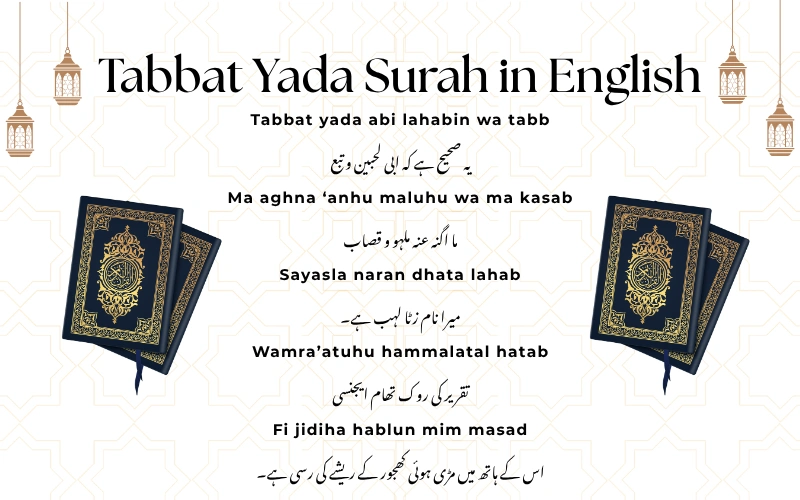
Here is the Full Tabbat Yada Surah in English Text, Translation, and Transliteration in a clean and beginner-friendly format.
Arabic Opening
Bismillahir Rahmanir Raheem
(In the name of Allah, the Most Gracious, the Most Merciful)
Tabbat Yada Surah in English Transliteration
| Verse | Transliteration |
|---|---|
| 1 | Tabbat yada abi lahabin wa tabb |
| 2 | Ma aghna ‘anhu maluhu wa ma kasab |
| 3 | Sayasla naran dhata lahab |
| 4 | Wamra’atuhu hammalatal hatab |
| 5 | Fi jidiha hablun mim masad |
Tabbat Yada Surah in English Translation
| Verse | English Translation |
|---|---|
| 1 | May the hands of Abu Lahab perish, and may he perish. |
| 2 | His wealth and whatever he earned will not benefit him. |
| 3 | He will burn in a blazing Fire. |
| 4 | And his wife as well—the carrier of firewood. |
| 5 | Around her neck will be a rope made of palm fiber. |
This is the complete English Tabbat Yada Surah in English Translation that many Muslims read and reflect on regularly.
Verse-by-Verse Meaning Explained Simply
Now let’s walk through the surah together in plain language.
No difficult terms. No lecture-style explanation. Just clear understanding.
Verse 1: “Tabbat yada abi lahabin wa tabb”
This verse is a direct condemnation of Abu Lahab’s actions.
The “hands” symbolize power, effort, and actions. In simple words, everything he tried to do against truth ultimately failed.
It is almost like the Quran is saying:
“All the power and influence you relied on will collapse.”
That message still hits hard today.
Verse 2: Wealth Could Not Save Him
“His wealth and whatever he earned will not benefit him.”
Abu Lahab had money, status, and tribal influence.
But none of it mattered.
And honestly, this is where the surah becomes deeply personal for modern readers too.
How many people today believe:
- money solves everything,
- influence protects them,
- or status makes them untouchable?
This verse destroys that illusion completely.
Verse 3: “He Will Burn in a Blazing Fire”
This verse contains one of the strongest symbolic moments in the surah.
Remember his nickname:
Abu Lahab — “Father of the Flame.”
Now look at the punishment:
“A blazing fire.”
The connection is powerful.
He lived with fiery arrogance and hostility, and the surah warns of a fiery end.
Verses 4–5: The Role of His Wife
His wife, Umm Jamil, is also mentioned directly.
Islamic historical narrations explain that she used to spread thorns and harmful objects in pathways to hurt the Prophet ﷺ and support hostility against him.
The phrase:
“carrier of firewood”
is understood by scholars both literally and symbolically.
It can refer to:
- carrying harmful materials,
- spreading conflict,
- fueling hatred,
- or helping keep hostility alive.
And honestly, this lesson still applies everywhere today.
Some people may not start problems themselves—but they constantly keep conflicts burning.
Tabbat Yada Surah in English Meaning: The Bigger Lesson
This surah is not only about one man from history.
It is about a mindset.
A mindset built on:
- arrogance,
- mockery,
- pride,
- hostility toward truth,
- and abuse of influence.
The message is timeless:
- Wealth cannot protect character.
- Power cannot erase wrongdoing.
- Supporting cruelty has consequences.
- Truth survives opposition.
That is why Tabbat Yada Surah in English Meaning continues to connect deeply with readers today.
Benefits of Reading Tabbat Yada Surah
People often search for the benefits of this surah, so let’s keep it honest and simple.
While specific spiritual rewards should always be understood through authentic Islamic teachings, many Muslims reflect on this surah because it:
| Benefit | Why It Matters |
|---|---|
| Encourages humility | Reminds us not to become arrogant |
| Teaches accountability | Actions always have consequences |
| Strengthens moral awareness | Warns against spreading harm |
| Helps beginners memorize Quran | Short and easy to learn |
| Builds historical understanding | Connects readers to early Islamic history |
| Encourages self-reflection | Makes people think about character and behavior |
Why This Surah Still Feels Relevant Today
One reason this surah remains so powerful is because human behavior has not changed much.
You still see:
- people using wealth to control others,
- public mockery,
- organized hate campaigns,
- arrogance fueled by influence,
- and people helping spread negativity.
Surah Al-Masad exposes all of it in just five verses.
That is remarkable.
Comparison Table: Abu Lahab’s Path vs a Believer’s Path
| Aspect | Abu Lahab’s Path | Better Path |
|---|---|---|
| Response to Truth | Mockery and hostility | Reflection and sincerity |
| Reliance | Wealth and status | Faith and good deeds |
| Treatment of Others | Harm and opposition | Compassion and support |
| Legacy | Negative example | Positive remembrance |
| Final Outcome | Loss and punishment | Hope and reward |
Tabbat Yada Surah in English Text for Beginners
If you are just starting your Quran journey, this surah is actually a great place to begin because:
- it is short,
- rhythmic,
- emotionally memorable,
- and easy to practice daily.
Easy Memorization Method
| Step | What To Do |
|---|---|
| 1 | Listen to one verse repeatedly |
| 2 | Read the transliteration slowly |
| 3 | Understand the meaning |
| 4 | Repeat aloud several times |
| 5 | Connect all verses together |
Most people fail memorization because they try to repeat sounds without understanding meaning.
Once the meaning connects emotionally, memorization becomes much easier.
Mini Glossary: Simple Definitions
What Does “Tabbat” Mean?
It means ruined, destroyed, or doomed.
What Does “Masad” Mean?
It refers to twisted palm-fiber rope.
Who Was Abu Lahab?
An uncle of Prophet Muhammad ﷺ who strongly opposed Islam.
What Does “Hammalatal Hatab” Mean?
“Carrier of firewood,” referring to someone spreading harm or fueling hostility.
People Also Ask About Tabbat Yada Surah
Is Tabbat Yada Surah a Makki Surah?
Yes, it was revealed in Makkah during the early years of Islam.
Can I Read Tabbat Yada Surah in English?
Yes. Reading the English meaning helps deepen understanding. Arabic recitation remains important for prayer.
Why Is Abu Lahab Mentioned by Name?
This is one of the rare places in the Quran where a direct enemy of Islam is specifically named because of his open hostility.
Is This Surah Only About History?
No. Its lessons about arrogance, pride, and harmful behavior apply to every generation.
Expert Insights & Real-Life Reflection
One fascinating thing about this surah is how directly it speaks about human ego.
People often assume:
- influence guarantees success,
- popularity equals truth,
- or public power protects reputation forever.
But history repeatedly proves otherwise.
Character outlasts status.
That is the core lesson running through Surah Al-Masad.
And maybe that is why these five verses continue to leave such a strong emotional impact centuries later.
Conclusion
Tabbat Yada Surah in English may be short, but its message is massive.
It teaches that:
- arrogance destroys,
- wealth cannot save character,
- spreading harm has consequences,
- and truth survives opposition.
More importantly, it pushes every reader to reflect honestly on their own behavior.
Are we building peace or spreading conflict?
Are we using influence for good or harm?
Are we relying only on status, or also on character?
That is why Surah Al-Masad still feels deeply relevant today.
Whether you came looking for:
- the Full Tabbat Yada Surah in English,
- the Tabbat Yada Surah in English Text,
- the Tabbat Yada Surah in English Transliteration,
- or the Tabbat Yada Surah in English Meaning,
you now have a complete beginner-friendly guide in one place.
FAQs About Tabbat Yada Surah in English
1. What is the full Tabbat Yada Surah in English?
It is Surah Al-Masad, the 111th chapter of the Quran, translated into English with five verses about Abu Lahab and his wife.
2. Why was Tabbat Yada Surah revealed?
According to Islamic tradition, it was revealed after Abu Lahab publicly insulted Prophet Muhammad ﷺ during the early call to Islam.
3. Can beginners memorize this surah easily?
Yes. Since it has only five short verses, it is commonly recommended for beginners.
4. What is the main lesson of Tabbat Yada Surah?
The surah teaches that wealth, pride, and hostility toward truth ultimately lead to loss.
5. What does “Tabbat Yada” mean?
It roughly means:
“May the hands perish” or “ruined are the hands.”
6. Is reading the English translation allowed?
Yes. Reading translations helps people understand the Quran better, especially beginners learning the meaning.
7. Who was Abu Lahab’s wife?
She was Umm Jamil, known in Islamic history for supporting hostility against the Prophet ﷺ.
8. Why is this surah important today?
Because its warnings about arrogance, abuse of power, and spreading harm remain relevant in every generation.
Thank you so much for reading this guide on Tabbat Yada Surah in English.
Also Read:
Allahumma Inni Auzubika Minal Hammi: 7 Powerful Benefits
Ayansh Name Meaning in Hindi: 15 Beautiful Facts Parents Love
What is Azlan Name Meaning in Urdu? – Complete Guide
Inaya Name Meaning in Urdu: A Complete Guide for Parents
Zainab Name Meaning in Urdu: Complete Guide with Islamic Significance & Lucky Numbers
Alfiya Name Meaning in Urdu: Complete Guide for Parents (2026)
Shibra Name Meaning in Urdu & Lucky Number – Full Guide 2026
Check out our Check out “Islamic Dua Hub” for deeper insights into naming traditions.