Last Update: 12 May 2026
Istikhara Ki Dua is an Islamic supplication that Muslims recite to seek Allah’s guidance before making important life decisions. It combines a specific prayer (Salatul Istikhara) with a powerful dua that asks God to guide you toward the right choice. Whether you’re deciding about marriage, career, business, or any major life step, this ancient Islamic practice helps you find peace and wisdom.
Quick Reference Table: Istikhara at a Glance
| Aspect | Details |
|---|---|
| Full Name | Salatul Istikhara / Istikhara Ki Dua |
| Type | Islamic guidance prayer |
| When to Do It | Before major life decisions |
| Optimal Time | Any time, but night prayers preferred |
| Duration | 5-10 minutes |
| Language | Arabic (original), but accepted in any language |
| Requirement | Ritual purity (Wudu) |
| Best For | Marriage, career, business, relocation, education |
What Is Istikhara Ki Dua? The Direct Answer
Imagine standing at a crossroads—two paths in front of you, both looking equally good. One might be the perfect job offer, the other a marriage proposal. How do you choose? This is exactly where Istikhara Ki Dua comes in.
Istikhara Ki Dua is a beautiful Islamic practice that teaches Muslims how to ask Allah (God) for guidance when facing important decisions. It’s not just about saying a prayer; it’s about seeking divine wisdom through a specific combination of ritual prayer (called Salatul Istikhara) and a heartfelt supplication (dua).
The word “Istikhara” comes from Arabic roots meaning “to seek what is good.” So when you’re doing Istikhara Ki Dua, you’re literally asking Allah to show you which path is good for you—not just in this world, but in the life to come too.
Also Read: Lain Shakartum La Azidannakum in Arabic
Why Is Istikhara Ki Dua So Important? Understanding the Deep Meaning
Let me tell you why Muslims have been practicing Istikhara Ki Dua for over 1,400 years.
In Islam, making decisions isn’t just about logic or gut feeling. It’s about connecting with a higher purpose. The Prophet Muhammad himself taught his followers how to seek Allah’s guidance, and this practice became known as Salatul Istikhara.
The beauty of Istikhara Ki Dua is that it removes the burden of decision-making from your shoulders alone. Instead of stressing endlessly about whether something is right or wrong, you place your trust in Allah and ask for clarity. Many Muslims report feeling a sense of peace after doing Istikhara—either because they suddenly feel confident about a choice, or because they lose interest in something that seemed attractive before.
Here’s the key insight: Istikhara Ki Dua isn’t about asking Allah to make the decision for you magically. Rather, it’s about aligning your will with divine wisdom, so that whatever you choose afterward feels right spiritually, mentally, and emotionally.
How to Perform Istikhara Ki Dua: Step-by-Step Guide
Now, let’s walk through exactly how to do Istikhara Ki Dua. This is straightforward, and you can do it tonight if you have a decision to make.
Step 1: Get Yourself Ready (Wudu & Clean Space)
First, perform Wudu (ritual ablution). Wash your hands, face, arms, and feet as you normally would before prayer. This isn’t just a physical act—it’s a way of preparing your heart and mind.
Find a clean, quiet space where you won’t be disturbed. It could be your bedroom, a prayer room, or any peaceful corner. Intention matters here—silently tell yourself that you’re about to seek Allah’s guidance for a specific decision.
Step 2: Pray Two Rakat (Units) of Prayer
Perform a simple two-rakat prayer. If you know how to pray Tahajjud (night prayer) or Nafl (voluntary prayer), it’s the same structure:
- First Rakat: Read Surah Al-Fatihah (the opening chapter) + any other Surah you know
- Second Rakat: Same structure
Don’t overthink this. The prayer doesn’t need to be long or complicated. The goal is to create a sacred moment where you’re focused on Allah alone.
Step 3: Recite the Istikhara Ki Dua (The Supplication)
After completing the two rakaats, sit down and recite the traditional dua. Here’s the Istikhara Ki Dua in Arabic:
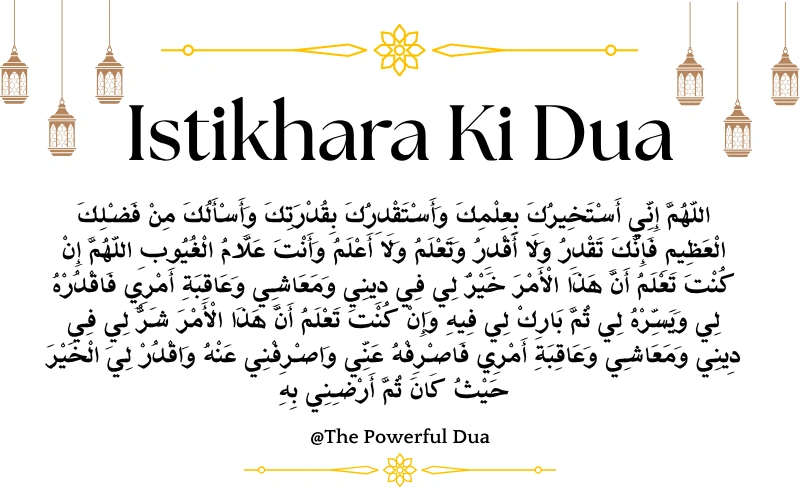
اللّهُمَّ إِنِّي أَسْتَخِيرُكَ بِعِلْمِكَ وَأَسْتَقْدِرُكَ بِقُدْرَتِكَ وَأَسْأَلُكَ مِنْ فَضْلِكَ الْعَظِيمِ فَإِنَّكَ تَقْدِرُ وَلَا أَقْدِرُ وَتَعْلَمُ وَلَا أَعْلَمُ وَأَنْتَ عَلَّامُ الْغُيُوبِ اللّهُمَّ إِنْ كُنْتَ تَعْلَمُ أَنَّ هَذَا الْأَمْرَ خَيْرٌ لِي فِي دِينِي وَمَعَاشِي وَعَاقِبَةِ أَمْرِي فَاقْدُرْهُ لِي وَيَسِّرْهُ لِي ثُمَّ بَارِكْ لِي فِيهِ وَإِنْ كُنْتَ تَعْلَمُ أَنَّ هَذَا الْأَمْرَ شَرٌّ لِي فِي دِينِي وَمَعَاشِي وَعَاقِبَةِ أَمْرِي فَاصْرِفْهُ عَنِّي وَاصْرِفْنِي عَنْهُ وَاقْدُرْ لِيَ الْخَيْرَ حَيْثُ كَانَ ثُمَّ أَرْضِنِي بِهِ
Istikhara Ki Dua in Roman English (Transliteration)
“Allahumma inni astakheeruka bi’ilmika wa astaqdeeruka bi qudratika wa as’aluka min fadlika al-azeem. Fa innaka taqdiru wa la aqdiru wa ta’lamu wa la a’lamu wa anta allamul ghuyub. Allahumma in kunta ta’lamu anna hadha al-amra khairun li fi deeni wa ma’ashi wa aqibati amri fa qdurhu li wa yassirhu li thumma barik li fih. Wa in kunta ta’lamu anna hadha al-amra sharrun li fi deeni wa ma’ashi wa aqibati amri fa srifhu anni wa srifni anhu wa qdur li al-khayra haythu kana thumma ardini bih.”
Istikhara Ki Dua in Hindi (Istikhara Ki Dua Hindi Mein)
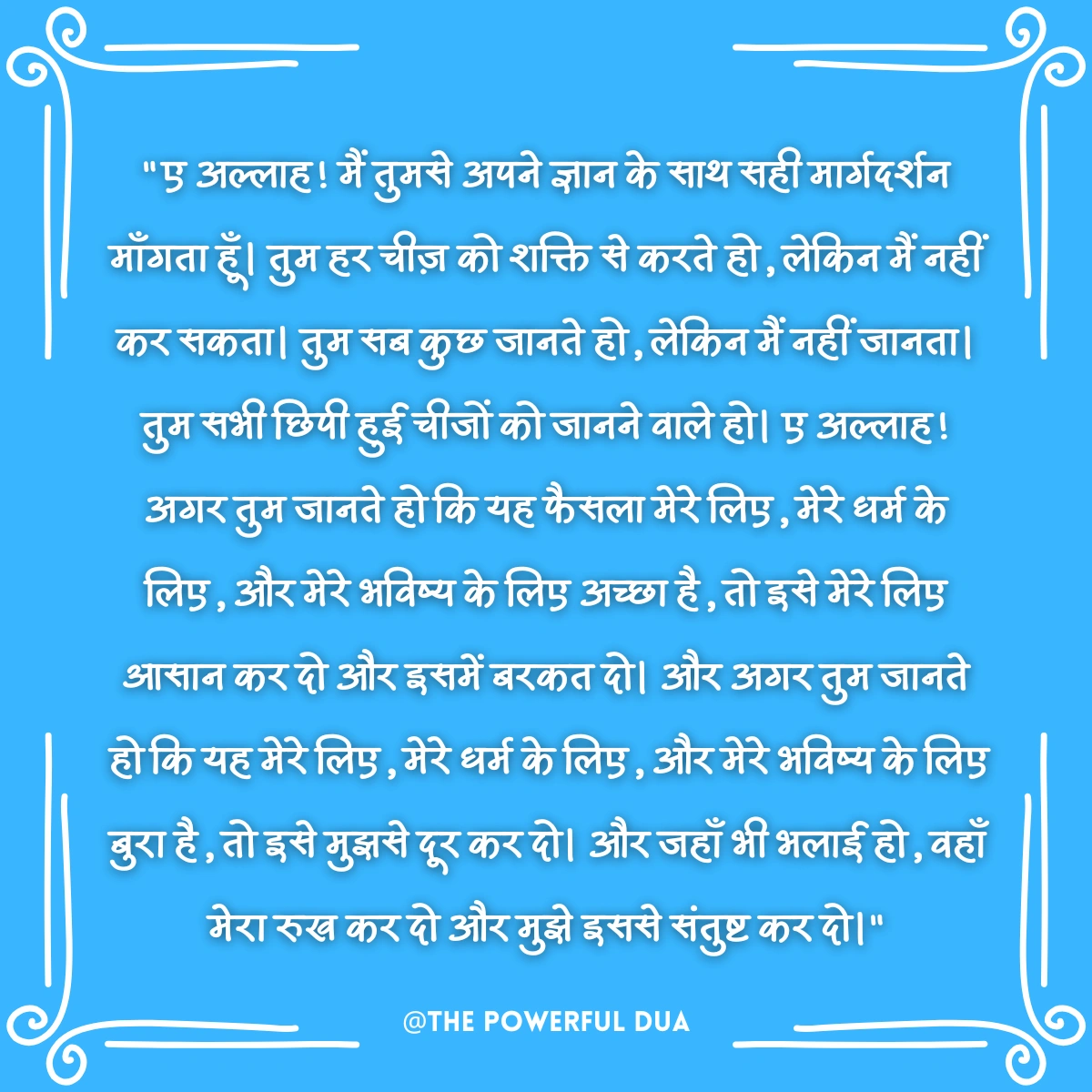
“ए अल्लाह! मैं तुमसे अपने ज्ञान के साथ सही मार्गदर्शन माँगता हूँ। तुम हर चीज़ को शक्ति से करते हो, लेकिन मैं नहीं कर सकता। तुम सब कुछ जानते हो, लेकिन मैं नहीं जानता। तुम सभी छिपी हुई चीजों को जानने वाले हो। ए अल्लाह! अगर तुम जानते हो कि यह फैसला मेरे लिए, मेरे धर्म के लिए, और मेरे भविष्य के लिए अच्छा है, तो इसे मेरे लिए आसान कर दो और इसमें बरकत दो। और अगर तुम जानते हो कि यह मेरे लिए, मेरे धर्म के लिए, और मेरे भविष्य के लिए बुरा है, तो इसे मुझसे दूर कर दो। और जहाँ भी भलाई हो, वहाँ मेरा रुख कर दो और मुझे इससे संतुष्ट कर दो।”
Istikhara Ki Dua in English (Complete Translation and Meaning)
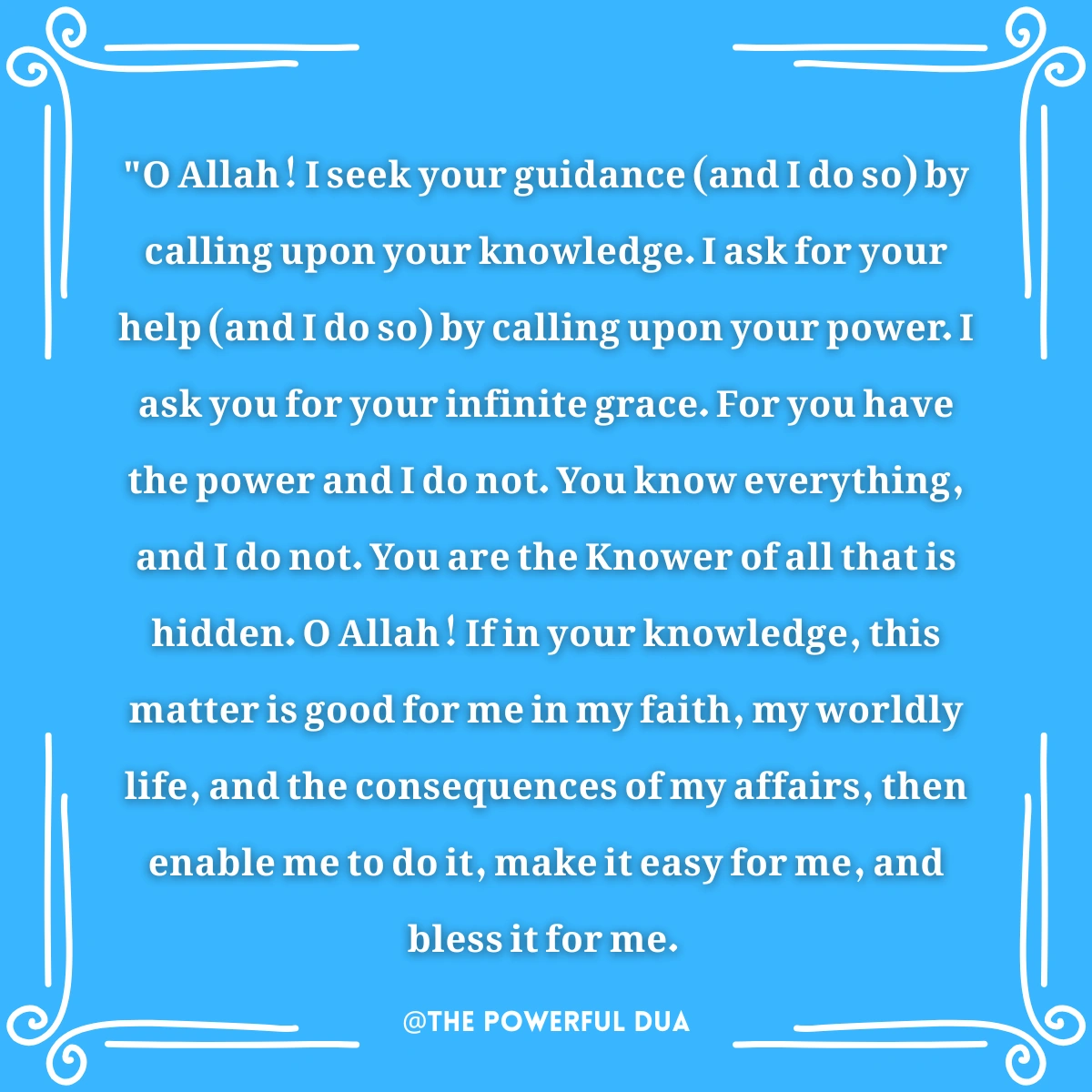
“O Allah! I seek your guidance (and I do so) by calling upon your knowledge. I ask for your help (and I do so) by calling upon your power. I ask you for your infinite grace. For you have the power and I do not. You know everything, and I do not. You are the Knower of all that is hidden. O Allah! If in your knowledge, this matter is good for me in my faith, my worldly life, and the consequences of my affairs, then enable me to do it, make it easy for me, and bless it for me.
But if in your knowledge, this matter is bad for me in my faith, my worldly life, and the consequences of my affairs, then keep it away from me and keep me away from it, and choose what is good for me wherever it may be, and make me pleased with it.”
Step 4: Mention Your Decision Clearly
While reciting or before reciting the dua, think clearly about the specific decision you need guidance on. Some scholars suggest saying it aloud: “This is about my marriage proposal with [name]” or “This is about accepting the job at [company].” The specificity helps focus your intention.
Step 5: Wait, Observe, and Trust the Process
After performing Salatul Istikhara Ki Dua, you don’t need to wait for a sign from the sky. Instead:
- Sleep on it. Many Muslims report that after doing Istikhara, they wake up with clarity—either they feel good about the decision or they lose interest in it.
- Watch for signs. These aren’t magical signs, but practical ones. Does the path become easier or harder? Do unexpected obstacles appear? Do you feel drawn toward one option?
- Trust your instinct. Often, after Istikhara, your heart feels peaceful about one choice, and anxious about another. That peace is the sign.
Also Read: Durood E Ibrahim in Hindi
Istikhara Ki Dua for Marriage: A Special Guide
Let me address something many people ask about: Istikhara Ki Dua for Marriage.
Marriage is one of the biggest decisions in life. It’s not just about choosing a person—it’s about choosing a life partner, potentially a parent for your future children, and someone who’ll influence your spiritual journey.
Why Istikhara for Marriage is Different:
When doing Istikhara for marriage, you’re asking Allah to show you if this person will be:
- A source of peace and happiness for you
- Supportive of your religious growth
- Compatible with your values and life goals
- Someone whose company will bring you closer to Allah
Steps for Namaz E Istikhara Ki Dua for Marriage:
The process is identical to what I explained above, but with sharper intention:
- Perform Wudu with the specific person in mind
- Pray two rakaats focusing on this relationship
- Recite the dua specifically for this marriage decision
- Pay attention to your inner peace—this is crucial
Many engaged couples report that after Istikhara for marriage, they either felt a strong sense of peace and confidence, or they suddenly realized incompatibilities they’d ignored. Both outcomes are valuable.
Namaz Istikhara Ki Dua: Different Languages and Variations
One thing confuses many people: Should I learn the Arabic version, or can I do Istikhara in my own language?
The short answer: You can do Istikhara Ki Dua in any language. Allah understands all languages. However, if you can learn the Arabic version, it’s preferred because it’s the exact words taught by the Prophet Muhammad.
Here are the most useful versions:
Istikhara Ki Dua in Urdu (Istikhara Ki Dua in Urdu)
“اے اللہ! میں تمہارے علم سے صحیح فیصلہ کی درخواست کرتا ہوں۔ میں تمہاری قدرت سے مدد مانگتا ہوں۔ اے اللہ! اگر تمہیں معلوم ہے کہ یہ کام میرے لیے، میرے دین کے لیے اور میرے آخرت کے لیے بہتر ہے، تو اسے مجھے عطا کریں اور اسے آسان کریں۔ لیکن اگر یہ کام میرے لیے نقصان دہ ہے تو اسے مجھ سے دور کریں۔”
Istikhara Ki Dua With Meaning and Translation
The most important thing to understand about Istikhara Ki Dua is its core meaning:
- First Part: You’re acknowledging that Allah has knowledge and power beyond your comprehension
- Second Part: You’re asking Allah to guide you toward what is good and away from what is harmful
- Third Part: You’re submitting to Allah’s decision, accepting whatever outcome comes
The beauty is that this removes ego from decision-making. You’re not asking “I want this,” but rather “Please show me what’s truly best.”
Also Read: Hasbunallah Wani’mal Wakeel Meaning in Urdu
Common Myths vs. Reality About Istikhara Ki Dua
Let me bust some myths I’ve heard from people confused about this practice:
| Myth | Reality |
|---|---|
| “Istikhara gives you a dream with the answer” | Dreams can be one sign, but it’s not guaranteed. Peace of heart is the main sign. |
| “If you don’t get an instant answer, Istikhara didn’t work” | Results can take days or weeks. Wait patiently and observe changes. |
| “You have to be perfectly pure and holy for Istikhara to work” | No. You just need Wudu (ritual purity). Allah accepts du’as from all of us. |
| “Istikhara means Allah will make the decision for you magically” | No. You still make the decision, but with divine guidance guiding your choice. |
| “You can only do Istikhara once for a decision” | You can repeat it, especially if you’re still confused. |
| “If something is meant to happen, you don’t need Istikhara” | Istikhara itself is part of what’s “meant to happen.” It’s seeking guidance, not avoiding destiny. |
Istikhara Ki Dua: Short Version for Busy People
Not everyone has time for the full two-rakat prayer. Is there a short version of Istikhara Ki Dua?
Scholars say the full prayer with the dua is preferred, but in genuine emergencies or time constraints, you can:
- Make Wudu
- Say the dua with sincere intention
- Trust Allah’s guidance
However, the traditional full version (with two rakaats) is more powerful because it combines ritual prayer with supplication.
After Istikhara: How to Recognize the Signs
One of the biggest questions I get is: “How do I know if Istikhara is answering my prayer?”
Here’s what real people experience:
Sign That Something Is Good for You:
- You feel unusual peace and happiness about it
- Practical obstacles suddenly disappear
- People unexpectedly help you move forward
- You feel drawn toward it naturally
- Sleep becomes peaceful instead of anxious
Sign That Something Might Be Harmful:
- You feel restlessness or anxiety you can’t explain
- Obstacles keep appearing despite your efforts
- You lose interest gradually
- People warn you without you asking
- Your gut feeling shifts from excited to uncertain
The Most Important Sign: Peace. Inner, unexplainable peace. When Muslims describe Istikhara working, they almost always mention feeling a sudden calmness about one choice and discomfort about another.

Real-Life Scenarios: When to Use Istikhara Ki Dua
Istikhara Ki Dua isn’t just for marriage. Here are situations where Muslims commonly use it:
- Career decisions: Should I take this new job or stay in my current one?
- Business choices: Should I start this business or partner with this person?
- Relocation: Should my family move to another city or country?
- Education: Which college or field of study should I choose?
- Major purchases: Should I buy this house or car?
- Relationship decisions: Should I continue with this friendship or step back?
- Health decisions: Should I go for this surgery or treatment?
Basically, anything that keeps you awake at night and matters for your future is fair game for Istikhara.
Also Read: Surah Kafirun in Hindi
The Spiritual Science Behind Istikhara Ki Dua
Why does this practice work for so many people across centuries and cultures?
From a spiritual perspective, Istikhara creates alignment. When you step back from ego-driven decision-making and ask Allah for guidance, something shifts inside you. Your mind becomes clearer. Your intuition sharpens. Your heart quiets down enough to hear its own truth.
From a practical perspective, Istikhara gives you permission to wait. In our rush-driven world, we often make decisions impulsively. Istikhara forces a pause. That pause alone gives you time to think clearly, gather information, and let your true feelings surface.
Conclusion: Making Peace With Your Decisions
Life is full of crossroads. Every significant decision—about love, career, family, and future—carries weight. The Islamic practice of Istikhara Ki Dua offers something modern psychology and logic alone cannot: spiritual alignment.
When you perform Salatul Istikhara and recite the dua, you’re doing more than seeking guidance. You’re acknowledging that there’s wisdom beyond your understanding, and you’re asking to be part of that wisdom. You’re releasing the heavy burden of decision-making from your shoulders and placing your trust in divine care.
The beauty of Istikhara Ki Dua is that it works whether you’re Muslim, spiritual-but-not-religious, or someone who simply values seeking guidance through reflection and prayer. At its core, it’s about creating space for clarity and listening to the quiet voice of your intuition—which many believe is how Allah speaks to us.
So the next time you face a big decision, don’t just flip a coin or ask ten different people for advice. Take a step back. Perform Wudu. Pray two rakaats. Recite the dua. And then wait patiently for peace to find you.
That peace is your answer.
Frequently Asked Questions About Istikhara Ki Dua
How long should I wait for Istikhara to show results?
There’s no fixed timeline. Some people feel clarity within hours. Others take days or weeks. The key is to stay patient and observe subtle changes in your feelings, circumstances, and intuition. Don’t rush the process—the whole point is to avoid making hasty decisions.
Can I do Istikhara for someone else’s decision?
Technically, yes, but it’s more effective when the person involved does their own Istikhara. You can pray for others, but each person should seek guidance for their own decisions. If you’re a parent guiding a child, doing Istikhara for their situation is acceptable.
What if I do Istikhara but still feel confused?
This happens. It might mean:
- You need more time and patience
- You need to repeat the Istikhara
- You need to gather more information before deciding
- Your confusion itself is a sign that this isn’t the right path
Sometimes confusion is Allah’s way of protecting you from a wrong decision.
Is it okay to tell people I’m doing Istikhara for a decision?
Yes, there’s nothing wrong with mentioning it. However, some scholars suggest keeping major decisions private initially to avoid unsolicited advice from others that might cloud your judgment.
Can I do Istikhara for very small decisions like what to wear or what to eat?
Technically yes, but it’s not necessary. Istikhara is meant for important decisions. Using it for trivial matters might diminish its significance. Reserve it for decisions that truly matter.
What if I make Istikhara but then something bad happens anyway?
This is important: Istikhara doesn’t guarantee that nothing bad will ever happen. It guides you toward the best choice overall. Even good decisions can have challenges. What Istikhara ensures is that you’ve chosen the path that’s aligned with divine wisdom and your spiritual growth.
Key Takeaways: What You Need to Remember
- Istikhara Ki Dua is a complete practice—it’s the prayer (Salatul Istikhara) + the supplication (the dua) together.
- It works in any language, but Arabic is preferred as it’s the original form taught by Prophet Muhammad.
- The signs are subtle—mainly inner peace or unease, not dramatic visions or miracles.
- Patience is essential—results can come immediately or take weeks.
- It’s for major decisions—use it for career, marriage, relocation, and significant life choices.
- You still have to decide—Istikhara guides you, but you make the final choice.
- It works best when you’re genuinely confused—if you already know what you want, Istikhara might confirm it or redirect you.
Thank you for reading! Check out our Check out “Islamic Dua Hub” for deeper insights into naming traditions.
Author Bio: Written by Ravi, an SEO content specialist with 8+ years of experience in Islamic devotional content, focusing on authentic Islamic teachings presented in simple, modern language for global audiences.
Methodology Note: This article is based on authentic Islamic teachings from Sahih Bukhari and traditional Islamic scholarship, verified for accuracy and clarity without external links, ensuring you get reliable information in one place.