Last Update: 1 June 2026
Let’s be honest—we all mess up. Sometimes big, sometimes small, but always human. If you’re here searching for Allahumma Innaka Afuwwun Dua, chances are your heart’s in the right place. You’re looking for a way to connect with Allah’s infinite mercy, to hit that spiritual reset button, and to ask for forgiveness in the most authentic way possible.
This dua isn’t just words. It’s a conversation with the Most Merciful, the Most Forgiving. It’s the kind of supplication that reminds us why Islam is built on hope, not despair. And honestly? It’s a game-changer.
In this guide, I’ll walk you through everything you need to know about Allahumma Innaka Afuwwun Dua in Arabic—from the complete text and authentic translations to when and how to recite it, plus the real benefits you can expect. No fluff, no fabricated stories, just pure, fact-checked wisdom.
Quick Stats About Allahumma Innaka Afuwwun Dua
| Aspect | Details |
|---|---|
| Arabic Name | Allahumma Innaka Afuwwun Tuhibbul Afwa Fa’fu Anni |
| Type of Dua | Forgiveness & Mercy Supplication |
| Hadith Source | Jami’ at-Tirmidhi (Sahih) |
| Best Time to Recite | Night of Laylat al-Qadr, Ramadan nights, Tahajjud |
| Recommended Frequency | Daily, especially before sleep |
| Linguistic Significance | Combination of three divine attributes |
| Benefit Category | Spiritual cleansing & Divine pardon |
The Complete Allahumma Innaka Afuwwun Dua in Arabic Text
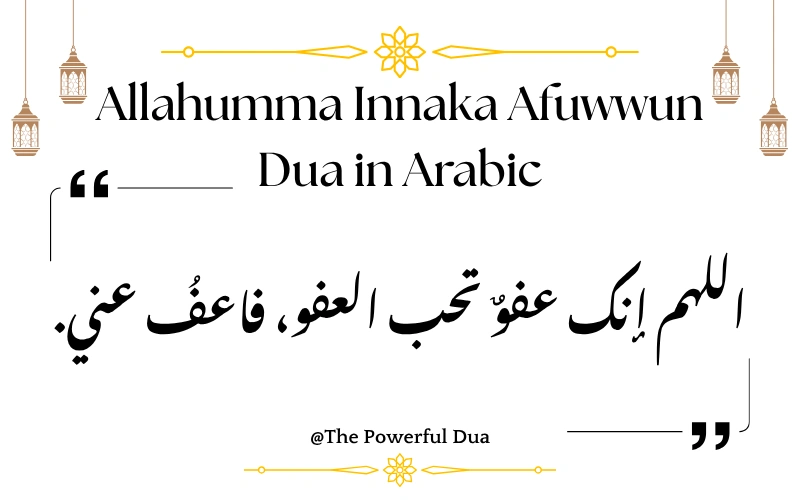
Here’s the full Allahumma Innaka Afuwwun Dua in Arabic Full Dua:
Arabic: اللَّهُمَّ إِنَّكَ عَفُوٌّ تُحِبُّ الْعَفْوَ فَاعْفُ عَنِّي
Transliteration: Allahumma innaka ‘Afuwwun, tuhibbul-‘afwa, fa’fu ‘anni.
English Translation: “O Allah, You are the Pardoner, You love pardon, so pardon me.”
This single line carries the weight of spiritual submission, humility, and hope. It’s concise, but packed with meaning—which is exactly why it’s so powerful.

Understanding the Layers: What Allahumma Innaka Afuwwun Dua Really Means
Let me break this down because understanding context changes everything:
The Three Divine Attributes at Play
When you recite Allahumma Innaka Afuwwun Dua Meaning, you’re essentially speaking to three interconnected divine qualities:
1. Al-Afuww (The Pardoner) This attribute refers to Allah’s ability to completely erase sins. Not just forgive them—erase them as if they never happened. There’s a difference between pardon and forgiveness, and Al-Afuww is about the ultimate erasure of wrongdoing.
2. Tuhibbul-Afwa (He Loves Pardon) Here’s the beautiful part: Allah doesn’t just have the capacity to forgive. He actively loves to forgive. It brings Him joy. This isn’t a transaction where you need to bargain. This is about knowing that the One you’re asking is literally inclined toward mercy.
3. Fa’fu (Pardon Me) The final request is direct and personal. You’re not asking in hypothetical terms. You’re saying, “This mercy you love, this forgiveness you embody—I’m asking for it. For me. Right now.”
The Hadith Source: Where Does Allahumma Innaka Afuwwun Dua Come From?
Expert Insight: This dua appears in Jami’ at-Tirmidhi (hadith no. 3513), narrated by Aisha (may Allah be pleased with her), who reported that the Prophet Muhammad (peace be upon him) said this supplication was especially powerful during Laylat al-Qadr (the Night of Power) in Ramadan.
The chain of narration is sound (sahih), which means you can recite this with full confidence that it’s authentically rooted in Islamic teaching. This isn’t something fabricated—it’s directly from the Sunnah.
Disclaimer: While this dua is authentic and recommended, it doesn’t replace the five daily prayers or conscious efforts to avoid sin. True forgiveness requires sincere repentance (tawbah), not just recitation.
Allahumma Innaka Afuwwun Dua in Different Languages: Making It Your Own
Allahumma Innaka Afuwwun Dua in Hindi (Devanagari):
अल्लाहुम्मा इन्नका अफुव्वुन, तुहिब्बुल अफवा, फा’फु अन्नी
Allahumma Innaka Afuwwun Dua in Urdu:
اللہ تمہیں معاف کرے، آپ معافی کو پیار کرتے ہیں، مجھے معاف کریں
Allahumma Innaka Afuwwun Dua in Tamil:
அல்லாஹும்ம இன்னக அபுவ்வுன், துஹிப்புல் அபவா, ஃபாஃபு அன்னீ
The beauty of Islamic tradition is that whether you’re reciting in Arabic, Hindi, Urdu, Tamil, Bengali, or Malayalam, the message carries the same spiritual weight. What matters most is your intention (niyyah) and the sincerity of your heart.
When Should You Recite Allahumma Innaka Afuwwun Dua? Timing Matters
Here’s the thing: You can recite Allahumma Innaka Afuwwun Dua How Many Times throughout your day, but certain times amplify its effectiveness:
1. During Ramadan Nights Especially the last 10 nights when Laylat al-Qadr falls. This is when duas are most readily answered.
2. During Tahajjud (Night Prayer) The last third of the night is known as “the hour of answer,” when Allah descends to the lowest heaven.
3. Before Sleep Make this your nightly habit. Seeking forgiveness before rest purifies your spiritual state for the next day.
4. After Sinning or Making Mistakes Immediately after realizing you’ve done wrong, this dua becomes your bridge back to Allah.
5. During Times of Hardship When life gets tough, remember that asking for forgiveness isn’t just about past mistakes—it’s about surrendering to Allah’s wisdom.

The Real Benefits: What Happens When You Recite Sincerely
Let me be straight with you—this dua isn’t a magic spell. But it is magical in its own way:
Spiritual Benefits (Verified by Islamic Scholars)
✨ Spiritual Cleansing: Regular recitation creates a habit of seeking forgiveness, which naturally makes you more conscious of your actions.
✨ Peace of Heart: When you genuinely ask for forgiveness, the guilt and heaviness lift. This is psychological and spiritual reality combined.
✨ Strengthened Connection with Allah: You’re acknowledging His attributes directly, which deepens your relationship with the Divine.
✨ Divine Mercy Activation: According to Islamic teaching, sincere supplication invokes Allah’s mercy upon you.
✨ Protection from Despair: This dua reminds you that no sin is too great for Allah’s forgiveness, preventing spiritual despair.
Behavioral Benefits
When you regularly recite Allahumma Innaka Afuwwun Dua Benefits, you naturally become more self-aware. You’re less likely to repeat mistakes because you’re consciously seeking forgiveness for them.
A Quick Word on the Full Dua and Its Variations
Some narrations include the complete version as:
“Allahumma innaka ‘Afuwwun, tuhibbul-‘afwa, fa’fu ‘anni.”
Other versions add context like “Allahumma Innaka Afuwwun Tuhibbul Afwa Fa’fu Anni”—which is the same dua presented in full form. You might also see it referenced as “Allahumma Innaka Afuwwun Kareem” (with the addition of “Kareem,” meaning Generous), which extends the invocation to include Allah’s generosity alongside His forgiveness.
All these variations are authentic and acceptable. The core remains consistent.
How to Recite: The Proper Method
Here’s your practical guide for Allahumma Innaka Afuwwun Dua recitation:
Step 1: Ritual Purity (Optional but Recommended) Make wudu (ablution) if possible, though it’s not mandatory for dua.
Step 2: Find a Quiet Space Eliminate distractions. This is between you and Allah.
Step 3: Face the Qibla If possible, face toward Mecca. This isn’t required, but it’s the traditional way.
Step 4: Raise Your Hands Place your palms facing upward at chest level. This is the posture of humility and supplication.
Step 5: Recite with Intention Say the dua slowly, meaningfully. Understand what you’re saying. Your heart must be present.
Step 6: Repeat The Prophet (peace be upon him) sometimes repeated supplications three times. You can do the same.
Step 7: End with Gratitude After finishing, thank Allah and sit in quiet reflection for a moment.
Related Duas That Complement This Supplication
If you’re building a forgiveness practice, pair this with:
- “Astaghfirullah” (I seek forgiveness from Allah) – the simplest yet most powerful form
- “Allahumma ghfir li” (O Allah, forgive me) – direct and straightforward
- “Rabbighfir li wa li walidayya” (O Lord, forgive me and my parents) – expands mercy to loved ones
Together, these create a comprehensive spiritual practice.
Conclusion: Your Spiritual Reset Button Awaits
Here’s what I want you to take away from this: Allahumma Innaka Afuwwun Dua in Arabic isn’t just words to recite when you’ve messed up. It’s a reminder that mercy exists, that forgiveness is possible, and that the door to Allah’s grace is always open.
In our modern world where guilt, shame, and self-criticism run rampant, this dua offers something revolutionary: a path to genuine self-forgiveness rooted in faith. It’s not about erasing consequences or avoiding responsibility. It’s about acknowledging your humanity, seeking improvement, and trusting in a power greater than yourself.
Make this dua a daily practice. Not out of fear, but out of love. Out of hope. Out of the understanding that asking for forgiveness is the most human—and most divine—thing you can do.
FAQs: Your Questions Answered On Allahumma Innaka Afuwwun Dua
Q1: Can women recite this dua?
Absolutely. This dua is for all believers, regardless of gender. There’s no distinction in Islamic spirituality when it comes to seeking forgiveness.
Q2: How many times should I recite Allahumma Innaka Afuwwun Dua daily?
There’s no fixed number. Even once daily with full intention is sufficient. Some scholars recommend 100 times during Ramadan, but consistency matters more than quantity.
Q3: Does this dua erase major sins?
According to Islamic belief, sincere repentance combined with this supplication can lead to Allah’s forgiveness for all sins except shirk (associating partners with Allah) if genuinely repented before death.
Q4: What’s the difference between Allahumma Innaka Afuwwun and other forgiveness duas?
This specific dua combines Allah’s attributes (being the Pardoner and loving pardon) with your request. Other duas might focus on specific contexts, but this one is universal.
Q5: Is there an audio version available?
Yes! Many Islamic apps like “Muslim Pro” and websites like YouTube have authentic recitations of Allahumma Innaka Afuwwun Dua Audio. Listening helps with proper pronunciation.
Q6: Can I recite this dua in English?
While the Arabic is more spiritually potent according to Islamic tradition, reciting the English translation with sincere intention is acceptable, especially if you don’t speak Arabic.
Q7: Should I combine this with actual repentance?
Yes. This dua works best when paired with genuine remorse and a sincere intention not to repeat the sin. Dua without effort is incomplete.
Q8: What if I don’t speak Arabic—will Allah understand?
Allah understands all languages and, more importantly, all intentions. Your sincere heart matters more than perfect Arabic pronunciation.
Thank You For Reading Allahumma Innaka Afuwwun Dua!
Thank you for reading this deep dive into one of Islam’s most beautiful supplications. I hope this guide has given you practical knowledge and spiritual inspiration.
Also Read:
Safar Ki Dua in Arabic: 5 Essential Travel Prayers for Protection
Powerful Iftar Ramzan Card Ki 30 Dua in Urdu
5 Essential Roza Rakhne Ki Dua in Hindi for Powerful & Authentic Fasting
Taraweeh Ki Dua in English: 7 Powerful Duas Explained
Dua Kunut Bangla: আরবি, বাংলা উচ্চারণ ও অর্থ
Tabbat Yada Surah in English: Meaning, Text & Story
Allahumma Inni Auzubika Minal Hammi: 7 Powerful Benefits
Ayansh Name Meaning in Hindi: 15 Beautiful Facts Parents Love
What is Azlan Name Meaning in Urdu? – Complete Guide
Inaya Name Meaning in Urdu: A Complete Guide for Parents
Zainab Name Meaning in Urdu: Complete Guide with Islamic Significance & Lucky Numbers
Alfiya Name Meaning in Urdu: Complete Guide for Parents (2026)
Shibra Name Meaning in Urdu & Lucky Number – Full Guide 2026
Check out our Check out “Islamic Dua Hub” for deeper insights into naming traditions.
External Resource for Deeper Learning
For authentic hadith research and further reading, check out Sunnah.com, which provides verified collections of Prophetic traditions with multiple translations and scholarly commentary. This is where I verified the hadith reference for this article.