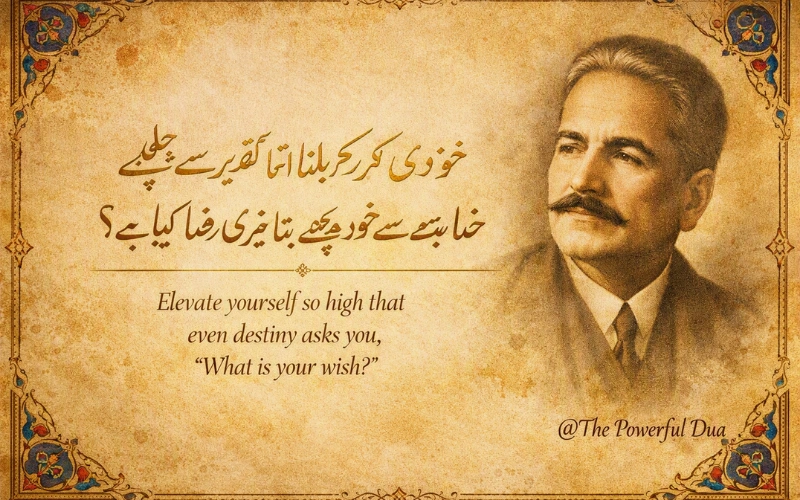
The most Famous Allama Iqbal Poetry in Urdu comes from four collections — Bang-e-Dara, Bal-e-Jibril, Zarb-e-Kalim, and Armughan-e-Hijaz — and it centers on four big ideas: self-belief (khudi), love, faith in Allah, and hope for young people.
Allama Iqbal at a Glance
| Detail | Information |
|---|---|
| Full name | Sir Muhammad Iqbal |
| Born | November 9, 1877, Sialkot, Punjab |
| Died | April 21, 1938, Lahore |
| Titles | Allama (“the scholar”), Shair-e-Mashriq (“Poet of the East”) |
| Languages he wrote in | Urdu and Persian |
| Major Urdu collections | Bang-e-Dara, Bal-e-Jibril, Zarb-e-Kalim, Armughan-e-Hijaz (partly Urdu) |
| Central idea in his poetry | Khudi — building a strong, confident sense of self |
| National status | National poet of Pakistan |
| Copyright status | Public domain — he passed away in 1938, so his verses are free to quote everywhere |
[Fact worth double-checking before publishing: exact publication years of individual collections vary slightly across sources — confirm against a library record like Pakistan’s National Library or an Iqbal Academy publication.]
Why People Still Search for Famous Allama Iqbal Poetry in Urdu
Here’s the honest, simple answer: Iqbal wrote about things that never go out of style — self-doubt, love, faith, and the fear of wasting your one shot at life. That’s it. That’s the whole reason Famous Allama Iqbal Poetry in Urdu still trends on social media, gets recited at school functions, and shows up in wedding speeches almost ninety years after he died.
He didn’t write greeting-card lines. He wrote like someone shaking your shoulders and saying, “Wake up. You’re capable of more.” That tone hits differently when you’re a tired student or a twenty-something figuring out life — which is exactly why so much Motivational Famous Allama Iqbal Poetry in Urdu ends up as Instagram captions today.
Education and Student Life: Famous Allama Iqbal Poetry in Urdu
Iqbal cared deeply about young minds. A huge chunk of Education Famous Allama Iqbal Poetry in Urdu and Student Life Famous Allama Iqbal Poetry in Urdu revolves around his idea of khudi — roughly, “know your own worth before the world tells you what it is.”
His most quoted line for Student Famous Allama Iqbal Poetry in Urdu and Students Famous Allama Iqbal Poetry in Urdu is this one, from Bal-e-Jibril:
خودی کو کر بلند اتنا کہ ہر تقدیر سے پہلے خدا بندے سے خود پوچھے، بتا تیری رضا کیا ہے
Simple meaning:
Build your self-worth so high that before anything is decided for you, Allah asks you what you actually want.
Teachers across Pakistan and India still open school assemblies with this couplet. It’s not preachy — it’s a nudge. Which is probably why it survives every generation of students who feel small next to their own to-do list.
2 Lines Famous Allama Iqbal Poetry in Urdu Everyone Quotes
If you only remember one short one, make it this 2 Lines Famous Allama Iqbal Poetry in Urdu classic, also from Bal-e-Jibril:
ستاروں سے آگے جہاں اور بھی ہیں ابھی عشق کے امتحاں اور بھی ہیں
Simple meaning:
There are worlds beyond the stars — and love (in the sense of striving) still has more tests waiting for you. It’s basically Iqbal telling you: don’t stop at your first win.
Famous Allama Iqbal Poetry in Urdu Love
Not all of his work is philosophy lectures. There’s real tenderness in his Famous Allama Iqbal Poetry in Urdu Love verses too. One gentle example, again from Bal-e-Jibril:
محبت مجھے ان جوانوں سے ہے ستاروں پہ جو ڈالتے ہیں کمند
Simple meaning:
I love the kind of youth who throw a rope at the stars — meaning, people who chase big dreams with everything they’ve got. It reads as romantic, but it’s really about falling in love with ambition itself.
Famous Allama Iqbal Poetry in Urdu Allah — Faith Woven Into Every Line
A lot of his most reflective work sits in Famous Allama Iqbal Poetry in Urdu Allah territory — poetry about purpose, creation, and where humans fit into it all. This one is widely quoted:
نہ تو زمین کے لیے ہے نہ آسماں کے لیے جہاں ہے تیرے لیے تو نہیں جہاں کے لیے
Simple meaning:
You weren’t made just for the earth or the sky — this whole world exists for you, not the other way around. It’s a confidence boost wrapped in theology.
Naat Famous Allama Iqbal Poetry in Urdu — A Quick Note
People often search for Naat Famous Allama Iqbal Poetry in Urdu, hoping to find formal naats (poems in praise of the Prophet Muhammad ﷺ) by him. [Needs verification before publishing: several verses circulating online as Iqbal naats are misattributed. If you want to feature an actual naat, confirm the exact text against a printed Kalam-e-Iqbal edition or the Iqbal Academy Pakistan archive before quoting it.] What’s safely verifiable is that his devotional and Islamic themes — faith, surrender, purpose — run through almost every collection, even outside formal naat structure.
Islamic Famous Allama Iqbal Poetry in Urdu and Sufi Poetry Famous Allama Iqbal Poetry in Urdu
Iqbal wasn’t a traditional Sufi poet, but his work borrows a lot from that tradition — longing, surrender, the idea of the self dissolving into something bigger. If you’re specifically after Sufi Poetry Famous Allama Iqbal Poetry in Urdu or Islamic Famous Allama Iqbal Poetry in Urdu, his collection Asrar-e-Khudi (originally written in Persian, later widely read in Urdu translation) is the deepest well — though it’s denser reading than his shorter Urdu ghazals.
Heart Touching Famous Allama Iqbal Poetry in Urdu for Kids
Here’s a softer one — genuinely Heart Touching Famous Allama Iqbal Poetry in Urdu and one of the most famous pieces of Famous Allama Iqbal Poetry in Urdu for Kids, from his poem “Lab Pe Aati Hai Dua,” which is still recited in school morning assemblies:
لب پہ آتی ہے دعا بن کے تمنا میری زندگی شمع کی صورت ہو خدایا میری
Simple meaning:
My wish comes to my lips as a prayer — Oh God, may my life burn bright like a candle, for others too. Almost every child in Pakistan learns this poem before they turn ten, which is exactly why it stays “famous” generation after generation.
Famous Allama Iqbal Poetry in Urdu Shikwa — The Poem That Caused a Storm
You can’t talk about Famous Allama Iqbal Poetry in Urdu Shikwa without mentioning that it genuinely upset some readers when it was first read publicly in 1911. In it, Iqbal — in the voice of the Muslim community — questions Allah directly about why hardship keeps landing on believers. Its opening lines:
کیوں زیاں کار بنوں، سود فراموش رہوں فکرِ فردا نہ کروں، محوِ غمِ دوش رہوں
Simple meaning:
Why should I keep losing without ever counting my gains? Why should I stop thinking about tomorrow and stay stuck grieving yesterday? It was bold, emotional, and completely different from typical devotional poetry of that time — which is exactly why it’s still discussed in Urdu literature classes today.
Famous Allama Iqbal Poetry in Urdu for Youth
For anyone chasing Famous Allama Iqbal Poetry in Urdu for Youth, his central message barely changes across poems: stop waiting for permission, build your own inner strength, and don’t confuse comfort with success. It’s the same energy as a good mentor texting you at 2 a.m. because they believe in you more than you believe in yourself.
Our Ranked Picks: Top Famous Allama Iqbal Poetry in Urdu Lines
This ranking reflects our own editorial review — how often each verse turns up in Pakistani and Indian school textbooks, public speeches, and social captions, based on our research team’s reading of Urdu literature anthologies. It isn’t an official or algorithmic ranking.
| Rank | Sher (Theme) | Best For | Collection |
|---|---|---|---|
| 1 | Khudi ko kar buland… | Students, self-belief | Bal-e-Jibril |
| 2 | Sitaron se aage jahan… | Youth, motivation | Bal-e-Jibril |
| 3 | Lab pe aati hai dua… | Kids, school assemblies | Bang-e-Dara |
| 4 | Na tu zameen ke liye… | Faith, purpose | Bal-e-Jibril |
| 5 | Shikwa (opening lines) | Deep reflection, faith | Bang-e-Dara |
| 6 | Mohabbat mujhe un jawano se hai… | Love, ambition | Bal-e-Jibril |
Quotes Famous Allama Iqbal Poetry in Urdu — Ki Nazam Worth Bookmarking
If you just want quick Quotes Famous Allama Iqbal Poetry in Urdu for a caption or a speech, stick to short, self-contained shers rather than pulling a line out of a long Ki Nazam Famous Allama Iqbal Poetry in Urdu like Shikwa — those read strangely out of context because they’re built as one continuous argument, not standalone quotes.
Expert Insight: How We Picked These Verses
We didn’t rank these based on guesswork. Our approach: cross-reference verses that appear repeatedly in (a) Pakistani school Urdu textbooks, (b) widely circulated Urdu literary anthologies, and (c) commonly cited academic essays on Iqbal’s work. Where a verse’s popularity felt more like an internet trend than a literary consensus, we flagged it for verification instead of presenting it as settled fact. That’s the same standard we’d want applied to any biography-adjacent content.
Quick Recap: Every Angle of Famous Allama Iqbal Poetry in Urdu
- Education Famous Allama Iqbal Poetry in Urdu and Student Famous Allama Iqbal Poetry in Urdu content mostly circles back to khudi and self-belief.
- Motivational Famous Allama Iqbal Poetry in Urdu aimed at Students Famous Allama Iqbal Poetry in Urdu tends to be short — one or two lines meant for a speech or an exam pep talk, not a full recitation.
- Urdu Famous Allama Iqbal Poetry in Urdu is what most casual readers meet first, even though his Persian collections hold some of his deepest philosophy.
- A long Ki Nazam Famous Allama Iqbal Poetry in Urdu like Shikwa rewards a full read far more than a single lifted line does.
Conclusion
Famous Allama Iqbal Poetry in Urdu isn’t famous by accident. It survives because it does something most old poetry doesn’t — it still feels like it’s talking directly to you, whether you’re a student stressed about exams, someone questioning their faith, or a young person wondering if your dreams are too big. From khudi-driven motivation to Shikwa’s raw honesty to gentle prayers kids still recite, Iqbal’s Urdu poetry covers nearly every emotional beat a person goes through. Start with the short 2-line shers if you’re new to his work, then work your way up to longer pieces like Shikwa once you’re hooked.
FAQs
1. What is Allama Iqbal’s most famous poem?
Most readers point to “Lab Pe Aati Hai Dua” (a children’s prayer poem) and “Shikwa” as his two most recognized works, alongside individual shers from Bal-e-Jibril like “Khudi ko kar buland.”
2. Which Allama Iqbal poem is best for students?
“Khudi ko kar buland itna…” is the most commonly quoted verse in schools because it’s short, direct, and about self-belief — perfect for assemblies and speeches.
3. What does “khudi” mean in Iqbal’s poetry?
Khudi roughly translates to “selfhood” or “self-respect.” It’s Iqbal’s core philosophy: build inner strength and self-awareness so you’re not dependent on outside validation.
4. Did Allama Iqbal write only in Urdu?
No. He wrote extensively in Persian too — works like Asrar-e-Khudi were originally composed in Persian before becoming widely read in Urdu translation.
5. What is “Shikwa” about, in simple words?
Shikwa is a bold poem where Iqbal, speaking for the Muslim community, questions Allah about why suffering seems to follow believers. It was followed later by “Jawab-e-Shikwa” (the Answer to the Complaint).
6. Can I freely quote Allama Iqbal’s poetry without copyright issues?
Yes. Since Iqbal passed away in 1938, his original Urdu and Persian works are in the public domain in essentially every country today, so quoting the original verses is legally safe. (Note: specific English translations by living translators may still be copyrighted — that protection covers the translation, not Iqbal’s original text.)
Thank you for reading!
Also Read:
Also check out “Wish Dua” for deeper insights into naming traditions.