Last Update: 13 August 2026
Janaze Ki Dua is the specific supplication recited silently during the four takbeers of Salat al-Janazah — the Islamic funeral prayer — asking Allah to forgive the deceased, protect the living, and unite the entire Muslim community in mercy.
I still remember the first time I stood in a janazah row and realized I only half-knew the words. My lips moved, but my heart wasn’t sure what it was asking for. That gap — between saying a dua and understanding it — is exactly what this guide closes. Whether you’re searching for Janaze Ki Dua in Hindi, Janaze Ki Dua in Urdu, or the Roman English transliteration you can read off your phone at the graveyard, you’ll find the authentic, hadith-verified text here, explained the way a knowledgeable friend would explain it — not a textbook.
What Is Janaze Ki Dua? (Meaning, Purpose, and Where It Comes From)
Salat al-Janazah (نماز جنازہ) is the funeral prayer offered for a deceased Muslim. Unlike the five daily prayers, it has no ruku (bowing) or sujood (prostration) — just four takbeers, each followed by a specific recitation, ending in salam.
Two technical terms worth knowing:
- Fard Kifayah — a “communal obligation.” If enough people in the community perform the janazah prayer, the obligation is lifted from everyone else. If nobody does, the entire community is considered sinful.
- Baligh vs. Nabaligh — baligh means an adult who has reached puberty; nabaligh means a minor who hasn’t. This distinction changes which Janaze Ki Dua you recite, because a child hasn’t accumulated sins that need forgiveness.
Here’s the part most people miss: the Janazah prayer isn’t really about the deceased alone. It’s the community’s collective plea for mercy — for the dead and for everyone standing in that row. That’s why the wording deliberately includes “our living and our dead,” not just “him” or “her.”
The Complete Janaze Ki Dua — Arabic, Roman English, Hindi & Urdu Meaning
1. Namaz Janaze Ki Dua (The General Congregational Dua)
This is the most widely recited Janaze Ki Dua, authenticated in Sunan Abu Dawud, Sunan al-Tirmidhi, and Musnad Ahmad, narrated by Abu Hurairah.
Arabic:
اللَّهُمَّ اغْفِرْ لِحَيِّنَا وَمَيِّتِنَا، وَشَاهِدِنَا وَغَائِبِنَا، وَصَغِيرِنَا وَكَبِيرِنَا، وَذَكَرِنَا وَأُنْثَانَا، اللَّهُمَّ مَنْ أَحْيَيْتَهُ مِنَّا فَأَحْيِهِ عَلَى الْإِيمَانِ، وَمَنْ تَوَفَّيْتَهُ مِنَّا فَتَوَفَّهُ عَلَى الْإِسْلَامِ، اللَّهُمَّ لَا تَحْرِمْنَا أَجْرَهُ وَلَا تُضِلَّنَا بَعْدَهُ
Janaze Ki Dua in Roman English (Transliteration):
Allahummaghfir li hayyina wa mayyitina, wa shahidina wa ghaibina, wa sagheerina wa kabeerina, wa dhakarina wa unthana. Allahumma man ahyaytahu minna fa ahyihi ‘alal-eeman, wa man tawaffaytahu minna fatawaffahu ‘alal-Islam. Allahumma la tahrimna ajrahu wa la tudillana ba’dahu.
Janaze Ki Dua Hindi Mein (हिंदी अर्थ):
हे अल्लाह! हमारे जीवित और मृत, उपस्थित और अनुपस्थित, छोटे और बड़े, पुरुष और स्त्री — सभी को क्षमा कर दे। हे अल्लाह! हम में से जिसे तू जीवित रखे उसे ईमान पर जीवित रख, और जिसे तू मृत्यु दे उसे इस्लाम पर मृत्यु दे। हे अल्लाह! हमें उसके सवाब से वंचित न कर और उसके बाद हमें गुमराह न कर।
Janaze Ki Dua in Urdu (اردو ترجمہ):
اے اللہ! ہمارے زندہ اور مردہ، حاضر اور غائب، چھوٹے اور بڑے، مرد اور عورت سب کی مغفرت فرما۔ اے اللہ! جسے تو زندہ رکھے اسے ایمان پر زندہ رکھ، اور جسے وفات دے اسے اسلام پر وفات دے۔ اے اللہ! ہمیں اس کے اجر سے محروم نہ کر اور اس کے بعد ہمیں گمراہ نہ کر۔
Janaze Ki Dua English (Translation):
“O Allah, forgive our living and our dead, those present and those absent, our young and our old, our males and our females. O Allah, whoever You keep alive among us, let him live upon faith, and whoever You cause to die, let him die upon Islam. O Allah, do not deprive us of his reward, and do not let us go astray after him.”
2. Baligh Janaze Ki Dua for Men
For a specific adult male deceased, this dua (Sahih Muslim) is added after the third takbeer:
Arabic:
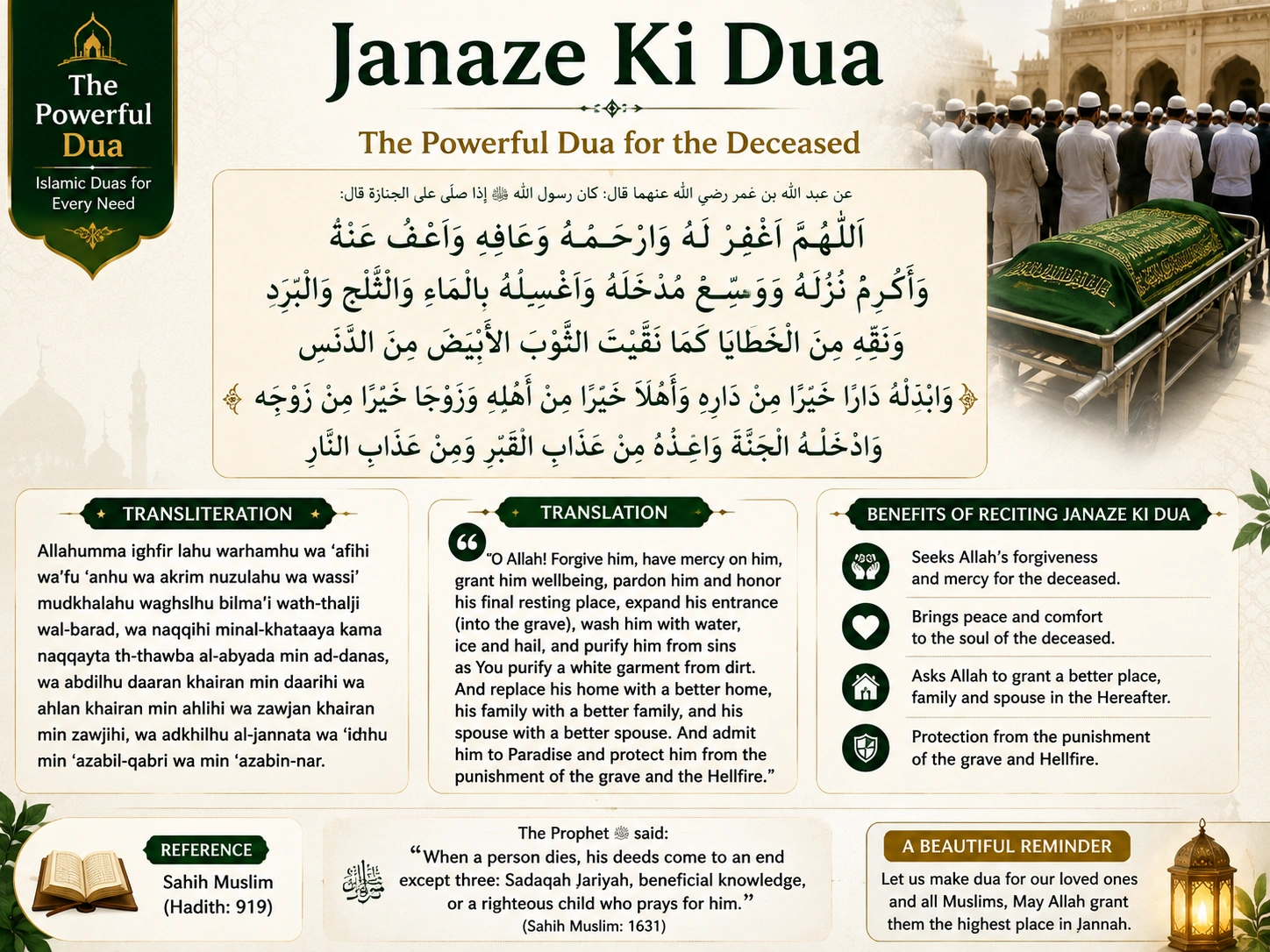
اللَّهُمَّ اغْفِرْ لَهُ وَارْحَمْهُ وَعَافِهِ وَاعْفُ عَنْهُ، وَأَكْرِمْ نُزُلَهُ، وَوَسِّعْ مُدْخَلَهُ، وَاغْسِلْهُ بِالْمَاءِ وَالثَّلْجِ وَالْبَرَدِ، وَنَقِّهِ مِنَ الْخَطَايَا كَمَا نَقَّيْتَ الثَّوْبَ الْأَبْيَضَ مِنَ الدَّنَسِ، وَأَدْخِلْهُ الْجَنَّةَ، وَأَعِذْهُ مِنْ عَذَابِ الْقَبْرِ
Roman English:
Allahummaghfir lahu warhamhu wa ‘afihi wa’fu ‘anhu, wa akrim nuzulahu, wa wassi’ mudkhalahu, waghsilhu bil-ma’i wath-thalji wal-baradi, wa naqqihi minal-khataya kama naqqaytath-thawbal-abyada minad-danas, wa adkhilhul-jannata wa a’idh-hu min ‘adhabil-qabr.
Meaning:
“O Allah, forgive him, have mercy on him, keep him safe, honor his resting place, wash him clean of sin as a white garment is cleansed of dirt, and admit him into Paradise, protected from the punishment of the grave.”
3. Aurat Ke Janaze Ki Dua (Baligh Aurat Ki Janaze Ki Dua)
For a woman, every pronoun simply flips to feminine. The Arabic changes lahu → laha, warhamhu → warhamha, and so on. The meaning stays identical — the shift is purely grammatical, not spiritual. This is one detail beginners often get wrong, so double-check your pronouns before leading the prayer.
4. Nabalig Bache Ki Janaze Ki Dua (Bacche Ki Janaze Ki Dua)
Here’s where the logic changes completely. A child hasn’t sinned, so you never ask for forgiveness. Instead, you ask that the child become a source of reward for the parents.
Arabic:
اللَّهُمَّ اجْعَلْهُ لَنَا فَرَطًا وَسَلَفًا وَأَجْرًا
Roman English:
Allahummaj’alhu lana faratan, wa salafan, wa ajran.
Meaning:
“O Allah, make him a forerunner for us, a treasure sent ahead, and a source of reward.” (For a girl, lahu becomes laha.) This Bache Ke Janaze Ki Dua reflects a beautiful Islamic principle: a child’s death is reframed as the family’s advance investment in Paradise, not a punishment.
The F-D-D-S Framework: A Copy-Paste Way to Remember Namaz E Janaze Ki Dua
After years of watching people freeze mid-prayer, I built a simple memory framework. Each of the four takbeers maps to one action:
| Takbeer | Letter | What You Recite |
|---|---|---|
| 1st | F – Fatiha | Surah Al-Fatihah (silently) |
| 2nd | D – Durood | Durood Ibrahim (salutation on the Prophet ﷺ) |
| 3rd | D – Dua | The Janaze Ki Dua (general or gender/age-specific) |
| 4th | S – Salam | Brief silent dua, then turn head right for salam |
F-D-D-S. Fatiha, Durood, Dua, Salam. That’s the entire structure — no bowing, no prostration, just four takbeers and one turn of the head.
Baligh vs. Nabaligh Janaze Ki Dua: Quick Comparison
| Aspect | Baligh (Adult) Dua | Nabaligh (Child) Dua |
|---|---|---|
| Asks for forgiveness? | Yes — sins are addressed directly | No — a child has no recorded sins |
| Core request | Mercy, cleansing, Paradise | Reward and intercession for parents |
| Gender adjustment | Pronoun changes only | Pronoun changes only |
| Hadith source | Sahih Muslim | Sunan Abu Dawud / scholarly compilations |
A Real Case Study: When the Wrong Dua Almost Went Unnoticed
A few years ago, a young man in our community was asked to lead the janazah prayer for a neighbor’s infant. He’d only ever memorized the adult Baligh Janaze Ki Dua and, out of habit, began reciting “Allahummaghfir lahu” — asking forgiveness for a child who had no sins to forgive. An elder gently corrected him mid-row, switching to “Allahummaj’alhu lana faratan.”
The transformation was instant: the same prayer, the same four takbeers, but now theologically accurate and emotionally appropriate for grieving parents. That single correction — knowing which Nabalig Janaze Ki Dua to use — is exactly why memorizing all four versions (general, male, female, child) matters more than memorizing just one.
Common Mistakes People Make With Janaze Ki Dua
- Reciting the adult dua for a child (or vice versa) — theologically incorrect and can visibly upset the family.
- Skipping the Fatiha in the first takbeer, assuming only the third takbeer’s dua “counts.”
- Rushing the takbeers without a brief pause to complete each recitation.
- Mixing up pronouns when praying for a woman using male-form Arabic.
- Standing in the wrong position — the imam should align with the chest of a male deceased and the middle of a female deceased, per the hadith of Anas ibn Malik (Sunan Abu Dawud).
Why Getting This Right Actually Matters (The Data)
This isn’t just ritual formality — it’s backed by real weight in Islamic tradition and demographic reality:
- According to Pew Research Center, the global Muslim population grew 21% between 2010 and 2020, rising from 1.7 billion to 2 billion — meaning janazah prayers are performed for millions of people worldwide every year.
- Per Sahih al-Bukhari, whoever attends a funeral prayer earns the reward of one qirat, and whoever stays until burial earns two — each qirat described as equal to the size of Mount Uhud.
- Per Sunan Abu Dawud (hadith of Malik ibn Hubayrah), if three rows of Muslims pray over the deceased, forgiveness is assured — which is why imams intentionally split small gatherings into three short rows rather than one long one.
- Sahih Muslim, one of the two most authentic hadith collections in Sunni Islam (the Sahihayn), is the primary source for the general Janaze Ki Dua text used worldwide today.
Key Takeaways
- Janaze Ki Dua is recited silently during the third takbeer of Salat al-Janazah, with the Fatiha and Durood in the first two.
- There are distinct versions for a general congregation, an adult man, an adult woman, and a child — memorize all four.
- Use the F-D-D-S framework (Fatiha, Durood, Dua, Salam) to never lose your place mid-prayer.
- Three rows of worshippers carries special spiritual significance per authentic hadith.
- Pronoun accuracy (he/she forms in Arabic) matters as much as the words themselves.
Summary
Janaze Ki Dua is far more than a memorized phrase — it’s a structured, hadith-verified supplication that changes based on who you’re praying for. This guide gave you the authentic Arabic, Roman transliteration, and Hindi/Urdu/English meanings for the general dua, the Baligh Janaze Ki Dua for men and women, and the Nabaligh Bacche Ki Janaze Ki Dua for children, along with a simple framework to recite it correctly under pressure.
Frequently Asked Questions
1. What is Janaze Ki Dua and when do you recite it?
Janaze Ki Dua is the supplication recited during the third takbeer of the Islamic funeral prayer (Salat al-Janazah), asking Allah for mercy and forgiveness for the deceased and the entire community.
2. Is Janaze Ki Dua the same for men and women?
The core wording is identical; only the Arabic pronouns change from masculine to feminine when praying for a woman (Aurat Ke Janaze Ki Dua).
3. Can I recite Janaze Ki Dua in Hindi instead of Arabic?
The prayer itself must be recited in Arabic for validity, but understanding the Janaze Ki Dua in Hindi or Urdu translation helps you pray with sincerity and focus.
4. What makes the Nabaligh Bache Ki Janaze Ki Dua different from the adult version?
It never asks for forgiveness, since a child has no recorded sins — instead it asks that the child become a source of reward and intercession for the parents.
5. Do I need wudu (ablution) to join Namaz E Janaze Ki Dua?
Yes, wudu is a prerequisite, just as it is for the five daily prayers, since Salat al-Janazah is still a formal prayer despite having no bowing or prostration.
Getting the Janaze Ki Dua right isn’t about perfect pronunciation — it’s about understanding what you’re asking Allah for, and for whom. Keep this guide bookmarked; you’ll likely need the Baligh, Nabaligh, or gender-specific version at a moment’s notice, and that’s exactly when clarity matters most.
Thank you for reading!
Also Read:
Also check out “Wish Dua” for deeper insights into naming traditions.