Last Update: 20 July 2026
The Istikhara Dua in English is a short prayer asking Allah for guidance before a decision, and yes — you can absolutely say it in English (or any language you understand), though many Muslims prefer to recite the original Arabic first and then reflect on its meaning in English.
That’s the one-line version. Now let’s actually unpack it, because “just say a prayer” doesn’t tell you how, when, or why it matters.
TL;DR Box
-
Istikhara means “seeking the best” — it’s a prayer for guidance, not a magic 8-ball.
-
Istikhara Dua can be recited in Arabic, English, or your own language — understanding it matters more than the exact wording.
-
It’s traditionally said after a two-unit (rakat) voluntary prayer.
-
It’s used for big decisions: marriage, jobs, moving, business — anything where you’re torn between options.
-
There’s no “yes/no” dream you’re guaranteed to get. Guidance often shows up as clarity, ease, or a sense of peace about a path.
What Is Istikhara, Really?
Istikhara comes from the Arabic root khayr, meaning “good” or “best.” So Salatul Istikhara — literally “the prayer of seeking the best” — is exactly what it sounds like: you’re asking God to steer you toward whatever is genuinely good for you, and away from whatever isn’t, even if you can’t see the full picture yourself.
It’s not fortune-telling. It’s not a guaranteed sign in a dream (that’s a common misconception). It’s closer to saying, “I’ve thought about this, I’ve made a decision as best I can, but I know You can see things I can’t — please guide me.”
The Istikhara Dua in Arabic, Transliteration, and English
Here’s Istikhara Dua as commonly narrated in the hadith collections (Sahih al-Bukhari), broken down so you can follow along even if you don’t read Arabic.
| Arabic | Transliteration | English Translation |
|---|---|---|
| اللَّهُمَّ إِنِّي أَسْتَخِيرُكَ بِعِلْمِكَ | Allahumma inni astakhiruka bi ‘ilmika | O Allah, I seek Your guidance through Your knowledge |
| وَأَسْتَقْدِرُكَ بِقُدْرَتِكَ | wa astaqdiruka bi qudratika | and I seek ability through Your power |
| وَأَسْأَلُكَ مِنْ فَضْلِكَ الْعَظِيمِ | wa as’aluka min fadlika-l ‘azim | and I ask You from Your immense favor |
| فَإِنَّكَ تَقْدِرُ وَلَا أَقْدِرُ | fa innaka taqdiru wa la aqdir | for You are able while I am not |
| وَتَعْلَمُ وَلَا أَعْلَمُ | wa ta’lamu wa la a’lam | and You know while I do not |
| وَأَنْتَ عَلَّامُ الْغُيُوبِ | wa anta ‘allamu-l ghuyub | and You are the Knower of the unseen |
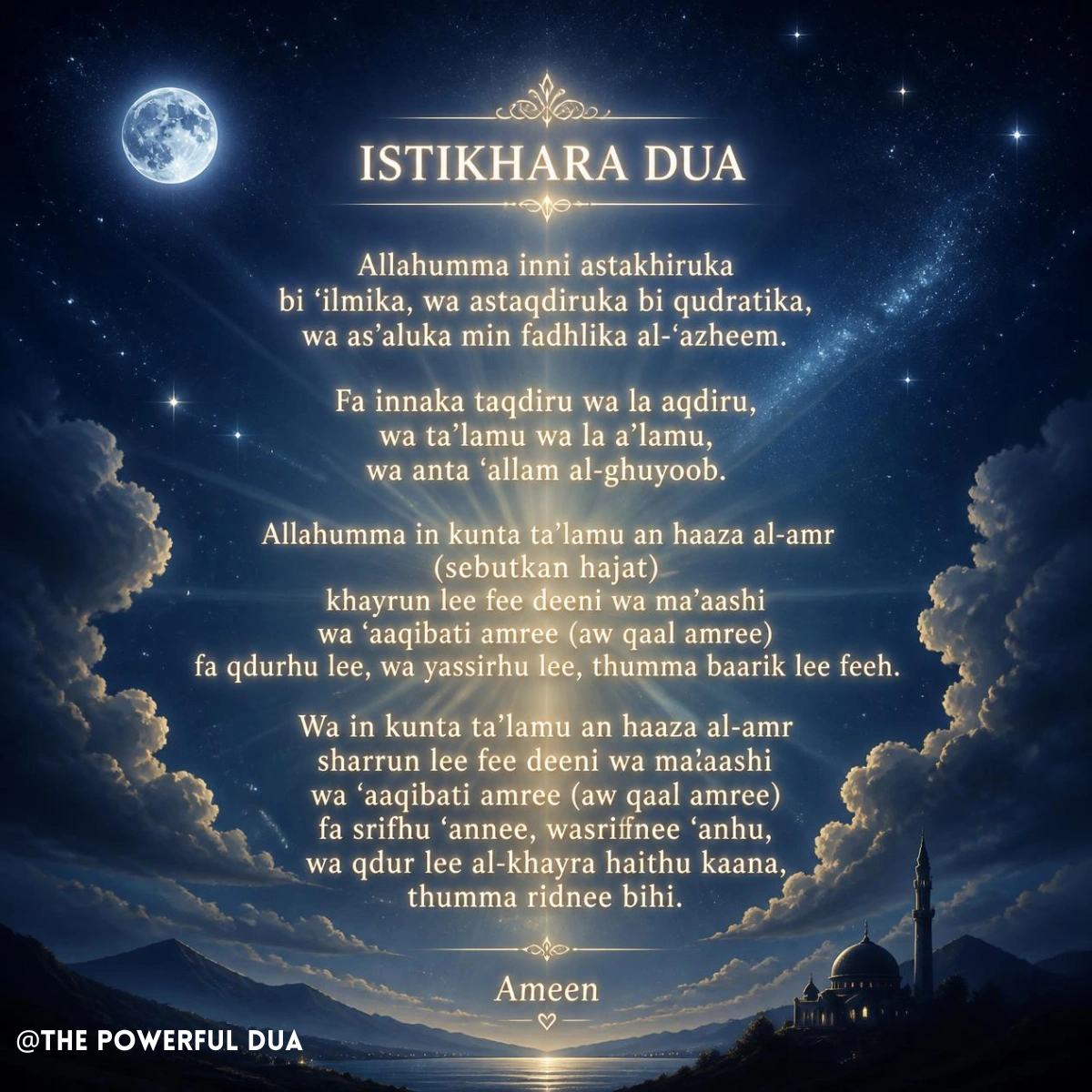
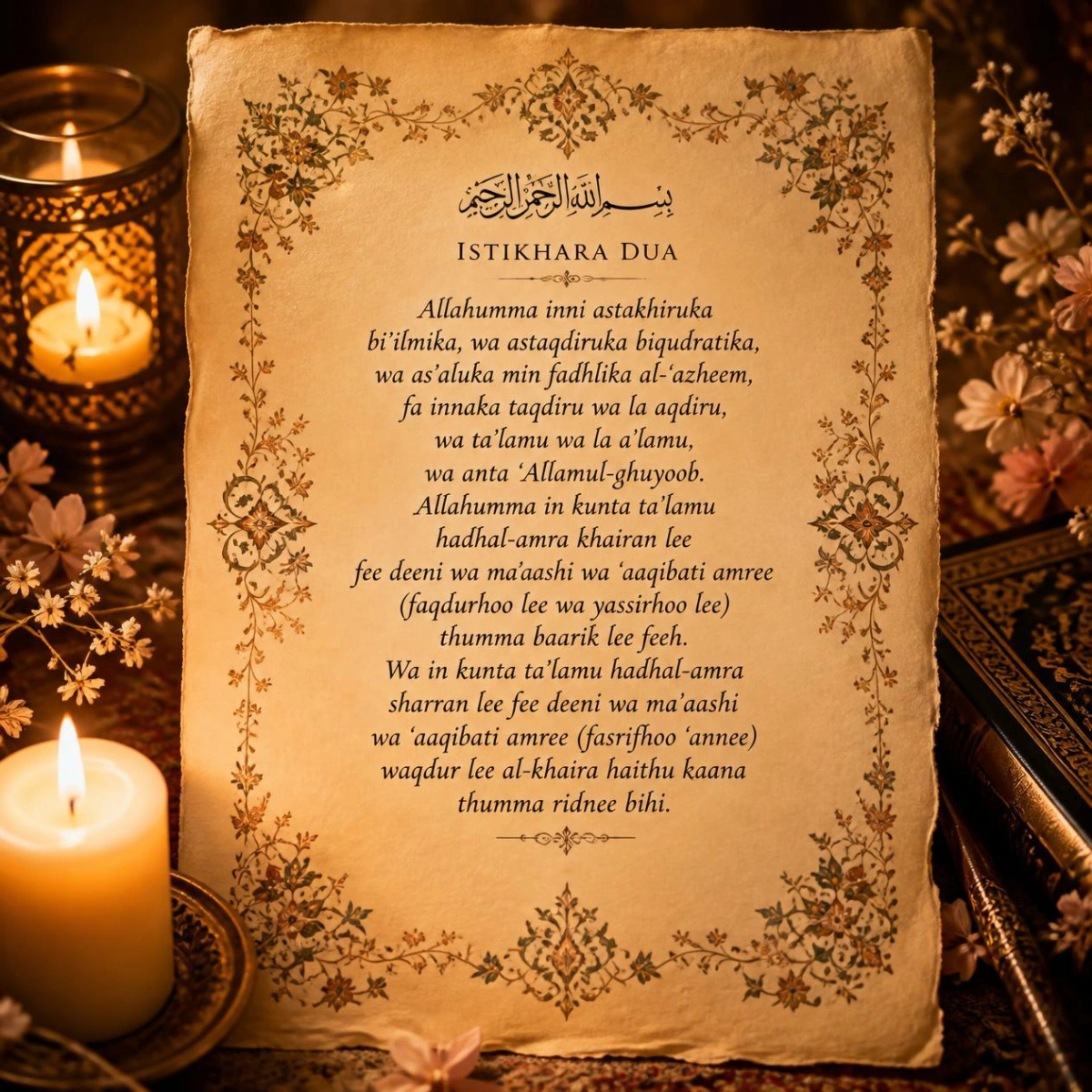
The full Istikhara Dua continues with a line where you mention your specific matter by name (your decision — the marriage, the job, the move), then asks Allah to make it easy and blessed if it’s good for you, or to turn you away from it if it isn’t.
Full Arabic Version:
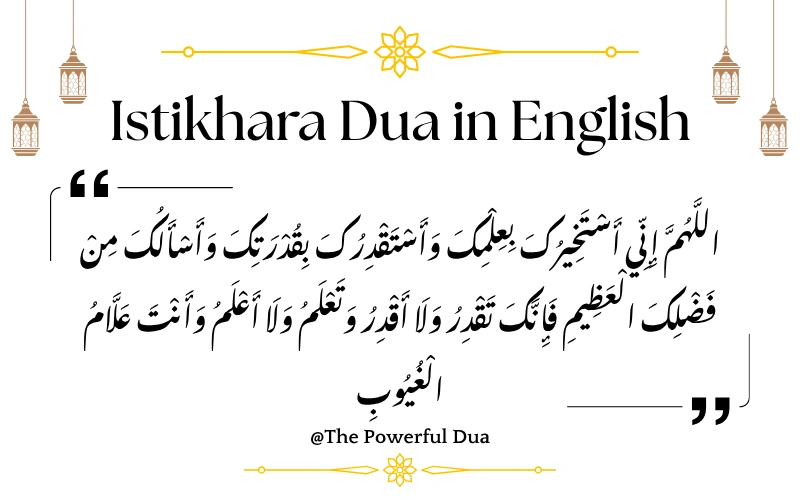
اللَّهُمَّ إِنِّي أَسْتَخِيرُكَ بِعِلْمِكَ وَأَسْتَقْدِرُكَ بِقُدْرَتِكَ وَأَسْأَلُكَ مِنْ فَضْلِكَ الْعَظِيمِ فَإِنَّكَ تَقْدِرُ وَلَا أَقْدِرُ وَتَعْلَمُ وَلَا أَعْلَمُ وَأَنْتَ عَلَّامُ الْغُيُوبِ
A Short (Simplified) English Version
If you’re newer to Arabic and want something you can say with full understanding while you’re still learning the original:
“O Allah, I don’t know what’s best for me in this matter, but You do. Please guide me toward whatever is truly good for me, and keep me away from whatever will bring me harm — even if it’s what I currently want. Make it easy if it’s good, and make it far from me if it’s not.”
This isn’t a replacement for the authentic wording, but it’s a genuine, sincere way to communicate the same request while you memorize the original.
How to Actually Perform Salat al-Istikhara (Step by Step)
| Step | What to Do |
|---|---|
| 1 | Make sure you’ve genuinely thought through the decision — Istikhara isn’t a substitute for research or advice from people you trust. |
| 2 | Perform wudu (ablution) as you would for any prayer. |
| 3 | Pray two voluntary (nafl) rakats, separate from any obligatory prayer. |
| 4 | After finishing the prayer, recite the Istikhara dua — Arabic if you know it, English/your language if you don’t yet. |
| 5 | Mention your specific matter clearly in your heart or out loud at the point in Istikhara Dua where it’s traditionally inserted. |
| 6 | Go ahead with your decision as planned — you don’t need to wait passively for a sign. |
| 7 | Stay attentive to how things unfold: ease, clarity, and peace of mind are often read as good indicators; persistent difficulty or unease can be worth reconsidering. |
Can I Say the Istikhara Dua in English?
Short answer: yes. Longer answer: scholars generally agree that supplications (dua, as opposed to the fixed wording of the prayer itself, like Quranic recitation in salah) can be made in any language, because the point is sincere communication with God, not the specific phonetics. That said, many people try to learn the Arabic over time because:
- It connects them to the exact wording used by the Prophet Muhammad ﷺ, as recorded in hadith.
- Arabic has a rhythm and precision that’s part of the broader worship tradition.
If you’re only comfortable in English right now, say it in English. Understanding what you’re asking for matters more than which language you ask in.
Marriage Istikhara Dua in English: A Common Use Case
One of the most searched contexts for Istikhara Dua is marriage — understandably, since it’s one of the bigger decisions people face. The process is identical to the general steps above; the only difference is what you mention during the dua. Instead of a job or a move, you’d mention the specific person or proposal you’re considering.
A few honest notes here, because this topic tends to get mythologized online:
- Istikhara Dua for marriage doesn’t replace practical steps — meeting the family, asking questions, checking compatibility. It complements them.
- There’s no requirement to see a specific dream. Some people do report dreams; many don’t, and that’s completely normal.
- If you feel torn after Istikhara Dua, it’s fine to repeat it, take more time, or seek advice from someone knowledgeable — it’s not a one-shot deal.
Common Mistakes People Make
- Treating it like a Magic 8-Ball. Expecting an instant, unmistakable sign (usually a dream) and feeling like it “didn’t work” when that doesn’t happen.
- Skipping the actual decision-making. Istikhara Dua works alongside research and advice, not instead of it.
- Only praying once, then panicking. It’s fine to repeat the Istikhara Dua over several days if you’re still unsure.
- Ignoring gradual clarity. Guidance often looks like growing ease or growing discomfort over time, not a single dramatic moment.
A Quick Mini-Glossary
- Istikhara — seeking the best; asking God for guidance.
- Dua — a personal supplication or prayer, as opposed to formal ritual prayer.
- Rakat — a single unit of prayer (standing, bowing, prostrating).
- Nafl — voluntary, non-obligatory prayer.
- Wudu — ritual washing done before prayer.
Conclusion
The Istikhara Dua is simpler than it’s often made out to be: two voluntary rakats, a sincere request for guidance, and then moving forward with your decision while staying attentive to how things unfold. You can say it in English while you’re learning the Arabic, and it works for anything — marriage, jobs, moves, or any fork in the road where you genuinely don’t know which way is best. It’s not about waiting for a dramatic sign; it’s about asking for help from Someone who can see what you can’t, and then trusting the process.
A note on accuracy: the transliteration and translation above reflect the commonly cited hadith version (Sahih al-Bukhari). For matters of religious practice, especially around specific rulings for your situation, it’s worth confirming details with a qualified local scholar or imam — this article is meant as a clear starting point, not a substitute for that guidance.
FAQs
1. Can I make Istikhara Dua in English if I don’t know Arabic?
Yes. Sincerity and understanding matter more than the specific language.
2. Do I need to see a dream after Istikhara?
No. A dream is one possible form guidance can take, but it’s not required or guaranteed.
3. Can I do Istikhara for more than one thing at a time?
It’s generally recommended to focus on one matter per prayer so your intention stays clear.
4. How long after Istikhara can I make my decision?
There’s no fixed waiting period. Some people decide the same day; others take a few days of repeated dua if they’re still unsure.
5. Is there a difference between Salat al-Istikhara and Salatul Istikhara?
No — these are just two ways of transliterating the same Arabic phrase.
6. Can I read the Istikhara Dua from a paper or my phone instead of memorizing it?
Yes, reading it is completely fine, especially while you’re still learning it.
7. What if I feel uneasy about a decision even after Istikhara?
That unease is worth paying attention to — many scholars suggest ongoing discomfort is itself a form of guidance, and it’s reasonable to step back or reconsider.
Thank you for reading Istikhara Dua!
Also Read:
Auzubillah Minashaitan Nirajeem Meaning in Urdu
Hasbunallah Wani’mal Wakeel Meaning
Also check out “Wish Dua” for deeper insights into naming traditions.
Dua is a short prayer asking Allah for guidance before a decision, and yes — you can absolutely say it in English (or any language you understand), though many Muslims prefer to recite the original Arabic first and then reflect on its meaning in English.
That’s the one-line version. Now let’s actually unpack it, because “just say a prayer” doesn’t tell you how, when, or why it matters.