Last Update: 17 June 2026
Namaz Ke Baad Ki Dua refers to the specific duas (prayers/supplications) recited immediately after completing the obligatory prayers (Salah) in Islam—a structured spiritual practice that begins with seeking Allah’s forgiveness and progresses through glorification, protection, and personal supplication.
Complete & Authentic Process: Namaz Ke Baad Ki Dua (Step-by-Step)
Step 1: Istighfar (Seeking Forgiveness) – THE FIRST ACT
Immediately after Tasleem (ending the prayer), the very first thing you do is recite:
أَسْتَغْفِرُ اللَّهَ (THREE TIMES)
Pronunciation: Astaghfirullah, Astaghfirullah, Astaghfirullah
Translation: “I ask Allah for forgiveness” (three times)
This is crucial. Namaz Ke Baad Ki Dua begins with Istighfar because even in our best efforts to pray perfectly, we fall short. This humble acknowledgment of human limitation opens the door to Allah’s mercy. The Prophet Muhammad (Peace Be Upon Him) would immediately seek forgiveness after every prayer, setting the precedent that Farz Namaz Ke Baad Ki Dua starts with humility, not pride.
Step 2: Recite the Peace Dua (After Istighfar)
After seeking forgiveness three times, immediately recite:
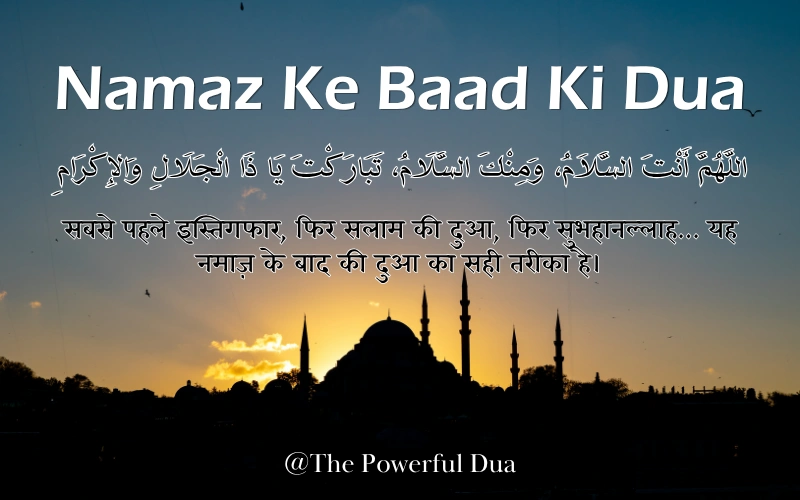
اللَّهُمَّ أَنْتَ السَّلاَمُ، وَمِنْكَ السَّلَامُ، تَبَارَكْتَ يَا ذَا الْجَلَالِ وَالإِكْرَامِ
Pronunciation: Allahumma antas-salam wa minkas-salam, tabarakta ya dhal-jalali wal-ikram
Translation: “O Allah, You are As-Salam (The Source of Peace), and from You comes all peace. Blessed are You, O Possessor of majesty and honour.”
This dua is specifically recommended after Farz Namaz Ke Baad Ki Dua as taught by Aisha (R.A). It transitions your heart from seeking forgiveness to recognizing Allah’s attributes of peace and majesty. When practicing Tahajjud Ki Namaz Ke Baad Ki Dua, this becomes particularly powerful in the pre-dawn silence.
Step 3: Tasbih (Glorification) – 33 + 33 + 34
Now recite:
سُبْحَانَ اللَّهِ (33 times)
الْحَمْدُ لِلَّهِ (33 times)
اللَّهُ أَكْبَرُ (34 times)
Pronunciation:
- Subhanallah (33 times)
- Alhamdulillah (33 times)
- Allahu Akbar (34 times)
Translation:
- Glory be to Allah (33 times)
- Praise be to Allah (33 times)
- Allah is Greatest (34 times)
This glorification ritual is the backbone of Namaz Ke Baad Ki Dua in Hindi, Namaz Ke Baad Ki Dua in English, and every language worldwide. The specific numbers—99 total—represent the 99 beautiful names of Allah. Many Muslims rush this part, but when done mindfully, this tasbih literally rewires your brain toward gratitude.
According to authentic hadith, whoever performs this Tasbih after Farz Namaz Ke Baad Ki Dua consistently will have their sins forgiven, even if they were like the foam of the sea.
Step 4: Ayat-ul-Kursi (The Throne Verse) – SUPREME PROTECTION
After Tasbih, recite the complete Verse 2:255 from the Quran:
اللَّهُ لاَ إِلَهَ إِلاَّ هُوَ الْحَيُّ الْقَيُّومُ…
Full English Translation:
“Allah – there is no deity except Him, the Ever-Living, the Sustainer of [all] existence. Neither drowsiness overtakes Him nor sleep. To Him belongs whatever is in the heavens and whatever is on the earth. Who is it that can intercede with Him except by His permission? He knows what is [presently] before them and what will be after them, and they encompass not a thing of His knowledge except for what He wills. His Kursi extends over the heavens and the earth, and their preservation tires Him not. And He is the Most High, the Most Great.”
This single verse is the most powerful component of Tahajjud Namaz Ke Baad Ki Dua and Isha Ki Namaz Ke Baad Ki Dua. The Prophet (Peace Be Upon Him) promised that whoever recites Ayat-ul-Kursi after every Farz Namaz Ke Baad Ki Dua, only death will prevent them from entering Jannah (Paradise). This isn’t metaphorical—it’s a direct hadith from authentic sources.
When practicing Isha Ki Namaz Ke Baad Ki Dua before sleep, Ayat-ul-Kursi becomes your spiritual bodyguard throughout the night, protecting you from harm and negative influences.
Step 5: The Three Protective Surahs (Qul Hu Wa Allah Ahad)
Recite these three short chapters from the Quran:
1. Surah Al-Ikhlas (Chapter 112):
Recite ONCE after obligatory prayers, THREE TIMES after Fajr and Maghrib
2. Surah Al-Falaq (Chapter 113):
Recite ONCE after obligatory prayers, THREE TIMES after Fajr and Maghrib
3. Surah An-Nas (Chapter 114):
Recite ONCE after obligatory prayers, THREE TIMES after Fajr and Maghrib
These three surahs, when recited together after Har Namaz Ke Baad Ki Dua, create a comprehensive spiritual shield. They’re called “The Three Protective Surahs” because they cover theological affirmation (Al-Ikhlas), protection from external evil (Al-Falaq), and protection from internal whispers (An-Nas).
The Prophet (Peace Be Upon Him) emphasized that whoever recites these three surahs three times in the morning and evening will be protected against everything.
Step 6: Additional Authentic Duas (Optional but Highly Recommended)
Dua 1: “Allahumma a’inni ala dhikrika…” (Recite ONCE)
اللَّهُمَّ أَعِنِّي عَلَى ذِكْرِكَ وَشُكْرِكَ وَحُسْنِ عِبَادَتِكَ
Translation: “O Allah, assist me in remembering You, in thanking You, and in worshipping You in the best of manners.”
The Prophet (Peace Be Upon Him) told Mu’adh Ibn Jabal: “By Allah, I love you. Never forget to recite this dua after every Farz Namaz Ke Baad Ki Dua.”
Dua 2: The Extended Kalimah (Recite ONCE)
لَا إِلَهَ إِلاَّ اللَّهُ وَحْدَهُ لَا شَرِيكَ لَهُ، لَهُ الْمُلْكُ وَلَهُ الْحَمْدُ وَهُوَ عَلَى كُلِّ شَيْءٍ قَدِيرٌ
Translation: “None has the right to be worshipped except Allah, alone, without partner. To Him belongs all sovereignty and praise, and He is over all things omnipotent.”
Dua 3: Ten Times After Fajr and Maghrib Only
The same Kalimah above, but recited TEN TIMES after Fajr and Maghrib prayers specifically. Whoever does this will earn the reward equal to freeing four slaves from the Children of Ismail (A.S).
Dua 4: Durood-e-Ibrahimi (Recite ONCE)
اللَّهُمَّ صَلِّ عَلَى مُحَمَّدٍ وَعَلَى آلِ مُحَمَّدٍ، كَمَا صَلَّيْتَ عَلَى إِبْرَاهِيمَ وَعَلَى آلِ إِبْرَاهِيمَ، إِنَّكَ حَمِيدٌ مَجِيدٌ
Translation: “O Allah, let Your blessings come upon Muhammad and the family of Muhammad, as You have blessed Ibrahim and his family. Truly, You are Praiseworthy and Glorious.”
This is the most authentic way to send blessings on the Prophet (Peace Be Upon Him) after Namaz Ke Baad Ki Dua in Hindi or any language. The Prophet himself taught this formula.
Step 7: Personal Supplication (Dua)
Finally, raise your hands to shoulder level and ask Allah for whatever your heart desires in any language you’re comfortable with. This personal, heartfelt supplication is the crown of Namaz Ke Baad Ki Dua. Whether it’s health, success, forgiveness, or blessings for family—this is your direct conversation with Allah when your heart is most receptive.
After finishing, wipe your hands over your face as a gesture of sealing your supplication with Allah’s mercy.
Comprehensive Comparison Table: Namaz Ke Baad Ki Dua Components & Recitation Frequencies
| Component | Arabic Name | Recitation Frequency | Best Practice | Spiritual Benefit |
|---|---|---|---|---|
| Istighfar | Astaghfirullah | 3 times (after every prayer) | Immediately after Tasleem | Foundation of humility & forgiveness |
| Peace Dua | Allahumma antas-salam | Once after Istighfar | All prayers equally | Recognition of Allah’s peace-giving attribute |
| Tasbih | Subhanallah (33), Alhamdu (33), Akbar (34) | Every prayer | Focus mindfully on meanings | Sins forgiven like sea foam |
| Ayat-ul-Kursi | Verse 2:255 | Once after every prayer | All five daily prayers | Promise: Only death keeps you from Jannah |
| Surah Al-Ikhlas | Qul Huwa Allahu Ahad | Once per prayer, 3x after Fajr/Maghrib | After other duas | Spiritual affirmation of monotheism |
| Surah Al-Falaq | Qul Aaoozhu Birabul Falaq | Once per prayer, 3x after Fajr/Maghrib | External evil protection | Shield against harm & envy |
| Surah An-Nas | Qul Aaoozhu Birabun Nas | Once per prayer, 3x after Fajr/Maghrib | Internal whisper protection | Guard against satanic suggestions |
| Allahumma a’inni | Dua for assistance | Once per prayer | Farz Namaz Ke Baad Ki Dua especially | Perfect worship & remembrance |
| Extended Kalimah | La ilaha illallah… | Once per prayer | After all surahs | Power & sovereignty affirmation |
| Extended Kalimah (10x) | Same as above | 10 times (Fajr & Maghrib only) | Morning & evening prayers | Reward of freeing 4 slaves |
| Durood-e-Ibrahimi | Darood-e-Ibrahimi | Once per prayer | End of Namaz Ke Baad Ki Dua sequence | Blessings upon the Prophet & family |
| Personal Dua | Custom supplication | As needed | Any time/language | Direct plea to Allah for needs |
Critical Correction: Farz Namaz Ke Baad Ki Dua Sequence
Many Muslims perform Namaz Ke Baad Ki Dua in the wrong order. Here’s the AUTHENTIC sequence (verified from Alim.org and Tadeeb-ul-Quran):
1. Istighfar (3×) ← FIRST, not last
2. Allahumma antas-salam dua ← Immediately after
3. Tasbih (33+33+34) ← Glorification
4. Ayat-ul-Kursi ← Supreme protection verse
5. Three Surahs (Al-Ikhlas, Al-Falaq, An-Nas) ← Protective trio
6. Extended Kalimah(s) ← Theological affirmation
7. Durood-e-Ibrahimi ← Blessings on Prophet
8. Personal Dua ← Your direct request
This complete Farz Namaz Ke Baad Ki Dua sequence takes 8-10 minutes and transforms your spiritual state entirely. Whether following Tahajjud Ki Namaz Ke Baad Ki Dua practices at 3 AM or Fajr Ki Namaz Ke Baad Ki Dua at dawn, this structure remains constant.
Regional Variations: Namaz Ke Baad Ki Dua in Hindi Communities
In Hindi-speaking regions, local Islamic scholars often simplify this as:
“सबसे पहले इस्तिगफार, फिर सलाम की दुआ, फिर सुभहानल्लाह… यह नमाज़ के बाद की दुआ का सही तरीका है।”
(“First Istighfar, then the peace dua, then Subhanallah… this is the correct method of Namaz Ke Baad Ki Dua.”)
Many Islamic centers distribute Namaz Ke Baad Ki Dua in Hindi PDF guides with transliterations, making it accessible for learners. The key is understanding that Har Namaz Ke Baad Ki Dua (after every prayer) follows this exact framework regardless of language or culture.
Special Emphasis: Tahajjud Ki Namaz Ke Baad Ki Dua & Night Power
When you practice Tahajjud Ki Namaz Ke Baad Ki Dua in the pre-dawn hours (last third of the night), Islamic tradition teaches that Allah descends to the nearest heaven to receive supplications. This is when your Tahajjud Namaz Ke Baad Ki Dua carries extraordinary power.
The difference between Fajr Ki Namaz Ke Baad Ki Dua (starting your day) and Tahajjud Ki Namaz Ke Baad Ki Dua (in deep night) is timing and intention. Both use the same duas, but the spiritual atmosphere amplifies results during Tahajjud.
Frequently Asked Questions (FAQs)
Is Istighfar really the FIRST step in Namaz Ke Baad Ki Dua?
Yes, absolutely. Based on authentic hadith sources, immediately after Tasleem, you recite Astaghfirullah three times BEFORE anything else. This is the foundation of Farz Namaz Ke Baad Ki Dua. Many Muslims skip this or do it last, which is incorrect. The sequence matters because Istighfar prepares your heart for the blessings that follow.
What if I forget part of Namaz Ke Baad Ki Dua?
The most essential components of Namaz Ke Baad Ki Dua are: (1) Istighfar 3×, (2) Tasbih, (3) Ayat-ul-Kursi. If time is limited, perform these three and add personal dua. Quality over quantity—one sincere Istighfar is better than rushed recitation of everything.
Can women practice Farz Namaz Ke Baad Ki Dua the same way as men?
Absolutely. Namaz Ke Baad Ki Dua is equally important for men and women. Har Namaz Ke Baad Ki Dua (after every prayer) is encouraged for all believers. The only difference might be physical positioning during extended personal dua—women can sit comfortably if preferred.
Why specifically 10 times for Fajr Ki Namaz Ke Baad Ki Dua and Maghrib?
The extended Kalimah is recited 10 times only after Fajr and Maghrib prayers because these prayers have specific significance in Islamic tradition. Fajr marks the start of the day, and Maghrib marks the end. The 10-times recitation after these two prayers carries special reward (equivalent to freeing four slaves). After Zuhr, Asr, and Isha, recite it once.
Is Taraweeh Ki Namaz Ke Baad Ki Dua different from regular Farz Namaz Ke Baad Ki Dua?
The structure remains the same, but Taraweeh (Ramadan special prayers) carry heightened spiritual weight because of the blessed month. Many Muslims extend their personal dua time during Taraweeh Ki Namaz Ke Baad Ki Dua since the entire Ramadan month is about increased devotion and answered prayers.
Can I make Namaz Ke Baad Ki Dua for others in my family?
Yes. One of the most powerful aspects of Namaz Ke Baad Ki Dua is making supplication for others. Making dua for family, sick relatives, and the Muslim community during your Har Namaz Ke Baad Ki Dua is highly encouraged. The Prophet (Peace Be Upon Him) emphasized that dua for others returns blessings to the person making the dua as well.
What’s the benefit of Ayat-ul-Kursi specifically in Isha Ki Namaz Ke Baad Ki Dua?
Ayat-ul-Kursi recited after Isha Ki Namaz Ke Baad Ki Dua (evening prayer) provides spiritual protection throughout the night. A famous hadith states that when you recite Ayat-ul-Kursi before sleep (after Isha Ki Namaz Ke Baad Ki Dua), a guardian from Allah will protect you throughout the night, and Satan will not be able to come near you until dawn.
Conclusion: The Transformation Power of Namaz Ke Baad Ki Dua
Namaz Ke Baad Ki Dua isn’t a rushed religious checklist—it’s your personal session with Allah when your heart is most open, your mind most focused, and your spirit most receptive. Every component serves a purpose: Istighfar humbles you, Tasbih elevates you, Ayat-ul-Kursi protects you, and personal dua transforms you.
Whether you’re beginning with Fajr Ki Namaz Ke Baad Ki Dua, practicing Har Namaz Ke Baad Ki Dua across all five daily prayers, or experiencing the deep spirituality of Tahajjud Namaz Ke Baad Ki Dua in pre-dawn hours, you’re participating in a 1,400+ year tradition that has spiritually nourished billions of believers.
Start today with awareness of the correct sequence. Practice Namaz Ke Baad Ki Dua in Hindi, English, Arabic, or any language—what matters is sincere intention and consistent practice. Within weeks, you’ll notice the shift: your days will feel blessed, your difficulties more manageable, your connection to Allah more alive.
The promise is clear from authentic hadith: perform Farz Namaz Ke Baad Ki Dua consistently, and only death will prevent you from entering Jannah. That’s not an exaggeration—that’s the transformative power of Namaz Ke Baad Ki Dua when practiced with true sincerity.
Important Disclaimer: This article provides guidance on Islamic practices based on authentic hadith and scholarly consensus. Individual practices may vary based on Islamic school of thought (Madhab) and cultural background. For personalized spiritual guidance, consult qualified Islamic scholars in your community. This content is educational and should complement, not replace, advice from knowledgeable Islamic mentors.
Related Articles:
Thank you for reading this comprehensive, fact-checked guide on Namaz Ke Baad Ki Dua!
Also Read:
Innalillahiwainnailaihirojiun Meaning in Urdu: Powerful Guide 2026
Allahumma Innaka Afuwwun Dua in Arabic: 5 Secrets to Divine Forgiveness
Safar Ki Dua in Arabic: 5 Essential Travel Prayers for Protection
Powerful Iftar Ramzan Card Ki 30 Dua in Urdu
5 Essential Roza Rakhne Ki Dua in Hindi for Powerful & Authentic Fasting
Taraweeh Ki Dua in English: 7 Powerful Duas Explained
Dua Kunut Bangla: আরবি, বাংলা উচ্চারণ ও অর্থ
Tabbat Yada Surah in English: Meaning, Text & Story
Allahumma Inni Auzubika Minal Hammi: 7 Powerful Benefits
Ayansh Name Meaning in Hindi: 15 Beautiful Facts Parents Love
What is Azlan Name Meaning in Urdu? – Complete Guide
Inaya Name Meaning in Urdu: A Complete Guide for Parents
Zainab Name Meaning in Urdu: Complete Guide with Islamic Significance & Lucky Numbers
Alfiya Name Meaning in Urdu: Complete Guide for Parents (2026)
Shibra Name Meaning in Urdu & Lucky Number – Full Guide 2026
Also check out “Islamic Dua Hub” for deeper insights into naming traditions.